


In 2026, Swiss treasurers and financial institutions face mounting pressure to optimize liquidity, forecast cash flows with precision, and manage risks in real time. AI-powered treasury management platforms deliver exactly that, including predictive analytics, automated decision-making, and seamless integration with banking systems.
Switzerland’s fintech-friendly environment and clear regulatory framework from FINMA AI governance make it an ideal location for such innovation. This guide walks through the technical and compliance aspects of building an AI-Powered Treasury Management Platform in Switzerland in 2026.
Swiss corporates and banks handle complex multi-currency operations, ESG reporting, and evolving crypto/tokenized asset integration. Traditional treasury systems fall short on speed and accuracy. AI-compliant fintech platform development enables:
Start with a modular, scalable architecture:
Best Practice: Adopt a “compliance-by-design” approach. Build audit logs, explainability modules, and risk classification from day one rather than bolting them on later.
FINMA’s Guidance 08/2024 on Governance and Risk Management when using Artificial Intelligence is the key reference. It follows a technology-neutral “same business, same risks, same rules” principle.
Note on Compliance: When building platforms, focus on enabling your clients (banks/institutions) to meet their FINMA obligations. The platform itself should include configurable controls, documentation tools, and audit trails that support their governance needs.
Common pitfalls to avoid: Poor data governance leading to biased outputs, insufficient monitoring causing model drift, and underestimating integration complexity with legacy banking systems.
Institutions using advanced treasury tech report better liquidity utilization, reduced manual effort, and stronger risk posture. In Switzerland, this also supports sustainable finance goals through ESG-integrated forecasting.
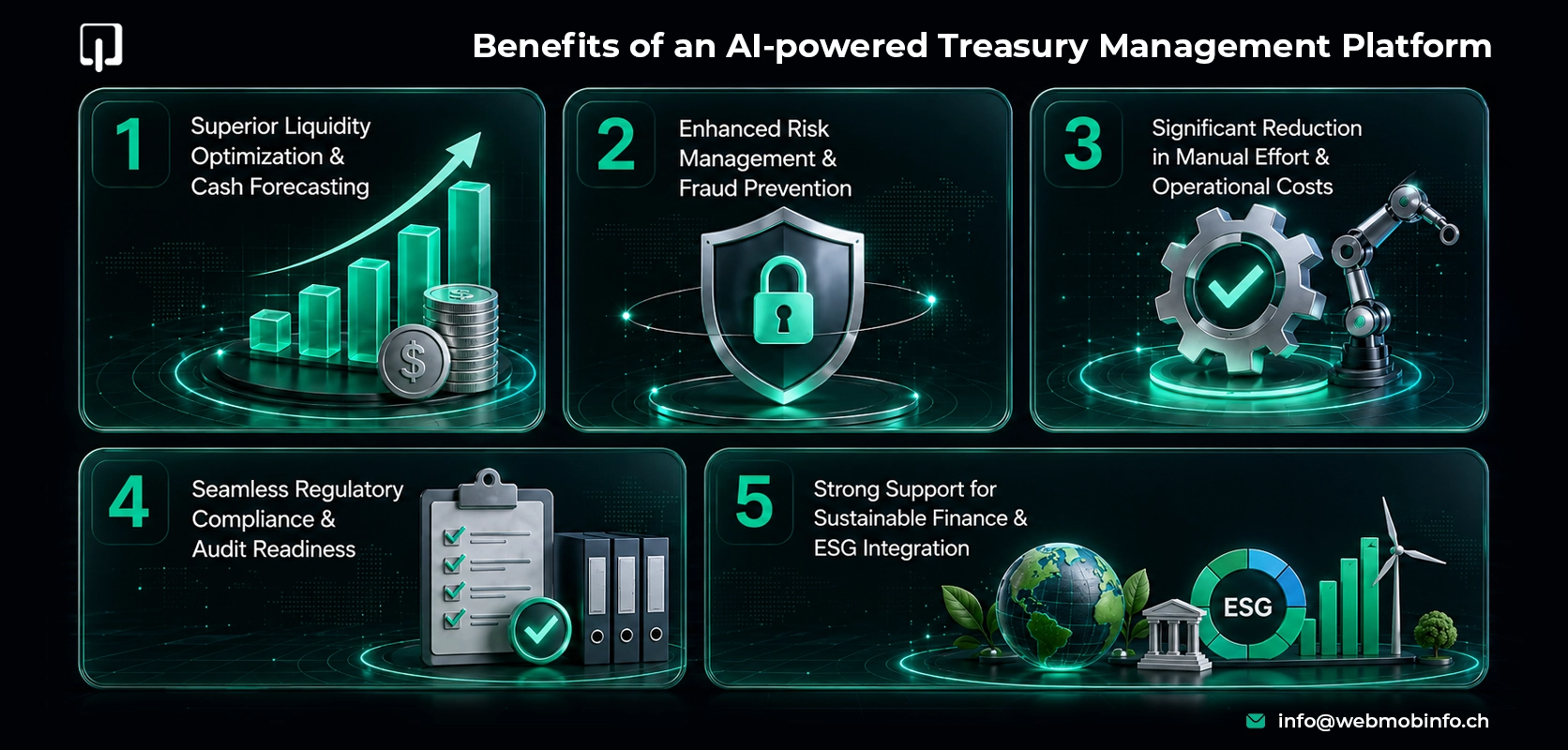
A robust AI-powered treasury management platform in Switzerland delivers predictive cash forecasting with up to 95% accuracy by integrating real-time bank feeds, market data, and external signals. Institutions achieve better liquidity optimization in Switzerland, reducing idle cash and borrowing costs while maintaining full FINMA AI governance compliance. Treasurers gain instant visibility and automated recommendations for smarter cash deployment.
Advanced platforms use machine learning for real-time anomaly detection and risk assessment, strengthening overall risk posture. In the Swiss market, this supports compliant fintech platform Zurich deployments with explainable AI models that meet FINMA AI governance standards. Automated fraud prevention and scenario analysis help corporates and banks minimize exposures in volatile multi-currency environments. (48 words)
By automating reconciliation, payments, and routine decisions through agentic AI, a well-built platform cuts manual treasury workload by 50% or more. Swiss institutions benefit from streamlined workflows in AI treasury management in Switzerland, freeing teams for strategic tasks. This leads to lower operational costs and faster decision-making while preserving audit-ready compliance trails. (47 words)
Built with compliance-by-design principles, AI treasury management platforms simplify adherence to FINMA requirements and evolving Swiss regulations. Features like automated reporting, model explainability, and data lineage support FINMA AI governance and FADP standards. For teams seeking compliant fintech platform development in Zurich, this reduces compliance overhead and regulatory risk significantly.
Modern treasury platforms integrate ESG factors into forecasting and liquidity decisions, helping institutions meet Switzerland’s growing sustainable finance demands. AI-driven insights enable green liquidity allocation and ESG risk analysis, aligning with national goals. This delivers both ethical impact and competitive advantage in ESG treasury Switzerland strategies.
At Webmob, we develop fintech solutions focused on institutional liquidity and cash management. Our platforms are designed with Swiss compliance in mind, helping banks, corporates, and fintechs implement AI features while supporting their regulatory responsibilities. Whether you need a full custom build, integration layer, or AI module enhancement, we’re here to support your project.

Let’s discuss and plan how we can accelerate your growth. Fill out this form and take the first step towards constant advancement.

We will respond to you within 24 hours.
Access to dedicated product specialists.




.png)

