


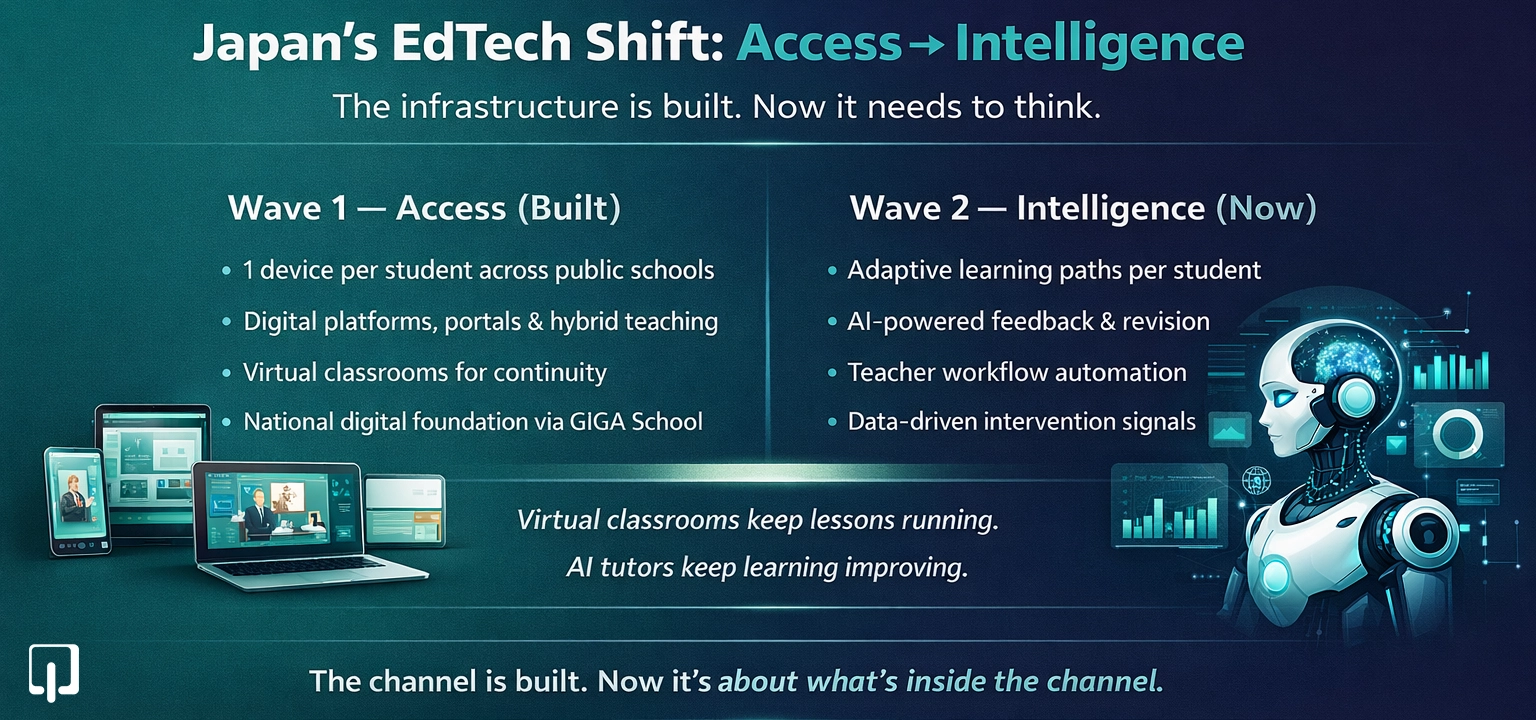
Japan’s education sector is moving into a different phase of digital change. The first phase of EdTech Japan was about access: devices, connectivity, digital platforms, and the ability to keep classes running across school and home. This phase mattered because it gave schools the base they needed to operate digitally at scale.
But access differs from personalization and from learning quality. (MEXT)
Now the conversation is changing.
The next phase of AI in Education in Japan centers on whether digital systems can actively support pacing, assessment, revision, teacher workflow, and student progress, moving beyond the question of whether schools can simply host Virtual Classrooms. The shift from virtual delivery to AI Tutors has become one of the most important themes in AI EdTech Japan 2026 (デジタル庁)
Japan’s digital education story began with infrastructure. Through the GIGA School concept, public elementary and junior high schools reached one device per student by March 2021. It gave schools a much stronger digital base and made online lessons, digital assignments, learning portals, and hybrid teaching far more realistic at system level. (MEXT)
The first wave was essential because it moved education from isolated ICT adoption to a national digital foundation. MEXT and the Digital Agency now frame the next stage as one where educational data, digital tools, and AI are used to improve learning quality. In other words, the first wave solved availability.
This matters because a device alone cannot tell a teacher which student is falling behind, which concept needs repetition, or what kind of support each learner needs next. A platform can deliver content, but that does not automatically create Adaptive Learning or Personalized Learning. The next chapter of EdTech Development in Japan begins at precisely this point. (デジタル庁)
Japan has already moved beyond the question of whether digital instruction is possible. OECD TALIS 2024 shows that 43% of teachers in Japan work in schools where at least one lesson was taught as hybrid or online in the last month. So virtual classroom Japan is no longer a niche idea. It is part of real school operations. (OECD Education GPS)
But a virtual classroom mainly solves continuity. It helps lessons happen across distance. It supports communication, homework, schedules, and lesson delivery. A virtual classroom alone leaves open the challenge of building a better learning path for each student. That is the limit of thinking about digital education only in terms of screens, meetings, and portals.
This gap explains why AI-enabled learning in Japan is becoming more important. Once schools have the channel, the next challenge is intelligence inside the channel. The Digital Agency’s Education DX Roadmap explicitly links educational data, self-regulated learning, diverse tools, and generative AI to a more personalized learning environment. (デジタル庁)
Japan is dealing with a combination of teacher workload, uneven infrastructure, changing learner needs, and long-term demographic pressure. These are concrete operational problems, directly affecting how schools run and how much time teachers can spend on actual teaching. (OECD)
Here is why the timing matters:

Full-time teachers in Japan report 55.1 working hours per week, well above the OECD average of 41. They also spend 5.2 hours per week on administrative work, compared with an OECD average of 3, which shows that the pressure is not only about teaching time but also about school operations and compliance work. (OECD)
Only 17.4% of lower secondary teachers in Japan report having used AI in their work, placing Japan among the lowest in TALIS 2024. The gap matters because it suggests the conversation around AI in education is moving faster than day-to-day classroom adoption. (OECD)
Among teachers who had not used AI in teaching, 88% said they lacked the knowledge and skills to teach using AI, and 65% said their schools lacked the infrastructure to use it. (OECD)
The Digital Agency says only about 20% of schools meet recommended network performance levels, and there are significant differences in device utilization across schools. (デジタル庁)
MEXT’s higher education reform summary projects university enrollment falling from 627,040 in 2021 to 459,757 in 2040, a 27% decrease, against a backdrop of declining birthrate and labor shortages. (MEXT)
Taken together, this changes the role of education technology. Schools do not just need more software. They need systems that help them do more with limited time, limited capacity, and more varied learner needs. This is why, AI in Education in Japan is becoming a structural issue. (デジタル庁)
A lot of writing on AI Tutors becomes unrealistic very quickly. It starts sounding like schools are about to replace teachers with bots. Japan's own policy direction points elsewhere.
MEXT’s 2025 guideline on generative AI in primary and secondary education frames AI as a potentially useful tool that should be used with human judgment, responsibility, and attention to safety, privacy, fairness, transparency, and information security. The guidelines position AI as a support layer inside a human-led system, with a clear distinction from any replacement for educators. (MEXT)
In the Japan context, an AI-tutor Japan model should be understood as a tool that can support:
A much stronger and more realistic framing emerges from this. A virtual classroom helps a lesson happen online. An AI tutor helps learning continue between lessons, around lessons, and after lessons. The deeper shift runs from delivery to guidance. It is also where Adaptive Learning becomes much more meaningful than simple digital content distribution. (デジタル庁)
This is the point where the blog should get practical. Not every AI use case matters equally. For schools and buyers looking at EdTech solutions for schools, the real question is where AI creates measurable value without adding confusion.
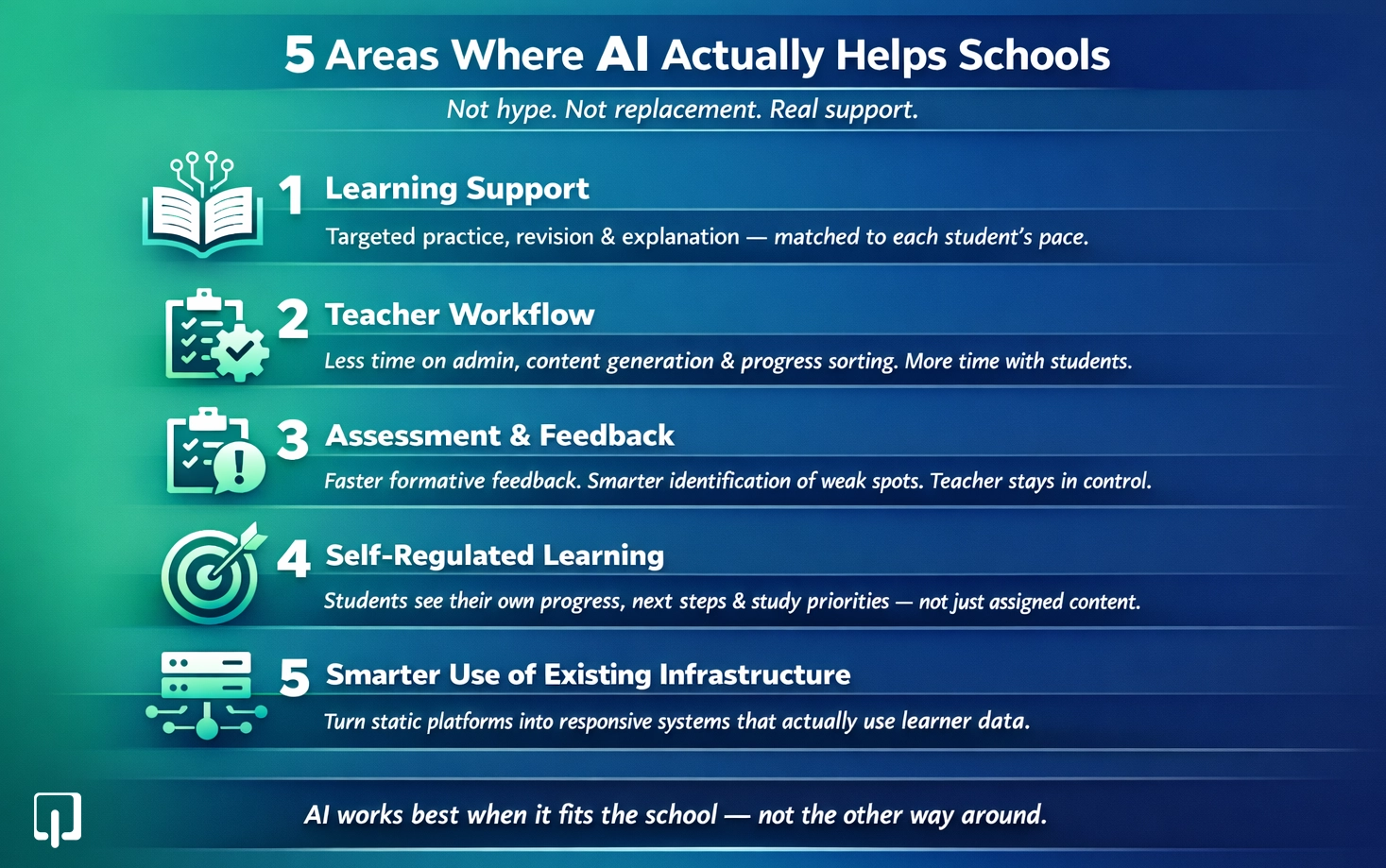
AI can help students get extra explanation, targeted practice, and revision support based on performance data. This is especially useful when a teacher is managing a full classroom with different learning speeds. The Education DX Roadmap’s focus on learning with optimal materials for each learner aligns directly with this. (デジタル庁)
AI can reduce time spent on repetitive tasks such as basic content generation, summary creation, first-pass lesson planning, or organizing student progress signals. The Digital Agency specifically links active use of generative AI with reducing school administrative workload so teachers can spend more time with students. (デジタル庁)
The focus falls on intelligent support for formative assessment, practice analysis, and identifying where learners need attention, specific applications rather than fully automated grading across everything. Used carefully, this can improve response speed without weakening teacher control. MEXT’s guidance supports appropriate, human-supervised use rather than blanket automation. (MEXT)
One of the more important ideas in Japan’s Education DX direction is that technology should help learners regulate their own learning, not just consume assigned content. AI systems that help students understand progress, next steps, and study priorities serve exactly this purpose. (デジタル庁)
Japan has already spent years building the digital base. AI can make that base more useful by turning platforms into systems that respond to learner data. This is one reason digital learning solutions Japan are moving beyond static LMS environments into more assistive and adaptive models. (MEXT)
This is where many vendors get the market wrong. Education products for Japan require a different approach from generic consumer AI apps. They need to fit school operations, governance, and trust expectations.
For teams working in Educational Software Dev, AI Tutor Development, or broader AI development, five design rules matter most.
Teachers need override power, visibility, and the ability to guide how AI is used. School systems will not trust tools that work like black boxes. MEXT’s guidance emphasizes appropriate use under human responsibility. (MEXT)
The Digital Agency’s roadmap makes clear that network performance and device usage still vary significantly across schools. Products must work in imperfect real-world conditions, not just ideal demo environments. (デジタル庁)
Japan’s policy direction is explicit about information security, transparency, fairness, and accountability. In school settings, these are core adoption requirements. (MEXT)
A tool that generates text alone falls short. Schools need systems that fit attendance, assignments, progress tracking, assessment, and communication workflows. This is why the next phase of LMS Development Services will likely be more data-aware and workflow-aware than the last phase. (デジタル庁)
The strongest products will win because they help schools answer concrete questions: Which students need support? Which concepts are weak? Where is time being lost? How can intervention happen earlier? That is the difference between shallow ai driven development and useful school technology. (デジタル庁)
The opportunity in AI Development Japan is real, but it is more specific than many people assume. The winning products are unlikely to be generic chat tools dropped into classrooms. The stronger opportunities are in systems that combine learning pathways, analytics, teacher assistance, school workflow support, and governance-friendly AI features. (デジタル庁)
Buyers need to shift how they think as well. A school or institution developing virtual classroom software in Japan should move beyond video and file sharing. A school evaluating EdTech solutions for schools should increasingly ask:
These questions matter because the market is shifting from platform access to capability depth. The real shape of EdTech Japan over the next few years follows from this shift. (デジタル庁)
For service providers, this also creates space for edtech consulting, curriculum-aligned product strategy, and implementation support. Since teacher readiness is still uneven and many schools lack the skills and infrastructure to use AI effectively, the partner model matters almost as much as the software itself. The same applies especially to any AI Dev Company Japan or team offering LMS Development Services into the education sector. (OECD)
The most likely outcome is AI getting layered into the education stack in practical ways, rather than replacing schooling.
We are likely to see:
The path fits both the Education DX Roadmap and MEXT's guidance. It also fits the reality that many schools are still building readiness. Progress will be uneven, but the direction is clear. AI-enabled learning Japan is moving from concept to operating model. (デジタル庁)
Japan's story here runs deeper than a sudden discovery of AI. The real story is that Japan has already built much of the digital base, and now it is trying to make that base more responsive, more personal, and more workable for teachers and students. That is why the move from Virtual Classrooms to AI Tutors matters. It marks the point where education technology starts being judged not just by access, but by how well it supports actual learning. (MEXT)
Japan's next education challenge goes beyond digitization. It centers on intelligent support.
EdTech in Japan has built the accessibility foundation. The focus now shifts to making learning more adaptive, data-informed, and manageable under real pressure. AI in Education in Japan is becoming less about novelty and more about necessity. (MEXT)
For schools, this means moving beyond Virtual Classrooms toward systems that improve support and visibility. For builders and institutions, the opportunity in Educational Software Dev, LMS Development Services, and AI Development Japan is real but only for products that solve school problems in a grounded way. (デジタル庁)
The next stage of EdTech Development in Japan will be defined by how well technology supports actual learning, not just access. (デジタル庁)
Japan’s GIGA rollout built the device and connectivity layer first, and AI use is now appearing on top of that through digital learning tools, schoolwork support, and limited generative AI use. MEXT says generative AI is already being introduced into education, while OECD data shows only 17% of teachers in Japan have used AI in their work so far.
Virtual Classrooms improve access, flexibility, and continuity of learning, especially for students who cannot easily attend school in person. MEXT also links digital and online learning to more individualized and advanced learning opportunities.
There is no single official benchmark. In practice, a narrow MVP can often take around 2 to 4 months, while a fuller production system may take 4 to 9 months, depending on curriculum fit, Japanese-language UX, safety controls, and system integrations; OECD guidance also suggests purpose-built learning tools perform better than generic AI wrappers.
Agentic AI means AI systems that can pursue goals with some autonomy, take actions, and adjust based on feedback. In education, that points to tools that do more than answer prompts, such as managing tutoring flows, supporting teachers, tracking progress, and automating parts of the learning workflow.
Yes, especially as part of a hybrid model. Japan still faces a major DX talent shortage, so offshore teams can be a practical way to expand engineering capacity while keeping product direction, pedagogy, and local market decisions close to Japan.

Let’s discuss and plan how we can accelerate your growth. Fill out this form and take the first step towards constant advancement.

We will respond to you within 24 hours.
Access to dedicated product specialists.



.png)

.png)

