A mid-size fund manager decides to issue a tokenized share class for one property fund. The pitch deck is ready. The interest from investors is genuine. Then comes the question from the CTO, which is very simple: who actually holds the legal title if the token gets transferred to a wallet nobody controls anymore? That question stalls half the projects that reach this stage.
This article is a working roadmap for teams past the theory stage. It covers what an asset tokenization platform development project actually requires, where issues arise during the process, and how the project can be done to ensure that there is no clash between legal, technical, and compliance considerations during implementation.
Digital asset tokenization converts a claim on an asset into a record on a distributed ledger. That record can represent a share, a bond, a fractional real estate interest, or a fund unit. The token itself is not the asset. It is a representation of rights tied to that asset, and those rights only hold up if a legal structure enforces them off-chain.
It is much more important than most explanations suggest. Owning a token does not mean necessarily owning the property, security, or receivable. The legal link is a SPV structure, a trust, or any other contract identifying the token as a proof of the right to the asset under certain jurisdiction. Without such a link, a token would be just another database entry without any legal power.
Teams also confuse cryptocurrencies with tokenization of financial assets. A cryptocurrency has no independent value. Its value comes from the network itself. A tokenized bond, by contrast, derives its value from a real debt obligation that exists independently of the blockchain. The technology stack overlaps, but the legal and risk profile does not.
Three friction points show up repeatedly in platform builds for fintech and proptech teams:
Custody design: The team must determine which person holds the private keys that will grant access to the token and allow for its management. Moreover, they will need a contingency plan regarding what will happen if the keys get lost. Not only does this matter from a technical point of view but also from the perspective of responsibility.
Compliance integration: Compliance integration. The KYC and AML checks must occur before a transfer is received into a wallet, not just during onboarding. This means that the smart contract layer must verify compliance status for every transaction, not just when tokens are issued.
Secondary market liquidity: The creation of a token does not guarantee buyers. There are many cases where tokens do not have enough trading volume because either there is no market or there is simply not enough interest from potential buyers. So platforms need a realistic plan instead of assuming liquidity will appear.
Two further mistakes compound these frictions. Teams often lock in a blockchain or token standard before confirming how the asset is classified under applicable law, a sequencing problem covered in the next section, which forces a costly redesign once counsel identifies restrictions the chosen chain cannot enforce. Teams also underestimate the operational cost of investor onboarding, particularly the need to re-verify identity when KYC data expires.
Choosing a blockchain alone does not resolve any of this. Teams still need to design the legal structure, compliance architecture, and operational processes around the technology, starting with the regulatory ground covered next.
The rules for tokenized assets can vary based on the country and the type of asset being tokenized. And, those rules can change faster than a technical development plan. For example, the road map of the team working for the Swiss and European Union market will be different from the road map of the team that targets the USA and Singapore.
In Switzerland, amendments under the DLT Act introduced a framework for ledger-based securities, under which tokenized rights may qualify as securities when structured correctly. However, the exact requirements depend on how the asset and token are structured, so teams should confirm the latest requirements through FINMA guidance or Swiss legal counsel.
In the EU, the Markets in Crypto-Assets Regulation (MiCA) primarily regulates crypto-assets and not the conventional financial instruments. So, whether or not the tokenized securities will be regulated by other EU security regulations such as MiFID II. That’s why teams need to confirm the latest guidelines issued by ESMA and the European Commission.
Depending on the jurisdiction and parties involved, transfers of tokenized financial instruments may also be subject to Travel Rule or similar requirements for information sharing. Thresholds and requirements may differ according to the regulatory regime and type of service provider, hence the teams should not assume it as one global regulation. .
Thus, it is very important to verify how the token and its asset would be categorized before development with the help of experienced legal counsel. Because once compliance rules are built into deployed smart contracts, changing them later can be very expensive and, in some cases, may need a full migration.
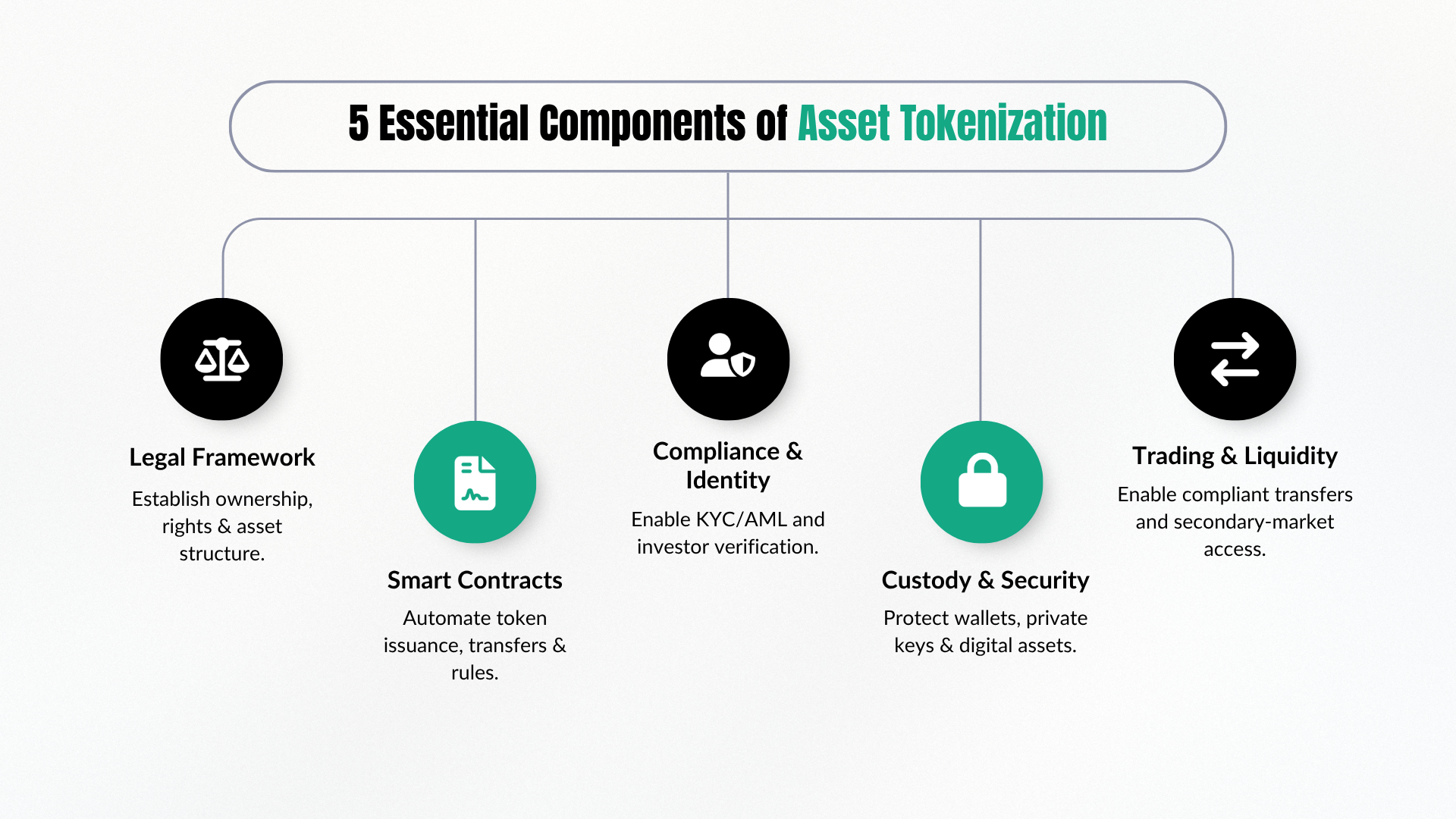
Once the legal classification is clear, it then becomes easier for the platform developers to design the technical architecture of the platform. A working RWA tokenization development platform generally needs five key layers. Skipping any of these may later lead to compliance or operational problems.
Standards such as ERC-1400 and ERC-3643 are designed for regulated token use cases. They can include identity checks and transfer restrictions directly within the smart contract instead of relying only on processes outside the blockchain.
A basic, unrestricted ERC-20 token on its own may not include the compliance controls needed for a regulated financial instrument. But, an ERC-20-compatible token can still be part of a compliant system when supported by the right compliance rules and controls around it.
Most teams frame this as a technical choice which is not entirely true. It is mainly a risk and speed decision, and the regulatory classification from the previous sections determines which paths are even viable.
Build from scratch: Complete control over compliance logic and custody infrastructure. Best fit for teams with a truly innovative asset structure or a well-planned product roadmap, which warrants an engineering effort.Takes the longest to reach a compliant pilot.
License an existing tokenization infrastructure provider: It will allow the company to reduce the time to market by taking advantage of the already tested compliance and custody systems. The solution will be somewhat inflexible but will provide a fast track to getting the system running.
Hybrid approach: Licensing the compliance and custody structure while developing a custom layer on top of it. Such an approach is suitable for medium-sized FinTech or PropTech companies that would like to build upon already existing compliance or custody structures and develop their own layer on top of it.
A useful test before committing to a build path: Is it possible for your team to clearly state the transfer conditions that need to be implemented by the smart contract, as well as who will validate an investor’s compliance prior to each transfer? If the answer is unclear, the platform is not ready to scope, no matter which build path is chosen.
With the regulatory, technical, and sourcing questions above answered, here is the order to work through them in practice:
A team is probably ready to begin development when it can answer four questions with confidence:
If any of these four answers is unclear, the platform is not ready to scope. Always start off with legal first, and not a developer, and consider the development process to be after, not before, these answers are given.
Once the legal structure and compliance requirements are clear, the technical work can be properly defined. This may include smart contract development, custody integration, compliance API connections, and an investor-facing application layer.
This is where an asset tokenization development company could come in handy as they would develop the platform based on the confirmed legal and compliance rather than make assumptions around those while developing the platform.
Webmob works with fintech and proptech teams on the application and integration layer of tokenization platforms, connecting compliance and custody infrastructure to a usable product for issuers and investors.
It is the process of building the legal, compliance, and technical infrastructure needed to issue and manage digital tokens that represent rights to a real-world or financial asset.
Not automatically. Legal ownership depends on the structure behind the token, such as a trust or special purpose vehicle, that grants enforceable rights to the token holder.
Standards such as ERC-1400 or ERC-3643 were designed to embed compliance and transfer-control mechanisms directly into the smart contract, which suits many regulated use cases.
No. Liquidity remains limited for many tokenized assets, and most need a dedicated secondary market mechanism, such as a licensed trading venue, to trade actively.
A hybrid approach can suit mid-size teams that want to reuse established compliance or custody infrastructure while building a differentiated application layer.
Legal counsel with experience in the target jurisdiction should confirm asset classification and applicable regulatory obligations before any smart contract development begins.

Let’s discuss and plan how we can accelerate your growth. Fill out this form and take the first step towards constant advancement.

We will respond to you within 24 hours.
Access to dedicated product specialists.