A financial transaction rarely involves just one organization. A securities transfer, for example, might involve a buyer, seller, custodian, and settlement provider. Each party needs to confirm that its responsibilities have been met, but they don't necessarily need access to the same information.
Traditionally, coordination among these organizations takes place through different systems, messages, and reconciliations. If there is disagreement in the records, or a system delays its response, it becomes challenging to complete the transaction.
Canton Network provides infrastructure for coordinating transactions across independent organizations while controlling which parties can access the underlying contract data. Applications use Daml smart contracts to define business rules, permissions, and permitted actions. Now, the challenge goes beyond writing smart contracts because the team needs to model the business workflow, coordinate participants, integrate existing systems, and handle failures without compromising transaction integrity.
This article explores the key architecture and implementation decisions involved in Canton Network development.
Before creating contracts, it is important to identify what type of transaction the application will need to support. For example, in the case of a financial institution creating a delivery versus payment process for a securities transfer, the buyer must make payment and the seller must deliver the ownership. Both parties must satisfy their commitments before completing the transaction. The development team needs to answer several questions:
These decisions determine the contract structure and the permissions each participant requires. Daml represents business agreements through contracts and defines the actions parties can perform against them. This makes Daml smart contract development relevant to workflows where several organizations must coordinate without giving up control of their own operations.
The first thing that one needs to do is to map out the workflow in terms of states, allowable actions, needed approval steps, and failure criteria. It is then possible to express the contract logic rather than assume how transactions should take place.
Canton coordinates transactions across independent participant nodes. Understanding its main components helps teams decide where contract logic runs, how participants interact, and which information each party can access.
Participant nodes connect organizations and applications to Canton. They have party services, Daml contract processing services, and ledger data maintenance. For instance, a bank and a custodian may run their own participant nodes within the same workflow.
Parties represent the actors involved in a transaction. Depending on the application, a party might represent a bank, investor, custodian, or another organization. Its permissions should reflect its actual responsibilities.
Synchronizers coordinate transactions across participant nodes, helping establish transaction order and coordinate their outcomes. They don't replace the business rules written in Daml or function as a shared database containing every participant's contract data.
Together, these components allow applications to coordinate shared business activity while preserving appropriate boundaries around contract information.
For Canton Network implementation, the architectural question is how these components should support the specific workflow, participants, and operating requirements. The answer depends on the use case, not simply on how many organizations participate.
In many cases, the transactions may be required to be shared without the financial institution disclosing all the commercial details of the transaction. For instance, a buyer and a seller require a view of a transaction contract, but an auditor will require to view the same without having the authority to authorize the transaction.
These three terms are very critical in Daml:
These help the developers define who has access to the agreement, who needs to approve it, and who can take action. This distinction is important when designing permissions, as organizations cannot have access by default simply because they use the same application. Access needs to correspond to the actual business relationship. The unauthorized action should be tested in the same way the successful transactions are tested. For instance, participants need to not be able to approve a transaction without having the necessary permission.
However, the privacy and authorization services provided by Canton should not be mistaken for automatic regulatory compliance. Organizations are still responsible for ensuring relevant controls in their applications.
Multi-party workflows become challenging when one action depends on another. Consider the purchase of a tokenized asset. The seller needs to send the asset to the buyer, who needs to pay the prearranged amount. One successful action without the other will lead to a violation of the agreed settlement terms.
The application should define the conditions that allow the transaction to complete and use Canton's transaction coordination capabilities where appropriate. However, not every operation automatically becomes part of a single atomic transaction. A bank payment API, custody platform, or legacy ledger may operate outside the Canton transaction itself. The application must distinguish between three things:
For example, a payment provider might time out after receiving a request. The application cannot safely assume that the payment failed just because no response arrived. It needs to establish the actual payment status before attempting the operation again.
This is where transaction IDs, idempotent processing, explicit state changes, and reconciliation are useful. This helps avoid duplication and inconsistencies in case of an unpredictable response from external systems. The critical design consideration is to delineate clearly where the Canton transaction ends and where the external systems start.
Most enterprise blockchain applications need to work alongside systems that already manage accounts, payments, assets, identity, and reporting.
A typical architecture might look like this:
Existing financial systems → Integration services → Canton participant node → Daml workflow → Other participant nodes
Each layer has a distinct responsibility.
Let's think about an application that is part of the bank's core ledger system. If the ledger defines the account balance, then the Canton system should have a proper way to retrieve and confirm this data. It can't just assume that its cache of the balance is accurate because it had been accurate before.
There must also be a way to deal with late messages, duplicated events, rejections, and failures. Otherwise, it is possible for two systems to have conflicting transaction state data even if the smart contract algorithm is right. Effective Canton Network integration therefore requires clear data ownership, defined interfaces, and a recovery process for situations where systems disagree.
Canton supports applications that communicate using synchronization domains. Participant nodes can connect to domains depending on the needs of the application, whereas domain management and operational aspects determine the deployment of the network. Before choosing an architecture, teams should establish:
These decisions influence connectivity, operational ownership, and future expansion. It is important to differentiate interoperability. Similarly, it is important to distinguish interoperability from automatic compatibility. Two applications can operate on Canton without sharing identical contract definitions or business rules. Connecting them may require agreed interfaces, compatible transaction semantics, and appropriate authorization.
Even a workflow that functions well in ordinary circumstances may fail if there is an integration timeout, incorrect permissions, or conflicting system states. The testing process needs to address the full lifecycle of the transaction.
For instance, where a transfer has been sent but no confirmation is received yet, the application must make a clear distinction between pending, declined, and completed transactions. It shouldn't indicate success on the basis of an accepted initial request alone.
Performance testing also needs realistic workloads. Transaction complexity, contention, network conditions, and integration patterns can all affect the performance of a deployed application. Teams should benchmark their own workflows rather than assume results from another deployment will apply.
Before implementation, business and engineering teams should agree on the following:
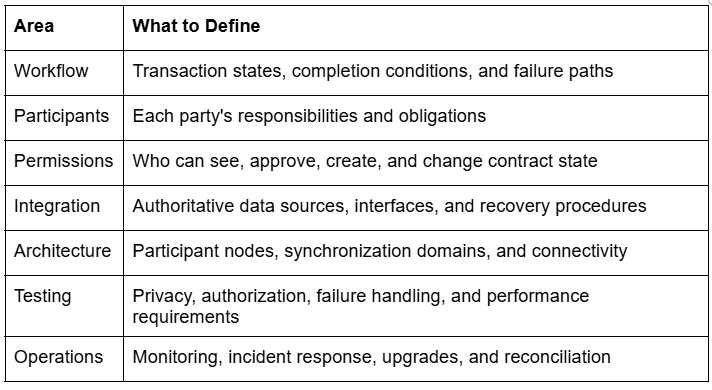
These decisions help teams separate the responsibilities of Daml contracts, Canton infrastructure, and the surrounding application.
Constructing a dependable Canton application is more complex than simply executing smart contracts. The flow has to model the business deal behind it, ensure proper permissions, and properly handle failure situations.
WebMob follows a structured path of enterprise blockchain development by identifying the workflow, stakeholders, and technical requirements. This will allow the team to determine the contract states, authorization mechanisms, integrations, and test cases for architecture definition.
This methodology will assist the organization to decide what needs to go to Canton, what systems will be integrated, and how the application is expected to run in production.
Canton Network provides infrastructure for coordinating transactions across independent organizations, while Daml defines the agreements, permissions, and actions that govern those workflows.
Building an application on Canton still requires careful engineering around system integrations, transaction states, privacy, testing, and recovery. Starting with a clearly defined business process gives teams a foundation for making the right architectural decisions.
Working with an experienced blockchain development company can help organizations translate these requirements into a practical architecture, avoid common implementation issues, and build an application that's ready to operate within their existing financial systems.
Canton Network development involves building applications that coordinate transactions across independent organizations using the Canton protocol and compatible smart contract applications, commonly written in Daml.
Daml defines contract business logic, including obligations, authorization, visibility, and permitted actions. Canton coordinates transactions across the participant nodes involved in a workflow.
Canton supports selective data sharing. Participants receive the contract information relevant to the parties they host, rather than automatically receiving every participant's underlying contract data.
Yes. Applications can connect through participant-node APIs and integration services to systems such as banking, custody, identity, asset management, and reporting platforms. The integration must account for data ownership and failure handling.
No. Canton provides technical mechanisms for authorization, privacy, and transaction coordination. Organizations must still implement the legal, regulatory, operational, and reporting controls relevant to their use case.

Let’s discuss and plan how we can accelerate your growth. Fill out this form and take the first step towards constant advancement.

We will respond to you within 24 hours.
Access to dedicated product specialists.