High-frequency trading systems are designed to process market data and execute orders within extremely short timeframes. But speed alone doesn't make a trading system reliable.
A market data feed can be paused, connection to the exchange can be severed, the execution gateway can go down, or the risk engine can fail. Even a few seconds' downtime can result in a trading system operating on incomplete data.
Consider a market maker running strategies across multiple exchanges. One exchange connection suddenly drops while several orders are still active. The strategy can no longer receive reliable updates from that venue, but some of its orders may still be sitting in the exchange's order book. If the system reconnects and starts submitting new orders without checking the existing ones, it could create duplicate exposure.
This is the challenge that HFT fault tolerance needs to address.
In order to tolerate faults in a trading system, there must be some method to sense failures, protect current positions, retrieve lost data, and re-establish a consistent operational state before the trading system continues functioning. This paper examines the design of such fault-tolerant systems.
Fault tolerance starts with understanding where failures can occur. An HFT platform depends on several connected components, and a problem in one can affect the entire execution process. Some common failure points include:
Such failures will require different handling. An issue involving the market data system might cause the strategy to stop quoting, whereas a problem with the execution gateway might require the platform to reconcile open orders first.
The architecture must be able to determine such failure points and the behavior of the various components on detecting them.
One of the foundations of high availability trading systems is redundancy. If a critical service has only one running instance, its failure can interrupt the entire trading workflow. A backup instance gives the platform another component that can take over when the primary instance becomes unavailable.
For example, a trading platform might maintain:
However, having a backup doesn't automatically guarantee uninterrupted operation.
This implies that the system should know whether the main unit is down, whether the backup unit has the state, and who should run the next activity.
Consider a situation where the strategy engine runs on two servers. If the main server gets disconnected from the network but is still running, the backup server will think it is down and run the strategy. This will result in the strategy being run and orders being submitted from two places.
It causes a split-brain scenario whereby two independent processes control the same process. This problem can be solved by ensuring that only one instance has the capability to run the strategy. Redundancy should hence apply to both the infrastructure and the control of execution.
Market data is one of the first things a trading system needs to protect.
An HFT strategy depends on current order book information to calculate prices and determine when to place, modify, or cancel orders. If updates stop arriving, the local order book may no longer represent the actual market.
Imagine a strategy receiving updates from an exchange at regular intervals. A network interruption causes the feed to stop, but the strategy continues running with the last available prices.
It may still generate quotes, even though the market has moved.
A safer approach is to monitor feed health and define when data should be considered stale. If the system detects missing updates, sequence gaps, or a connection failure, it should stop using the affected data until its validity is restored.
A recovery process generally involves:
This is not just a theoretical requirement. Exchange infrastructure specifications document how market-data failover works.
For example, Euronext's market data specification describes a high-availability mechanism in which a secondary publisher can take over following a primary publisher failure without a gap in market-data packet sequence numbers. The specification also explains the connectivity requirements clients must account for.
For an HFT platform, the important lesson is that backup connectivity must preserve data continuity or provide a reliable recovery mechanism.
A market-data connection failure and an order-entry connection failure are not the same problem. If an execution gateway disconnects, the platform may not know whether its latest orders reached the exchange. Some requests may have been accepted, others rejected, and some may still be awaiting confirmation.
Blindly resending orders can create duplicates. Consider this sequence:
At this point, the system shouldn't simply submit the same order again. It should first use the available exchange interfaces to establish the actual order state. That may involve querying open orders, retrieving execution reports, and checking the order's unique client identifier.
The recovery process should distinguish between:
Only after reconciling these states should the system decide what action to take.
FIX-based trading connections also provide mechanisms for recovering missed messages. The FIX Session Layer specification describes sequence numbers and retransmission requests used to recover missing messages and restore message order after a session interruption.
This is why trading system recovery needs to account for order state, not just network connectivity.
Recovering an exchange connection isn't enough if the platform's internal position records are incorrect. Suppose a strategy has an open buy order for 1,000 units. The exchange executes 400 units, but the execution update doesn't reach the trading system before its gateway crashes.
The platform may still believe the order is completely unfilled. If it resumes trading using that incorrect information, it could calculate the wrong inventory and approve additional orders based on an outdated position. To prevent this, the platform needs to reconcile internal records with exchange-side information.
This includes:
The system should also distinguish between confirmed and unconfirmed states. An order request being sent isn't the same as an order being accepted, and an acknowledgement isn't the same as a fill.
Risk controls must remain effective during normal operations and recovery. For US broker-dealers with market access, SEC Rule 15c3-5 requires financial and regulatory risk controls, including controls designed to prevent erroneous orders and orders exceeding appropriate credit or capital thresholds. The SEC specifically clarifies that the rule applies to market-maker quotes as well.
The practical implication is that a recovery process shouldn't bypass risk validation simply to restore trading quickly.
Failover allows a backup component to take over when the primary component becomes unavailable. But the transition needs to be controlled.
Consider an execution gateway handling orders across two exchanges. If the gateway fails, its replacement needs to know which sessions are active, which messages have been processed, and which orders are still open.
A poorly managed failover can cause:
A safer process is:
Failure detected → Stop new submissions from the affected component → Activate the backup → Restore session state → Reconcile outstanding orders → Validate risk and position information → Resume execution
Failover behaviour also depends on the exchange.
For example, CME Group's Drop Copy 4.0 failover documentation describes how clients may receive a significant sequence-number increase after connecting to a new primary connection. It recommends requesting missing messages, with a maximum of 2,500 messages per resend request in the documented scenario.
This illustrates why recovery logic needs to follow the actual exchange protocol rather than assume every reconnection starts with a clean session.
A system shouldn't wait for an entire service to stop responding before identifying a problem. Real-time trading system monitoring helps detect early warning signs and gives operations teams enough information to respond before a minor issue becomes a trading incident.
Monitoring should cover more than whether a service is running. Important indicators include:
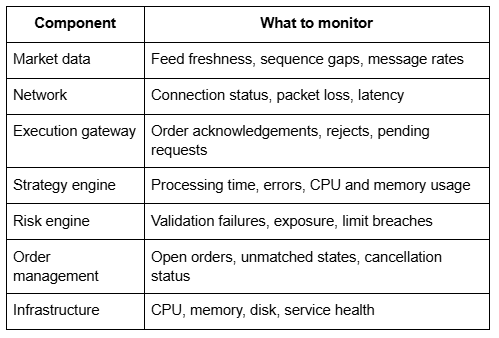
For example, an increase in market-data processing time may indicate that a feed handler is struggling to process incoming updates. A growing number of unacknowledged orders may indicate a connectivity problem or an overloaded execution gateway.
Monitoring should also connect events across services. When an order behaves unexpectedly, engineers need to trace the original market-data event, strategy decision, risk checks, order submission, exchange acknowledgement, and eventual execution.
Without this connection, teams may know that a service failed but struggle to establish how that failure affected trading.
A fault-tolerant system needs to be tested based on the fault scenario that is to be tested. In the case of conducting successful test execution of the order. There will be no point in testing the order, as it is unknown whether the fault-tolerant system will be able to recover fault in the gateway or reconcile the order in which confirmation was dropped.
Some of the scenarios for testing may include:
At the end of the test scenario, it is necessary to check the market data status, order status, positions, and risk data. One needs to estimate the time required for fault detection, switching to backup, reconciling the system and running the system safely.
This allows understanding the real performance and not just guessing the performance.
Building a fault-tolerant HFT system requires planning for failures across the entire trading workflow, not just deploying backup servers.
WebMob approaches fault-tolerant trading systems by considering market-data continuity, exchange connectivity, execution recovery, position reconciliation, risk controls, and real-time monitoring as connected engineering requirements.
The architecture is designed around the trading model, supported venues, expected message volumes, and operational risks. This helps identify critical failure points, define recovery behaviour, and test how the platform responds before taking it into production.
The HFT system should be able to operate fast on market data as well as orders, but it should also be stable under circumstances where there is a system component failure.
To achieve reliable fault tolerance in such a case, the infrastructure requires more than redundancy. The system should be able to detect disruptions, safeguard the ongoing trade, recover lost messages, reconcile orders and positions, and ensure the system's state is preserved before resuming operations.
For businesses developing HFT infrastructure, engaging a reliable trading software development firm can assist in meeting these specifications in a tested architecture design.
Fault tolerance is the ability of a high-frequency trading system to detect and handle component failures while maintaining control over market data, orders, positions, and risk. It includes recovery mechanisms that allow the system to restore normal operations safely.
High availability focuses on minimizing service downtime through redundancy and failover. Fault tolerance goes further by ensuring the system handles failures without losing critical state or producing incorrect trading behaviour.
HFT systems reconnect to the exchange, recover missing messages where supported, retrieve open orders and execution information, reconcile positions, and verify the current state before resuming trading.
Real-time monitoring in HFT helps detect stale market data, connection failures, processing delays, unacknowledged orders, and risk-limit issues before they create larger operational problems.
Redundancy provides backup components for critical services such as market-data feeds, execution gateways, and strategy engines. However, failover must include state synchronization and execution ownership to prevent duplicate activity.
Teams should simulate feed interruptions, gateway crashes, delayed acknowledgements, missing execution reports, duplicate messages, and infrastructure failures to test HFT systems for fault tolerance. They should then verify that orders, positions, market data, and risk records remain consistent after recovery.

Let’s discuss and plan how we can accelerate your growth. Fill out this form and take the first step towards constant advancement.

We will respond to you within 24 hours.
Access to dedicated product specialists.