


The world of real estate has witnessed a significant transformation with the advent of technology. Among the most revolutionary innovations, AI is undoubtedly changing how real estate businesses operate. Today, AI-powered solutions are not only automating tasks but are also reshaping how agents, buyers, and sellers interact. If you're looking to stay ahead of the curve in real estate, understanding how to build an AI agent is key.
In this guide, we will walk you through the process of building an AI agent for real estate, explore its core features, and help you understand how it can enhance productivity and customer satisfaction. Let’s explore why adopting AI is no longer a choice, but a necessity for real estate companies.
The real estate sector has always relied on human expertise, but now, AI is becoming just as crucial. From chatbots that answer queries instantly to predictive analytics that forecast property prices, AI is revolutionizing the industry. Real estate AI agents can process vast amounts of data, analyze market trends, and even assist with property valuations, all at a fraction of the time it would take a human agent.
AI has entered the market as a game-changer, helping companies not only streamline processes but also make smarter decisions. Whether it’s enhancing customer service or helping companies better understand their target market, AI integration is a critical component of modern real estate operations.
Real estate is a dynamic industry. But keeping up with market trends, handling numerous client requests, and ensuring personalized service can overwhelm even the best agents. This is where AI real estate agents come into play. By automating mundane tasks, analyzing trends, and providing real-time insights, these AI agents deliver substantial productivity gains.
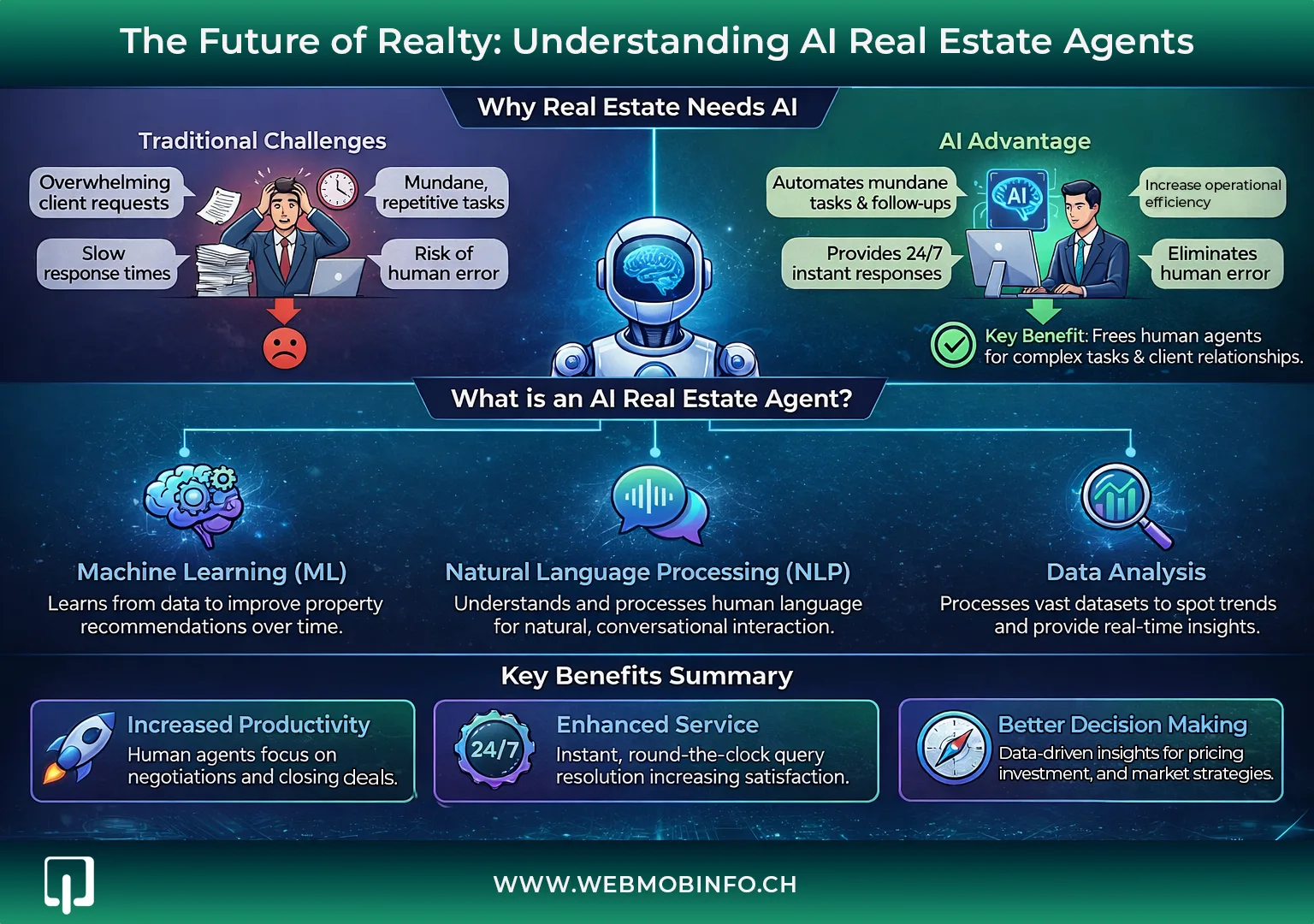
For real estate companies, adopting AI solutions means gaining an edge in a competitive market. AI agents allow businesses to increase operational efficiency, enhance customer engagement, and provide tailored property recommendations. It also eliminates human error and ensures faster responses to clients. Whether it's for lead generation or client interaction management, AI agents handle these with ease, freeing human agents to focus on more complex tasks.
An AI real estate agent is a software solution that uses artificial intelligence to simulate the behavior of a human agent. Unlike traditional agents, AI agents don’t get tired or overwhelmed. They are programmed to assist in everything from property searches to client communication, offering personalized recommendations based on buyer preferences.
AI agents for real estate use machine learning, natural language processing (NLP), and data analysis to provide insights, automate repetitive tasks, and improve the overall customer experience. These agents can handle a variety of functions, such as filtering properties based on buyer preferences or automating client communication.
The introduction of AI agents into the real estate process provides numerous advantages:
These benefits combine to make AI agents indispensable for real estate companies looking to stay competitive.
Real estate AI agents come equipped with several core features that allow them to work efficiently and effectively. Here are some key functionalities:
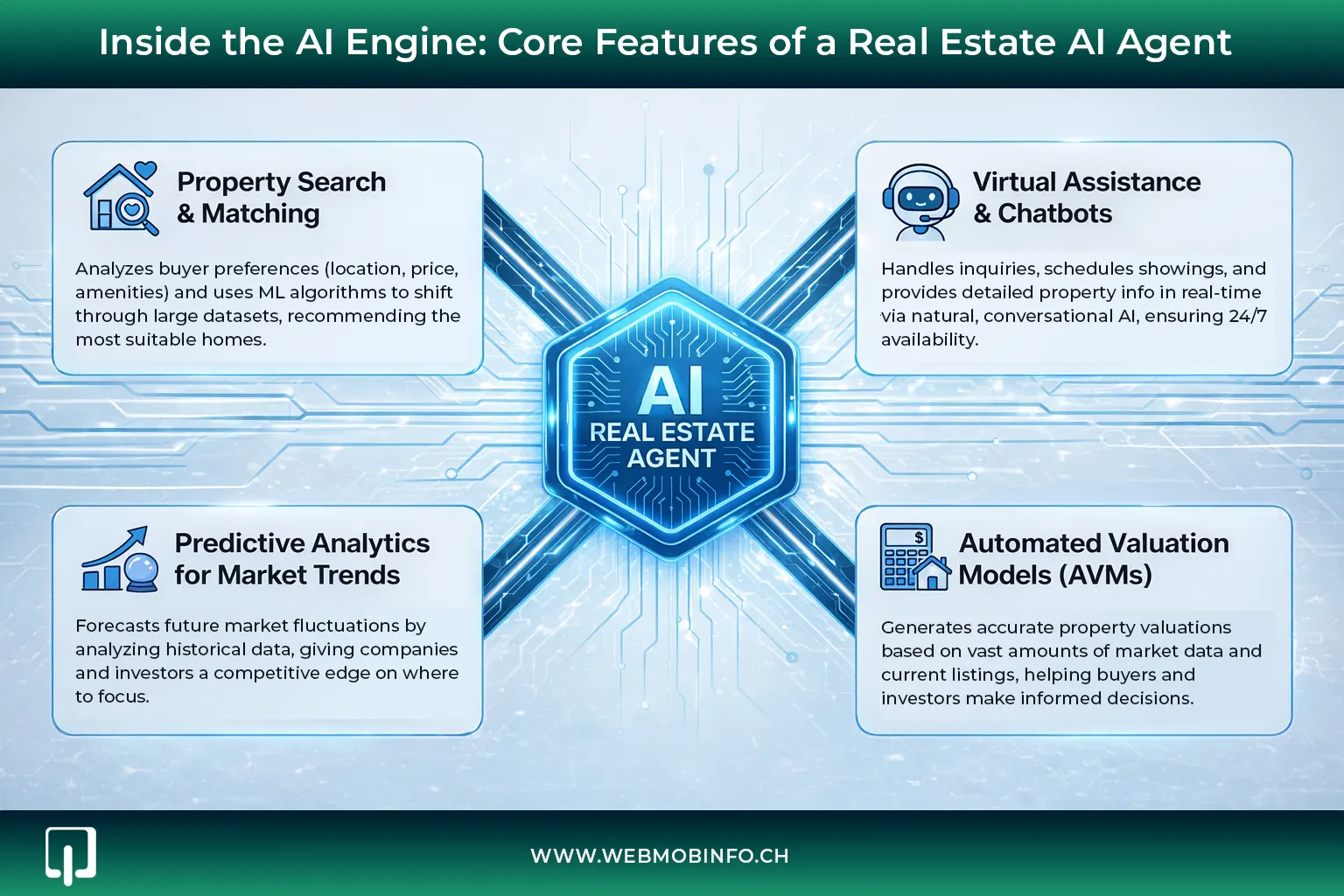
AI agents excel at analyzing buyer preferences and matching them to suitable properties. Using machine learning algorithms, they sift through large datasets of listings and recommend homes that meet the client’s needs, whether it's location, price, or amenities.
AI-powered chatbots can handle inquiries, schedule showings, and provide detailed property information in real-time. This allows buyers to receive immediate responses, increasing satisfaction and accelerating the buying process.
One of the most powerful features of AI in real estate is its ability to predict future trends. By analyzing historical data, AI agents can forecast market fluctuations, giving real estate companies and investors valuable insights into where to focus their efforts.
AI real estate agents can generate accurate property valuations based on vast amounts of historical data, market trends, and current property listings. These Automated Valuation Models (AVMs) valuations help investors make more informed decisions and provide buyers with realistic price expectations.
Building an AI agent for real estate involves several steps. Let’s break down the process:
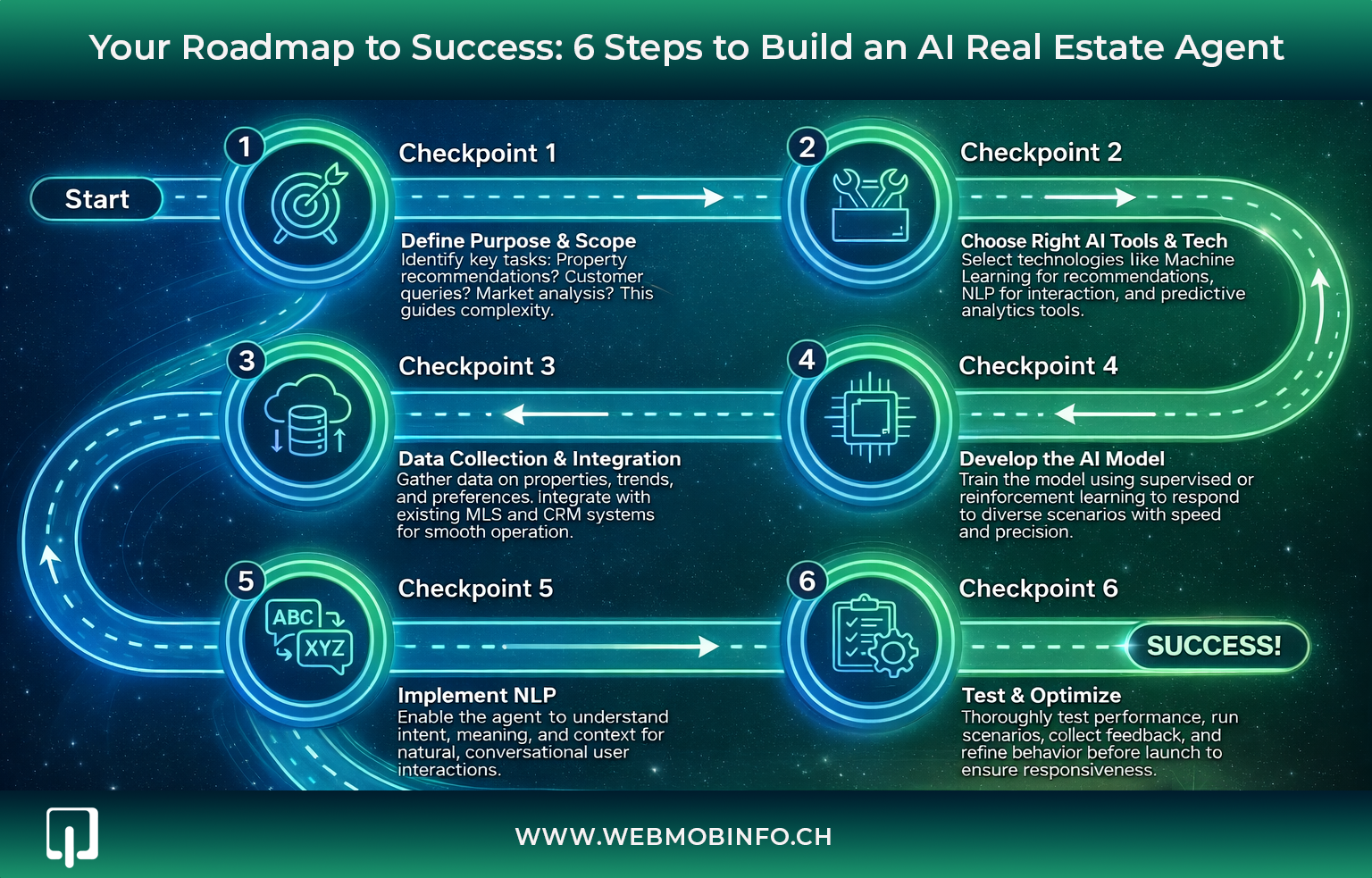
The first step in developing an AI agent is identifying the tasks it will handle. For example, will the AI focus on property recommendations, answering customer queries, or market analysis? Defining the scope will determine the AI's complexity and guide its development.
AI agent development for real estate companies requires specific tools and technologies. Some of the most commonly used technologies include machine learning algorithms for property recommendations, natural language processing (NLP) for client interaction, and predictive analytics for market forecasting.
To build an effective AI agent, you need a lot of data. Collect data on properties, past market trends, and customer preferences. This data will feed into your AI model, helping it make better recommendations. Additionally, integrating your AI agent with existing platforms, like MLS or CRM systems, ensures smooth operation.
Once you’ve gathered the data, the next step is to train your AI model. Use techniques such as supervised or reinforcement learning to train the agent to respond to different scenarios. This step is crucial for ensuring that your AI agent behaves like a human agent but with the speed and precision of a machine.
For client interactions, NLP is essential. It allows your AI agent to understand and process human language, providing accurate responses to customer queries. NLP helps the agent recognize intent, meaning, and context, making it more conversational and user-friendly.
Before launching, thoroughly test the AI agent to ensure it’s accurate and responsive. Optimize its performance by running different scenarios and collecting feedback. This process helps refine the AI’s behavior and ensures it meets the needs of real estate agents and clients.
Developing an AI agent for real estate is not without challenges. Here are some key obstacles:
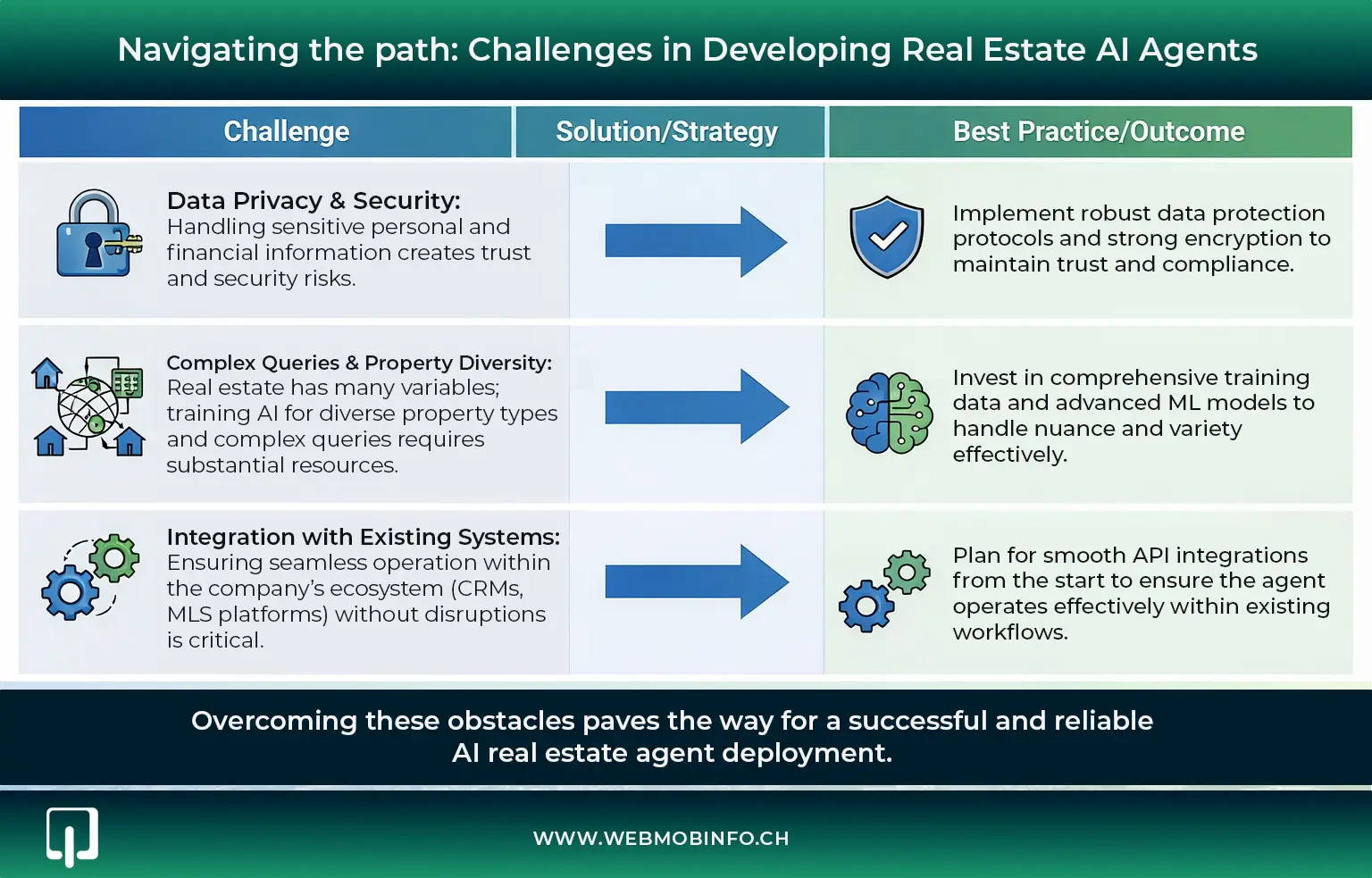
Real estate transactions involve sensitive personal and financial information. Ensuring that the data handled by the AI agent is secure is critical. Data protection protocols and encryption are necessary to maintain trust.
Real estate deals involve many variables, from the condition of the property to its location. AI agents must be trained to handle complex queries and diverse property types effectively, which can require substantial resources.
AI agents must seamlessly integrate with existing systems such as CRMs and property listing platforms. Ensuring smooth integration is crucial for avoiding disruptions and ensuring the agent operates effectively within the company’s ecosystem.
Several companies have already made strides in integrating AI into real estate operations. Here are a few examples:
Zillow has incorporated AI into its Zestimate tool, which estimates home values based on various factors such as location, size, and market trends. This AI-powered tool is an excellent example of how AI can help buyers and sellers make informed decisions about property prices.
Compass has developed an AI-powered assistant that helps real estate agents find suitable properties and generate leads. The AI agent analyzes client preferences and automatically recommends listings that match.
Reonomy leverages AI to provide detailed commercial real estate data and analytics. Their AI system helps users search for properties, analyze market trends, and make more informed investment decisions.
Choosing the right AI development company is critical for the success of your real estate AI agent. Here’s what to consider:
Look for a development company with experience in the real estate industry. They should understand the nuances of real estate transactions and be familiar with the specific challenges of this market.
Depending on your needs, you can choose between custom-built AI solutions or existing platforms. Custom solutions offer greater flexibility but cost more. Off-the-shelf products are faster to implement but may not meet all your specific requirements.
Understand the costs associated with developing an AI agent. In addition to development, consider post-launch maintenance and support to keep the agent running smoothly.
The future of AI in real estate looks bright. We’re seeing the integration of virtual reality (VR) and augmented reality (AR) into property-viewing experiences. Additionally, AI-powered predictive analytics will continue to improve, providing more accurate market forecasts.
AI is not here to replace real estate agents; instead, it’s here to help them perform better. By automating repetitive tasks and providing valuable insights, AI allows agents to focus on building relationships and closing deals. For customers, AI ensures a more personalized and efficient experience.
Building an AI agent for real estate is no longer a future idea. It is a practical move for companies seeking greater speed, clarity, and control across operations. From handling property searches to responding to buyers instantly, an AI real estate agent helps reduce manual effort and improves decision-making. When designed well, a real estate AI agent becomes a steady support system for sales teams, brokers, and customers alike. It works quietly in the background, processing data, learning patterns, and assisting at every step where time and accuracy matter.
That is where the right technology partner makes all the difference. At Webmob Software Solutions, we are an AI development company with hands-on experience building AI agents for real estate companies. Our team focuses on creating practical, business-ready solutions, whether they are customer-facing AI agents for real estate, internal workflow automation, or data-driven real estate AI agents designed for scale. We help businesses plan, build, and deploy some of the best AI agents for real estate, aligned with real-world needs and long-term goals.
Thinking about building your own AI real estate agent?
Let’s talk. Connect with our experts at Webmob Software Solutions and see how we can help you move forward with confidence and clarity.

An AI real estate agent is a software-based assistant that uses data, machine learning, and language processing to support real estate operations. A real estate AI agent can answer buyer queries, suggest properties, analyze demand, and assist agents, helping businesses improve speed, accuracy, and customer experience.
An AI agent for real estate automates routine tasks like lead qualification, property matching, and follow-ups. This reduces manual effort and response delays. Real estate AI agents also analyze buyer behavior and market data, enabling teams to focus more on closing deals and client relationships.
Yes, AI agent development for real estate companies can be fully customized. Businesses can design features based on property type, region, customer flow, and internal systems. A skilled AI development company builds solutions that fit existing CRMs, listing platforms, and operational goals without disrupting workflows.
The best AI agents for real estate are those built around real business needs, not generic templates. Look for an AI development company with experience in real estate AI agents, strong data handling practices, and post-deployment support. Practical results matter more than complex features.
Modern AI real estate agents are designed with strong security measures, including encryption and access control. When built by a trusted AI development company, a real estate AI agent follows data protection standards and ensures sensitive customer and property information remains secure and well-managed.

Let’s discuss and plan how we can accelerate your growth. Fill out this form and take the first step towards constant advancement.

We will respond to you within 24 hours.
Access to dedicated product specialists.





.png)

