


The launch of the Aamal Platform by the Real Estate General Authority (REGA) has set a new standard for how businesses interact with Saudi Arabia's property infrastructure. For fintechs, PropTech companies, and real estate tokenization development companies like Webmob, the challenge is no longer just funding or product design. It is technical compliance, specifically understanding how to connect to the Riyadh Real Estate Registry at an API level.
Saudi Arabia completed its first sovereign-native tokenized property deed transfer in late 2025, executing the entire process in approximately 66 seconds through a direct integration between RER and droppRWA's settlement layer. This was not a proof of concept. It was a production-grade transaction between government entities (NHC and REDF) using a government-authored tokenization standard.
For any white label tokenization company looking to operate within KSA, understanding the RER Aamal Platform API, the Nafath Integration KSA requirements, the REGA PropTech Sandbox rules, and the distributed ledger for deeds architecture is no longer optional. This article provides a comprehensive technical breakdown sourced entirely from official announcements, ecosystem disclosures, and regulatory frameworks.
The Real Estate Registry (RER) launched its "Aamal" Business Portal in January 2026 as a dedicated digital gateway for developers, corporates, and financing institutions. It sits within RER's broader "As'hal" (Easier) strategy to digitize and automate registry services for business users through a unified, secure experience.
At its core, Aamal exposes an enterprise-oriented interface on top of RER's fundamental capabilities. These include first title registration, ownership transfer, split/merge operations, and rights, restrictions, and responsibilities (RRR) management. For institutional users, the portal also packages portfolio dashboards, delegation management, and payments into a single access layer.
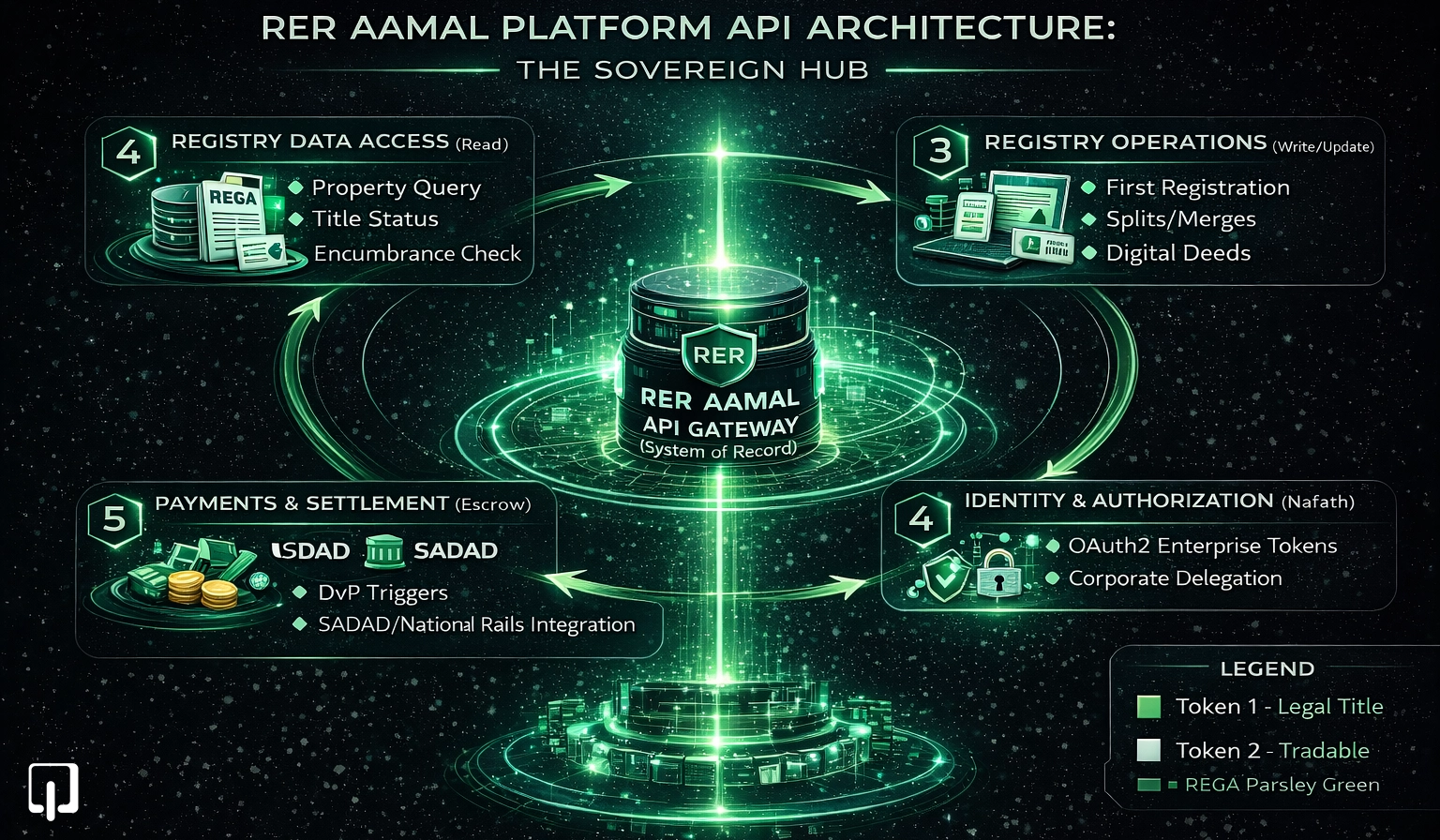
Public announcements explicitly reference "technical linkage (API) services with enterprises' internal systems" as a core feature. While a formal OpenAPI or Swagger specification is not yet publicly available as of mid-February 2026, the announced feature set gives a clear picture of what the RER Aamal Platform API will cover:
· Registry Data Access (Read): Query property by Property Number, location, or owner. Retrieve title status, RRR records, encumbrances, and transaction history.
· Registry Operations (Write/Update): Initiate and track first registration, transfers, splits/merges, and RRR modifications. Submit supporting documents and receive digital deeds.
· Identity and Authorization: Link registry transactions to Nafath-authenticated identities and corporate authorizations. Maintain delegation mappings for enterprise teams.
· Payments and Settlement: Connect to escrow and national payment rails as specified by RER's blockchain infrastructure.
Any real estate tokenization development company planning to build a fractional ownership platform on top of Saudi infrastructure must treat the Aamal API as the authoritative system of record for legal title data and property identifiers. There is no room for parallel asset IDs or shadow registries.
Your platform cannot function without trust. In Saudi Arabia, that trust starts with Nafath Integration KSA, the national digital identity and authentication application operated by the Saudi Data and AI Authority's National Information Center.
Nafath supports multi-factor authentication (MFA) combining local authentication, PIN, request numbers, and biometrics. The level of assurance scales with the sensitivity of the transaction, making it the backbone for verifying every investor, signer, and corporate representative on a tokenization platform.
RER's blockchain system description explicitly mandates integration with Absher and Nafath for verified digital identity, with support for W3C verifiable credentials. Any PropTech or fractional ownership platform connecting to Aamal or the blockchain registry must treat Nafath-based authentication as the primary identity provider for KYC and for signing high-value real estate actions.
The integration pattern, documented through third-party integrators and open-source packages, follows a consistent five-step process:
1. The user logs into the PropTech platform.
2. The platform sends a Nafath authentication request using the user's national ID (or Iqama for residents).
3. The user approves the request via the Nafath mobile app using MFA.
4. The platform stores an authentication assertion or verifiable credential referencing Nafath transaction data.
5. The platform uses this verified identity to authorize registry-linked actions such as initiating transfers, subscribing to fractional units, or signing digital mandates.
From a technical standpoint, enterprise API authentication for Aamal is expected to use OAuth2-style bearer tokens or client credential mechanisms, consistent with other Saudi government APIs. Nafath integrators already use bearer token headers and API keys for secure calls. Blockchain development services that handle this secure handshake between Nafath, your platform, and RER form a critical piece of any compliant deployment.
One of the most common points of confusion for companies entering the Saudi market involves the distinction between the REGA PropTech Sandbox and the RER Blockchain Registry. They are not the same thing, and the path your product takes depends entirely on its maturity and regulatory classification.
The blockchain registry is where production-grade, regulatory-approved tokenization and deed recording occur. The sandbox is where new models are stress-tested and iteratively aligned with REGA's evolving frameworks.
The second edition of the REGA PropTech Sandbox, announced in February 2026, includes a specific "fractional ownership pathway under the real estate tokenization framework" with testing phases of 6 to 24 months followed by an exit decision. Sandbox participation does not equal full authorization. Entrants receive time-limited permissions to test with predefined customer segments while REGA gathers evidence and refines regulations.
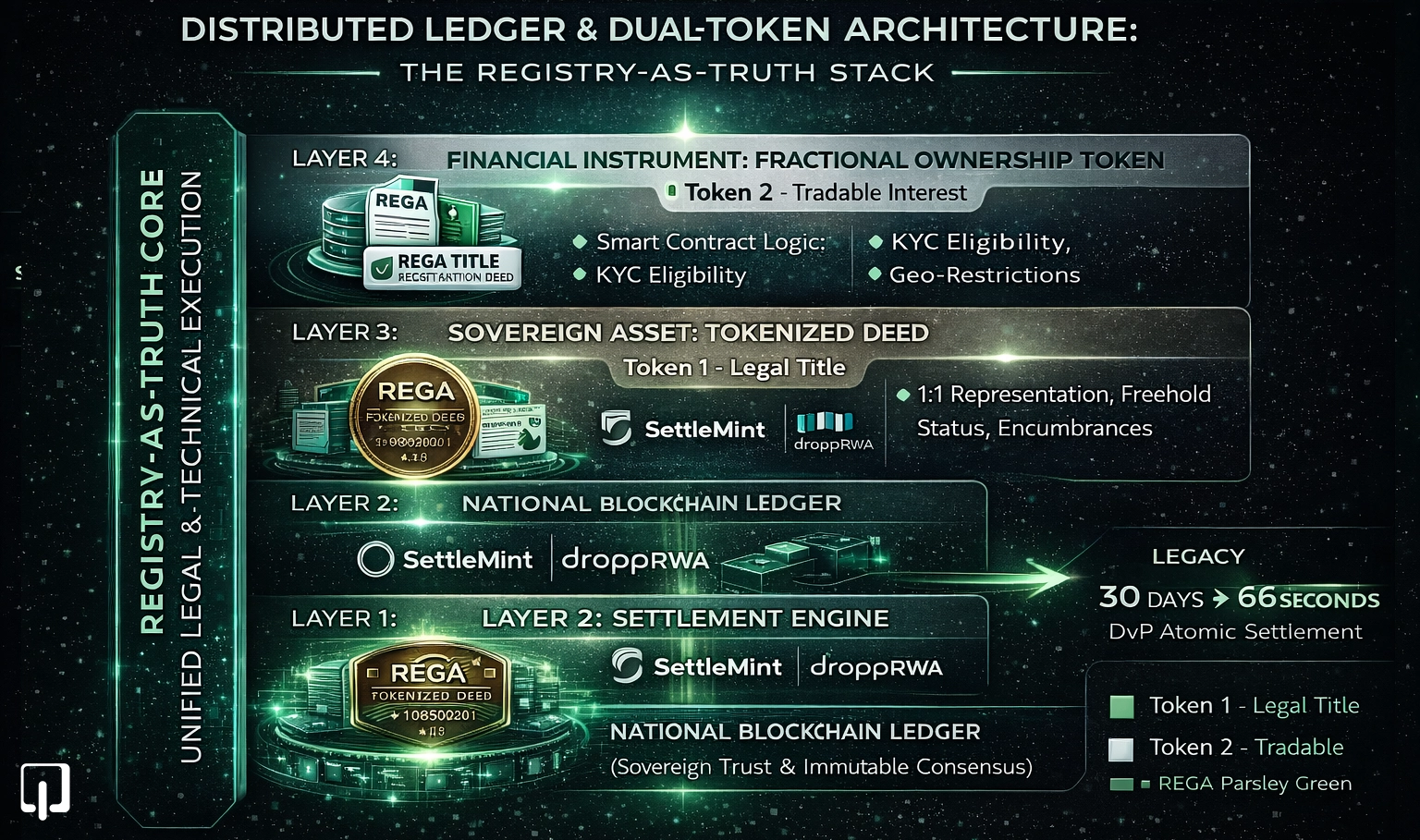
The national blockchain registry operated by RER is not a typical private chain experiment. It is a production-grade, national-scale platform with clearly defined architecture elements.
· Distributed Ledger: Government validator nodes ensure state-level trust and consensus.
· Digital Title Records: Tokenized deeds are stored on-chain or cryptographically anchored to on-chain data.
· Smart Contract Engine: Embeds rules for transfers, encumbrances, and compliance directly into the ledger logic.
· Escrow Workflows: Linked to national payment systems, enabling atomic delivery-versus-payment settlement.
· Identity Integration: Absher/Nafath identities and W3C verifiable credentials are core to the system.
· Open Interface Layer: Designed for PropTech and fintech developers to connect their platforms.
SettleMint serves as the blockchain technology provider, while Inspire for Solutions Development delivers the digital marketplace layer. This creates a layered architecture where the core ledger and smart contracts sit at the base, RER registry and Aamal function as official service layers, and external PropTech platforms connect via APIs.
The first tokenized deed transaction revealed a dual-token approach that any fractional ownership platform must understand:
· Token 1 (Tokenized Deed): A 1:1 representation of the legal title, linked directly to the official RER record. It references the Property Number, title ID, current owner, and legal constraints (freehold vs. leasehold, encumbrances).
· Token 2 (Fractional Ownership Token): A separate standard for digital real estate shares, referencing the underlying tokenized deed. Smart contract parameters include total number of units, rights per unit, transfer rules (KYC/eligibility, geographical restrictions, lockups), and integration hooks for RER notification.
Compliance logic is embedded directly into the ownership token to enforce approved investor categories and transaction limits. This is the architecture that any white label tokenization KSA deployment must replicate.
Real estate coding in Saudi Arabia starts with a fundamental building block: the unique Property Number and Title Registration Deed assigned by REGA to each registered property during title registration campaigns.
These identifiers are the anchors for all downstream digital services, including geospatial mapping via REGA's Geospatial Real Estate Portal, market indicators via the Real Estate Indicators platform, and any tokenization scheme referencing legal parcels, units, or off-plan projects.
Although field-level schemas are not published, integration designs should plan around these data domains:
· Property Object: property_number, location (coordinates or geospatial reference), land use, area, zoning, project linkage.
· Title Object: title_id, property_number, owner(s), ownership share, encumbrances (mortgages, easements), registration date, status.
· Transaction Object: transaction_id, type (transfer, split, merge, RRR change), participants, timestamps, legal basis, associated documents.
· RRR Object: rights (e.g., full ownership, usufruct), restrictions (e.g., liens, zoning limits), responsibilities (e.g., maintenance obligations, service fees).
Tokenization platforms must model the registry's canonical property identifiers and link all digital units, tokens, and shares to the relevant Property Number and title reference. Inventing parallel asset IDs outside of this framework will create compliance gaps.
Whether you are tokenizing off-plan properties or completed assets, the end-to-end lifecycle for a fractional ownership platform in KSA follows six phases with specific registry, Nafath, and API integration requirements at each stage.
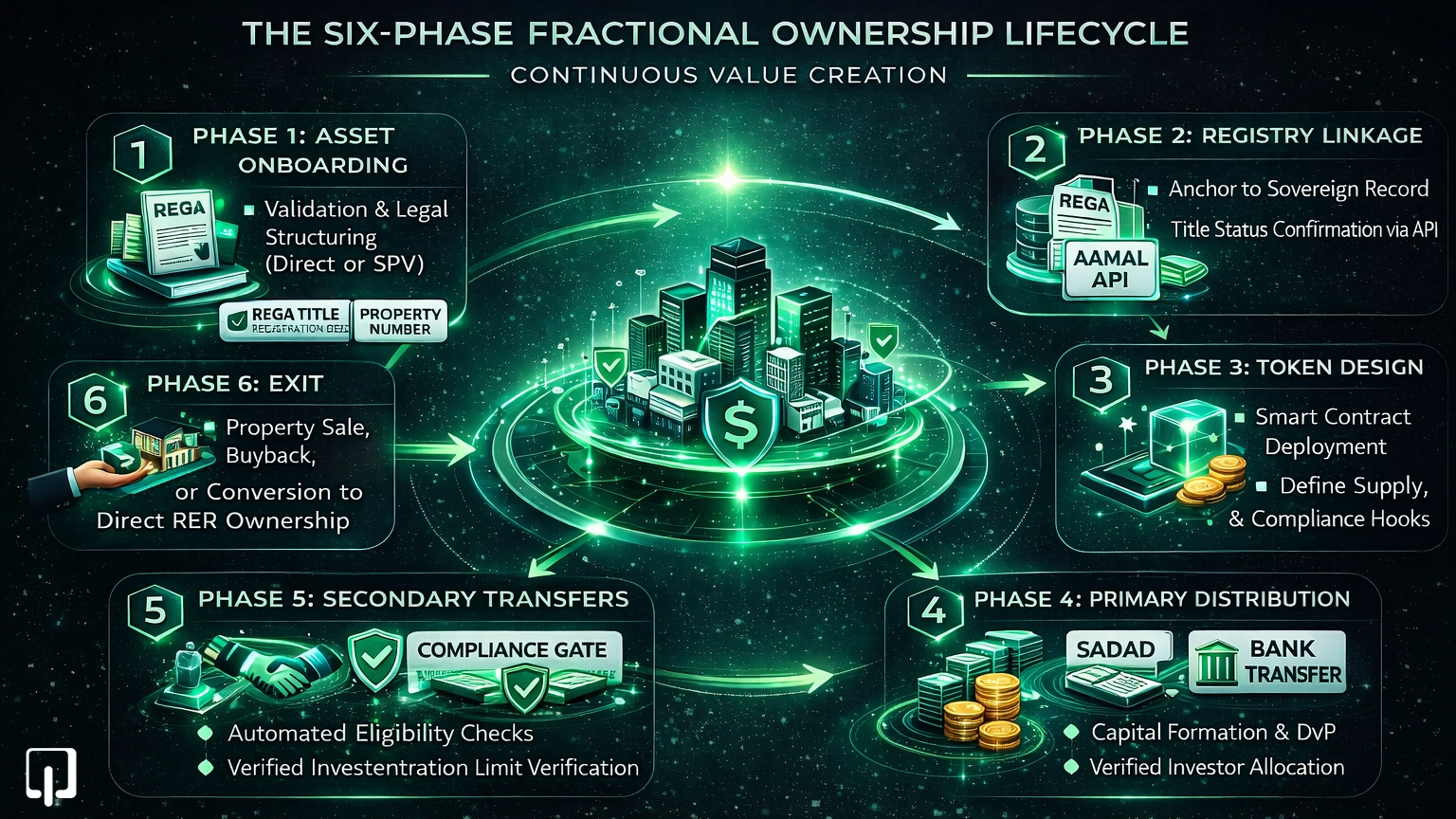
· Phase 1 (Asset Onboarding): The issuer ensures the title is fully registered in RER with a valid Property Number and Title Registration Deed. Legal structuring determines whether investors hold direct co-ownership interests or indirect interests via SPV units. Novel models may require entry through the REGA PropTech Sandbox.
· Phase 2 (Registry Linkage): RER and the tokenization infrastructure coordinate to link the physical title deed to a tokenized deed on the national blockchain. An Aamal or RER service call confirms the current title status and anchors the digital asset to the authoritative record.
· Phase 3 (Token Design): A separate fractional ownership token standard is deployed, referencing the underlying tokenized deed. Smart contracts encode total units, rights per unit, transfer rules, and compliance hooks.
Phase 4 (Primary Distribution): Investors onboard through the platform, completing KYC via Nafath. Subscription orders trigger payment flows through local rails (bank transfers, SADAD) and escrow workflows. Fractional tokens are minted and allocated once payment and compliance checks pass.
· Phase 5 (Secondary Transfers): Investors transfer units peer-to-peer or via a marketplace, gated by smart contract rules. On-chain checks verify investor eligibility, concentration limits, and transaction type. Threshold crossings may trigger RER notification via Aamal.
· Phase 6 (Exit): Exit events include property sale, issuer buyback, or conversion of fractional interests into direct RER ownership entries (for approved models). Smart contracts enforce delivery-versus-payment settlement and coordinate token retirement.
Investors need data. By integrating predictive real estate analytics, a fractional ownership platform can offer dynamic pricing, market comparables, and cash-flow projections that drive investor confidence.

REGA operates a Real Estate Indicators platform that publishes market data and statistics, along with a Geospatial Real Estate Portal for location-based information. These datasets, combined with transactional data from RER and platforms such as Ejar (rental contracts), form the backbone for automated valuation models (AVMs).
The national blockchain registry's architecture explicitly references automatic valuation models as part of the tokenized platform stack. For a fractional ownership platform, this creates three clear integration points:
· Use REGA indicators and geospatial data to enrich property records with market comparables and price trends.
· Train AVMs on anonymized or aggregated RER/REGA data where legally permitted.
· Surface AI-driven valuations and predictive cash-flow analytics alongside token offerings and secondary trading dashboards.
An important caveat: AVMs must be treated as decision-support tools rather than authoritative appraisals. Legal valuations for regulatory purposes may still require licensed valuers under REGA's "Val" licensing scheme. AI development services that build these valuation models directly into your dashboard must account for this regulatory boundary.
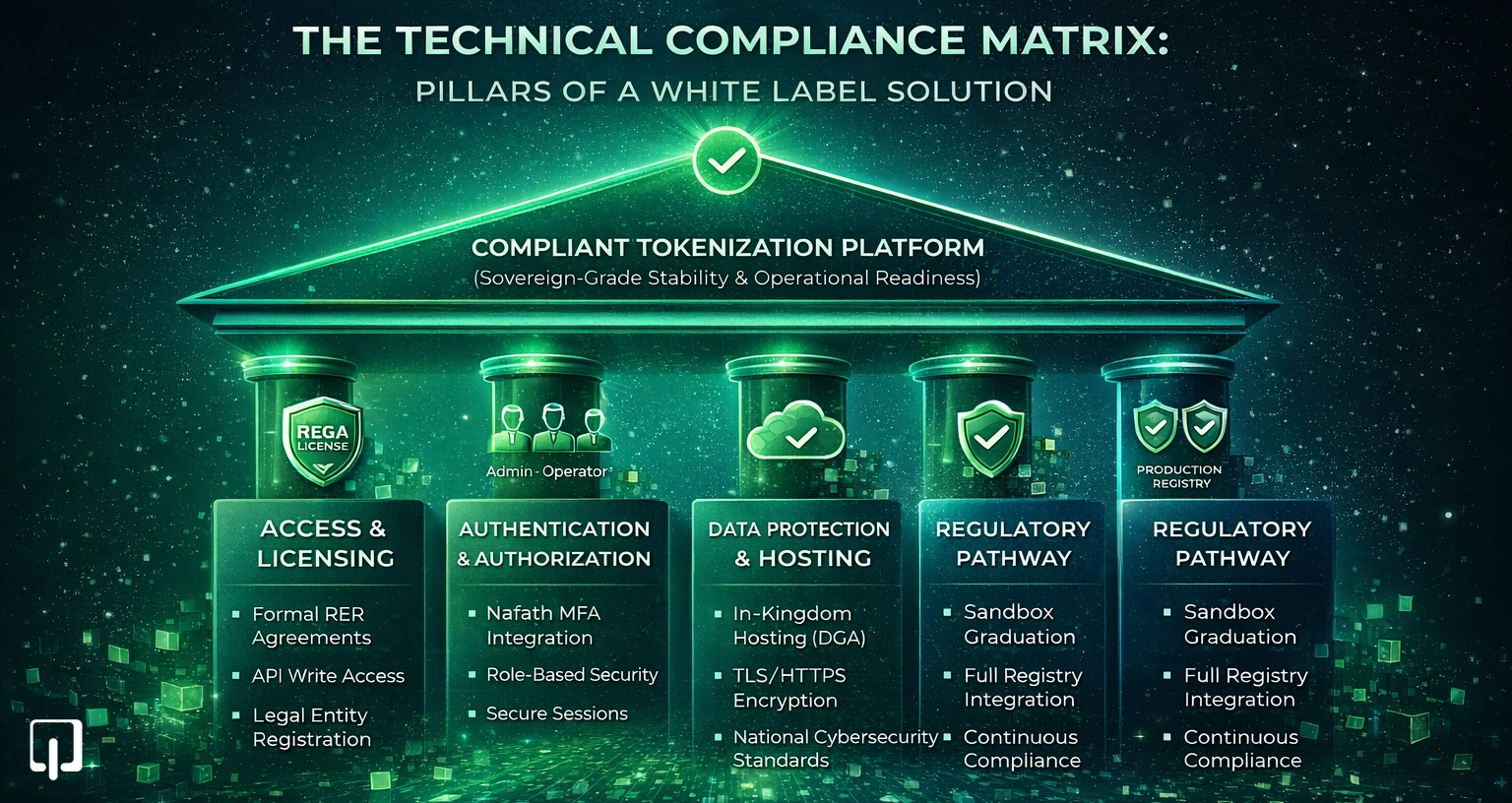
Any white label tokenization KSA deployment connecting to the Aamal API and the blockchain registry must address four compliance domains:
· Access and Licensing: Aamal targets companies, developers, and financing entities. Access requires corporate registration, REGA-related licensing, and KYC of authorized signatories. Write operations (registration, transfer) and access to sensitive ownership data require formal agreements with RER.
· Authentication and Authorization: End-user actions must be backed by Nafath-authenticated sessions. Enterprise API calls use OAuth2-style bearer tokens. RER's delegation management model maps to corporate IAM roles (admin, operator, auditor).
· Data Protection and Hosting: Core registry data and personal data must reside within KSA. TLS/HTTPS for all endpoints, encryption in transit and at rest, and alignment with national cybersecurity standards are baseline requirements. Platforms must implement fine-grained access controls and detailed audit logging.
· Regulatory Pathway: Novel fractional models should enter through the REGA PropTech Sandbox for supervised testing (6 to 24 months) before connecting in production to the blockchain registry and Aamal APIs.
The RER Aamal Platform API provides enterprise-grade access to Saudi Arabia's Real Estate Registry, enabling businesses to perform title registrations, ownership transfers, split/merge operations, and RRR management through machine-to-machine integration endpoints.
Yes. RER's blockchain system mandates integration with Nafath and Absher for verified digital identity. All high-value user actions, including title-linked transfers and signing mandates, must be backed by Nafath-authenticated sessions.
The RER Blockchain Registry is a production infrastructure for legally binding deed registration and tokenized transfers. The REGA PropTech Sandbox is an experimental regulatory environment where novel models, including fractional ownership, are tested under temporary permits for 6 to 24 months.
Saudi Arabia's distributed ledger for deeds uses government validator nodes, digital title records (tokenized deeds), smart contracts for compliance, and escrow workflows linked to national payment systems. SettleMint is the blockchain technology provider.
Real estate coding Saudi Arabia refers to the unique Property Number and Title Registration Deed assigned to each registered property by REGA. These identifiers serve as anchors for geospatial mapping, market analytics, and tokenization schemes.
If the business model involves novel fractional ownership structures or retail-facing tokenization, entering the REGA PropTech Sandbox is the expected regulatory pathway before production integration with RER and the Aamal API.
The dual-token structure consists of a tokenized deed (a 1:1 legal title representation) and a fractional ownership token (representing investor shares with embedded compliance logic). Both are anchored to the official RER record.
Automated property valuation AI uses REGA's Real Estate Indicators, geospatial data, and aggregated registry data to generate market comparables, price trends, and predictive cash-flow analytics for token offerings and secondary trading.
Core registry data and sensitive personal data must be hosted within KSA. All endpoints require TLS/HTTPS encryption, and platforms must align with national cybersecurity standards and Digital Government Authority guidance.
As of mid-February 2026, no official Aamal API specification (OpenAPI/Swagger) is publicly visible. All integration details must be inferred from public announcements or aligned through bilateral agreements with RER.
Saudi Arabia's digital real estate infrastructure has moved from planning into production with the launch of the Aamal Business Portal and the national blockchain registry. For any real estate tokenization development company or white label tokenization company, the integration requirements are now clearly defined across four critical layers: Nafath-based identity verification, RER-anchored property coding, REGA-supervised sandbox compliance, and distributed ledger settlement logic. The dual-token architecture, combining tokenized deeds with fractional ownership tokens, provides the structural foundation for digital real estate shares that carry legal weight. Companies that build modular, compliant platforms today, anchored to the Aamal API and aligned with REGA's evolving standards, will be positioned to capture the Saudi market as official technical specifications are published through 2026. The window to build is now open. The question is whether your technical stack is ready to connect.

Let’s discuss and plan how we can accelerate your growth. Fill out this form and take the first step towards constant advancement.

We will respond to you within 24 hours.
Access to dedicated product specialists.



.png)

