Real estate tokenization is no longer a concept discussed only in research papers or pilot programs. It is now a practical approach used by investment funds to improve access, liquidity, and operational control over property-backed assets. At its core, real estate tokenization converts ownership or economic rights of a property into digital tokens recorded on a blockchain. These tokens can represent fractional ownership, revenue rights, or structured investment instruments tied to real-world assets.
For investment funds, this shift matters for several reasons. Tokenization reduces friction in fundraising. It simplifies investor onboarding. It also opens doors to a broader pool of global participants while maintaining regulatory discipline. Funds that once relied on complex paper-heavy processes can now operate with greater transparency and speed.
Market signals reinforce this momentum. Reports from major financial institutions suggest that tokenized real-world assets (RWAs) could reach trillions of dollars in value over the next decade. Real estate remains one of the strongest candidates due to its size, stability, and predictable cash flows. Institutional interest continues to grow, not because tokenization is fashionable, but because it solves long-standing operational issues.
As funds consider this path, one critical decision appears early. Should they launch using a white-label real estate tokenization platform, or should they invest in custom real estate STO development? This choice affects timelines, cost structures, compliance flexibility, and long-term control. The following sections examine both paths in detail, with a focus on practical implications rather than theory.
A white-label real estate tokenization platform is a pre-built system that allows funds to launch tokenized real estate offerings using an existing technical framework. The platform is typically developed and maintained by an asset tokenization development company, while the fund applies its branding, asset details, and investor terms.
In practical terms, a white-label solution provides ready-made components. These usually include smart contracts for token issuance, investor onboarding modules, compliance checks, dashboards for asset performance, and basic reporting tools. Instead of building everything from the ground up, the fund configures these elements to match its offering.
White-label platforms are often considered the best real estate tokenization software for developers seeking reliable infrastructure without lengthy development cycles. They are also suitable for funds with limited internal engineering capacity.
This approach works particularly well for first-time tokenization initiatives, pilot projects, and funds focused on rapid market entry. It allows leadership teams to focus on asset strategy and investor relations rather than platform engineering.

Custom real estate STO development follows a different path. Instead of adapting an existing platform, the fund commissions a system explicitly designed around its investment structure, regulatory obligations, and operational workflows.
This approach begins with defining how tokens represent value. Some funds issue equity-like instruments. Others structure revenue-sharing models, debt instruments, or hybrid formats. Custom development allows these structures to be encoded directly into smart contracts without compromise.
From a technical standpoint, custom real estate tokenization platform development includes architecture design, smart contract engineering, backend systems, investor portals, custody integrations, and compliance logic. Each component is built to reflect the fund’s legal and financial requirements.
Institutional funds with complex governance models or multi-jurisdictional exposure often choose this path. Regulatory expectations differ across regions, and custom systems allow precise handling of transfer restrictions, investor eligibility, and reporting obligations.
Choosing between a white-label solution and a custom build becomes clearer when comparing them across core dimensions. Each option serves different priorities.
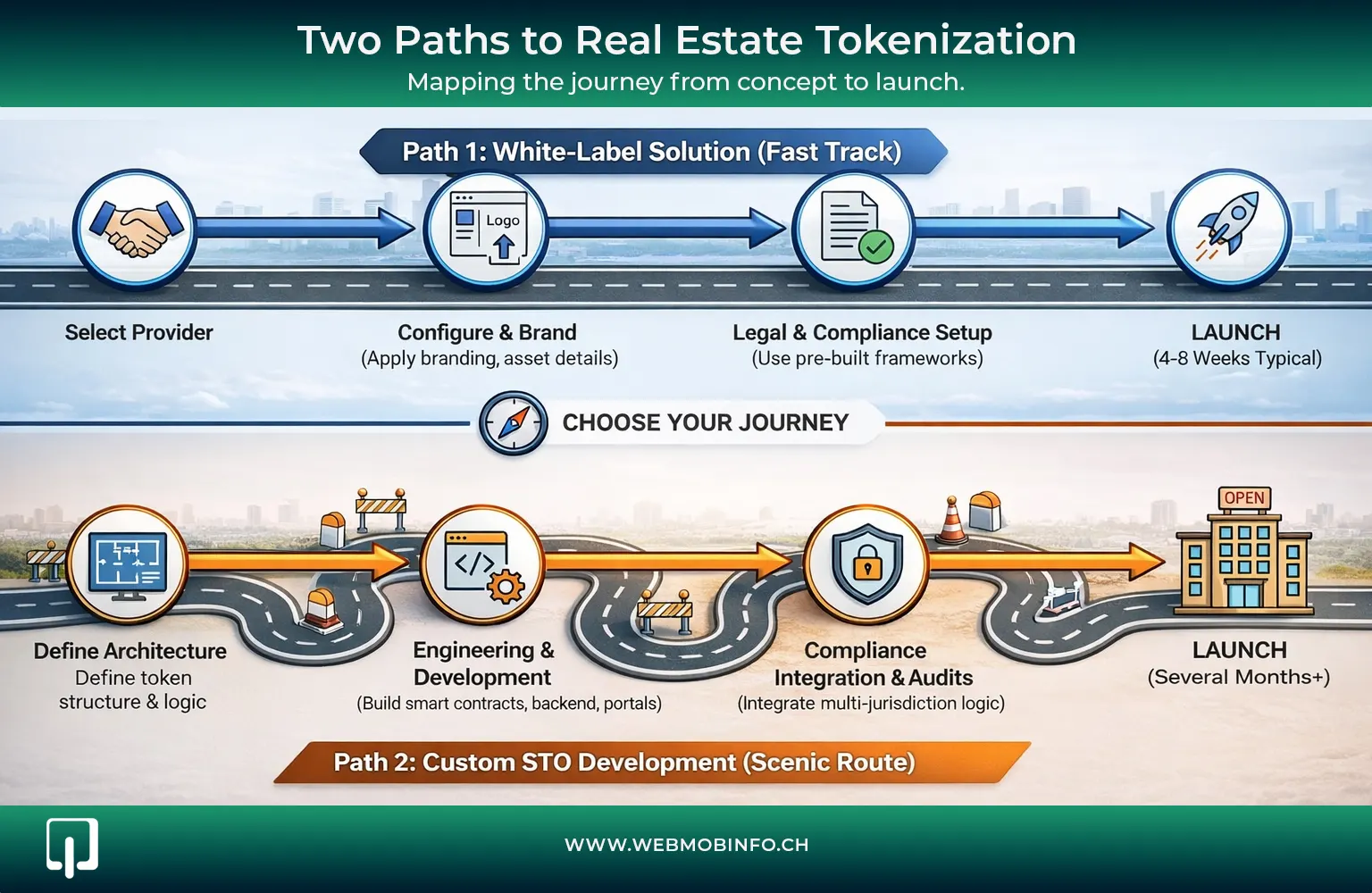
White-label platforms enable fast launches. Most infrastructure is already in place. Custom builds require extended planning, development, and testing.
White-label platforms involve lower upfront costs. Licensing fees are predictable. Custom development requires a higher initial investment due to engineering, audits, and integration work.
White-label platforms allow surface-level adjustments such as branding and configuration. Custom builds support big functional changes at the protocol and application level.
The scalability of white-label tokenization depends on the provider's platform limits. Custom systems scale according to the fund’s chosen infrastructure and growth plans.
White-label platforms include standard compliance modules. Custom systems allow detailed regulatory logic across multiple jurisdictions.
White-label solutions involve shared ownership of core technology. Custom platforms grant full control over intellectual property.
White-label platforms are well-suited for quick launches and test funds. Custom builds suit institutional and multi-region funds with complex requirements.
Funds often underestimate how these factors interact. Speed may reduce flexibility. Control may increase cost. The right choice depends on priorities, not trends.
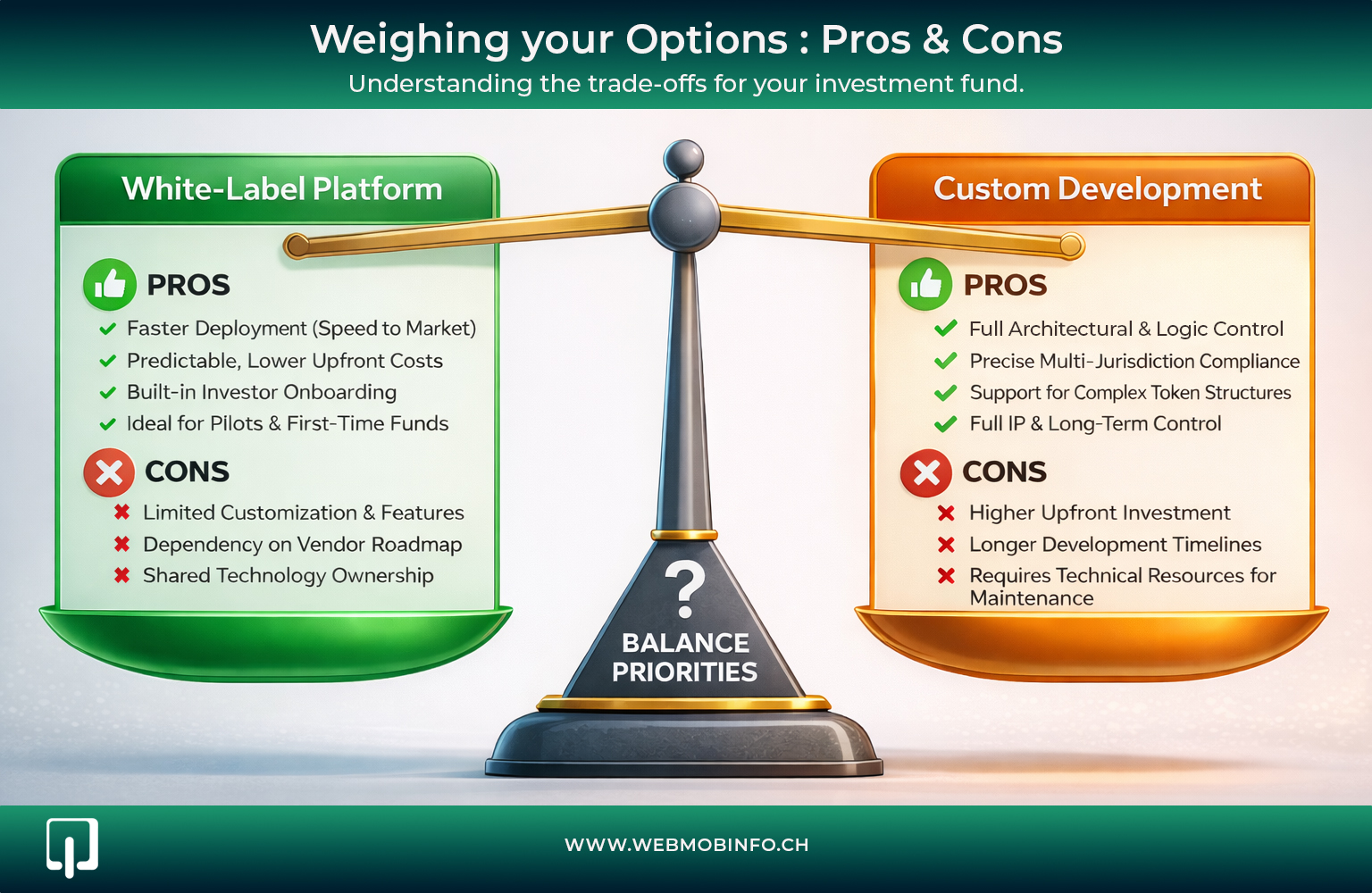
White-label platforms offer faster deployment. This can be decisive when capital needs to be raised within tight windows. Costs remain predictable, which helps financial planning. Built-in investor onboarding simplifies operations, especially for funds without dedicated compliance teams. Early-stage growth is supported without heavy technical oversight.
Customization remains limited. Funds must work within predefined structures. Feature updates depend on the vendor’s roadmap. Over time, this dependency can restrict strategic options if the fund’s model changes.
Custom development provides full architectural control. Compliance logic can be designed to meet strict regulatory standards across regions. Token structures can reflect sophisticated financial instruments. Institutional investors often prefer this clarity and precision.
Costs are higher. Development timelines are longer. Ongoing maintenance requires internal or external technical resources. This approach demands commitment beyond the initial launch.
Understanding these trade-offs helps leadership teams set realistic expectations before committing resources.
There is no universal answer. The right approach depends on fund maturity, investment strategy, and regulatory exposure.
.webp)
A white-label real estate tokenization platform is appropriate when speed matters. Funds exploring tokenization for the first time often benefit from reduced technical complexity. If the objective is to validate investor interest or launch a limited offering, white-label systems minimize risk. Pre-built compliance frameworks also help teams without in-house legal engineering expertise.
Custom real estate STO development makes sense for funds targeting institutional capital. Complex token logic, such as blended debt and equity structures, requires precise control. Funds operating across jurisdictions benefit from custom compliance handling. Long-term strategies often justify higher upfront investment.
Decision-makers should assess not only current needs but expected growth. A system that fits today may constrain tomorrow.
Timeframes differ significantly. White-label platforms often enable launches within four to eight weeks, depending on asset readiness and legal approvals. Custom builds can take several months, sometimes longer when regulatory reviews are involved.
Budget structures also differ. White-label solutions rely on licensing, setup fees, and ongoing platform costs. Custom builds concentrate expenses upfront, with maintenance and updates following.
Some funds adopt a phased approach. They begin with a white-label platform, then transition to custom development as operations mature. This approach balances early speed with future control, though migration planning becomes critical.
Several property-focused funds have launched tokenized offerings using white-label platforms to gauge demand for fractional investments. These projects often emphasize simplified onboarding and faster capital deployment.
In contrast, larger funds with international investor bases have invested in custom platforms. These systems support advanced reporting, jurisdiction-specific restrictions, and integration with traditional fund administration tools.
Across both paths, outcomes improve when experienced legal and technical partners support real estate tokenization services. Platform choice alone does not guarantee success. Execution matters.
Real estate tokenization has moved from concept to execution for funds seeking better access, transparency, and operational efficiency. As outlined in this blog, the choice between a White-label real estate tokenization platform and Custom real estate STO development depends on how quickly you want to enter the market and how much control your fund requires. A white-label solution offers speed and structure, while custom development supports complex investment models, regulatory depth, and long-term ownership. Evaluating factors such as compliance needs, future expansion, and the Scalability of white-label tokenization is essential before committing to either path.
At Webmob Software Solutions, we are recognized as a reliable asset tokenization development company, providing secure, compliant real estate tokenization services to funds and enterprises. From advising on the right White-Label Tokenization Platform to delivering a full Real estate tokenization platform, we help clients choose solutions that align with their real business goals. As an experienced RWA tokenization software company, we focus on clarity, compliance, and execution rather than one-size-fits-all offerings.
If you are exploring a white-label real estate tokenization platform, planning Custom real estate STO development, or evaluating the Best real estate tokenization software for developers, connect with our experts today.

It is a pre-built system that allows funds to launch tokenized real estate offerings using existing infrastructure with configurable features.
Custom development builds the platform from scratch based on specific legal, financial, and operational requirements.
Institutional funds often prefer custom development due to regulatory complexity and control requirements.
They can be, but limitations may appear as fund strategies grow more complex.
White-label platforms have lower upfront costs. Custom builds require a higher initial investment but offer greater control.

Let’s discuss and plan how we can accelerate your growth. Fill out this form and take the first step towards constant advancement.

We will respond to you within 24 hours.
Access to dedicated product specialists.




.png)