Saudi Arabia is rewriting how property changes hands. Between 2025 and early 2026, the Kingdom has moved from paper-based real estate ownership to a national blockchain-backed registry that natively supports fractional and tokenized property interests. For developers, investors, and platform operators, this shift creates a dual challenge: meeting strict legal requirements for fractional ownership in Saudi Arabia while building the technical infrastructure to support real estate tokenization in Riyadh.
This article breaks down both sides of that equation. Whether you are looking to build a fractional real estate platform in KSA or invest through one, understanding the regulatory architecture and the technology stack is non-negotiable.
Fractional ownership of real estate in Saudi Arabia is not a new concept. Saudi law has long recognized collective investment in property through “real-estate contributions” and other shared-ownership structures, governed by specific implementing regulations under the Real Estate General Authority (REGA).
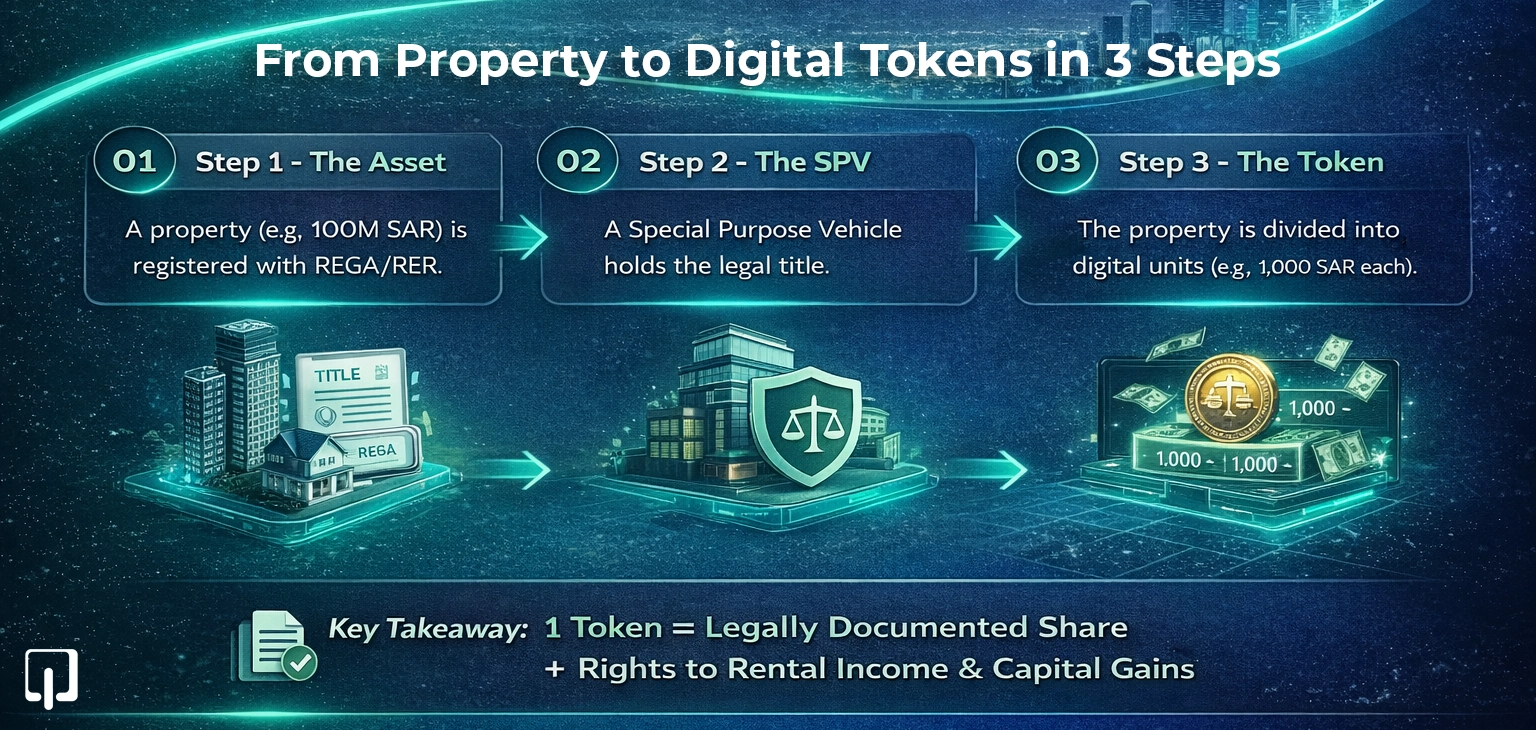
What has changed is the delivery mechanism. Tokenized fractional ownership replaces paper or conventional electronic records with blockchain-based tokens. In most implementations, a special-purpose vehicle (SPV) holds legal title to the property, and tokens represent pro-rata interests in that SPV, including rights to rental income and sale proceeds.
In an illustrative example used by Saudi commentators, a property valued at 100 million SAR is divided into 100,000 digital units, each worth 1,000 SAR. Holding a single token represents legally documented fractional ownership and entitlement to the corresponding share of rental income and capital gains on sale. The national platform allows such tokens to be bought and sold via authorized marketplaces, with transfers recorded directly in the registry’s blockchain layer.
This is one of the most frequently asked questions in the Saudi real estate tokenization space, and the answer carries significant legal weight.
REGA and the Real Estate Registry (RER) describe tokenized property interests as digital deeds anchored in the national registry. The registry serves as the “single source of truth,” and no token may be issued unless there is a corresponding real, registered title deed (or fractional title) in the official system.
For a tokenized fractional property, proof of ownership shifts from a paper or static electronic deed to an encrypted digital deed (the token) that is legally linked to the registry record for a specific share in the property. According to REGA, buying real-estate shares via a compliant tokenization platform confers on the investor the same legal rights as traditional deed ownership, enforceable under Saudi property law and the digital registry framework.
The regulatory architecture governing fractional ownership real estate in Riyadh is built on multiple pillars. Here is how they interact:
· REGA oversees sector regulation and operates the regulatory sandbox for digital real-estate models.
· The Real Estate Registry (RER) operates the national register and, since 2025–2026, the blockchain-enabled digital infrastructure for property tokenization and ownership transfer.
· Official announcements describe this as the world’s first national-scale real-estate tokenization infrastructure, with RER acting as the qualified digital property register.
· Nine technology firms have been approved to tokenize real estate and sell digital shares within REGA’s sandbox.
· At least one platform (Ghanem) has launched regulated fractional ownership for Saudi investors, fully integrated with the Real Estate Registry.
· In November 2025, REGA and RER announced completion of the first official real-estate tokenization under their regulatory umbrella, including the first sovereign-native tokenised title deed transfer executed under national property laws.
· Legal practitioners report that Saudi Arabia plans to issue formal regulations for real-estate tokenization by around June 2026, as announced at the Real Estate Future Forum.
· Until those regulations are issued, platforms function under sandbox rules, existing real-estate law, and capital-market and tax frameworks.
A platform seeking to tokenize and fractionalize Riyadh real estate in 2025–2026 must align with four main legal pillars:

· Operators must integrate directly with the Real Estate Registry.
· Each fractional share must be recorded in the official system.
· Platforms must meet standards for governance, transparency, and investor protection.
· Where token offerings resemble public securities or collective investment schemes, the Capital Market Authority (CMA) may require additional oversight.
· Detailed classification rules for tokenized real-estate instruments are still being refined.
· Platforms must analyze whether token transfers trigger Real Estate Transaction Tax (RETT) at 5%.
· VAT and Zakat treatment depends on the token structure and investor profile.
· Properties must lie within authorized foreign-ownership zones.
· Aggregate foreign holdings across all tokens must not exceed regulatory caps.
· REGA approvals must cover the structure.
Tax treatment is one of the most complex areas of fractional property investment in Riyadh. Here is what platform operators and investors need to understand:
· RETT (5%): Generally triggered by the transfer of ownership in real property. A central question is whether the taxable event occurs at the level of token transfers or at the level of the underlying real-estate interest being represented.
· Zakat: For Saudi investors, the treatment depends on whether tokens are held as trading assets (included in the Zakat base at fair market value) or as long-term investment property (focus shifts to income generated rather than principal value).
· VAT: Outcomes depend on whether the token is considered a financial instrument (potentially VAT-exempt) or a direct transfer of real-estate interests (potentially subject to VAT in addition to RETT).
· Cross-Border Investors: Non-Saudi investors face corporate income tax or withholding tax on Saudi-sourced income, adding further layers of complexity.
Advisors strongly recommend maintaining robust documentation of token issuance, ownership history, valuation, and cash flows, and seeking private clarification from ZATCA where appropriate.
Understanding the difference between REITs and tokenized fractional ownership is essential for investors evaluating fractional real estate investment options in Saudi Arabia.
From a compliance standpoint, REITs benefit from a mature, well-defined CMA framework and exchange-level disclosure rules. Tokenized fractional models sit in a newer regime where core principles are clear but detailed product classifications and secondary-market rules are still being refined.
Saudi Arabia approved a landmark Law of Real Estate Ownership by Non-Saudis in July 2025, which entered into force on 22 January 2026.
· Scope: Non-Saudi individuals and legal entities, whether resident or non-resident, can own or hold real-estate rights in designated zones across the Kingdom.
· Definition: “Non-Saudi” includes foreign individuals, foreign companies, funds, nonprofits, and certain Saudi companies with non-Saudi shareholders.
· Transfer Fee: REGA can levy a real-estate transfer fee on disposals by non-Saudis, capped at 5% of the property’s value.
· Zones: High-demand urban areas like parts of Riyadh and Jeddah are expected to feature among designated zones.
Neither the law nor public guidance carves out separate rules for tokenized or fractional property interests. However, REGA and RER explicitly describe the national tokenization infrastructure as a way to enable fractional and international investment into Saudi real estate. This suggests that compliant tokenized structures can be used by foreign investors, subject to foreign-ownership caps and approvals.
A compliance-ready fractional platform that wishes to onboard foreign non-resident investors must ensure that properties lie within authorized zones, aggregate foreign holdings do not exceed caps, and all AML/KYC checks are performed, leveraging Nafath for resident investors and equivalent checks for non-residents.
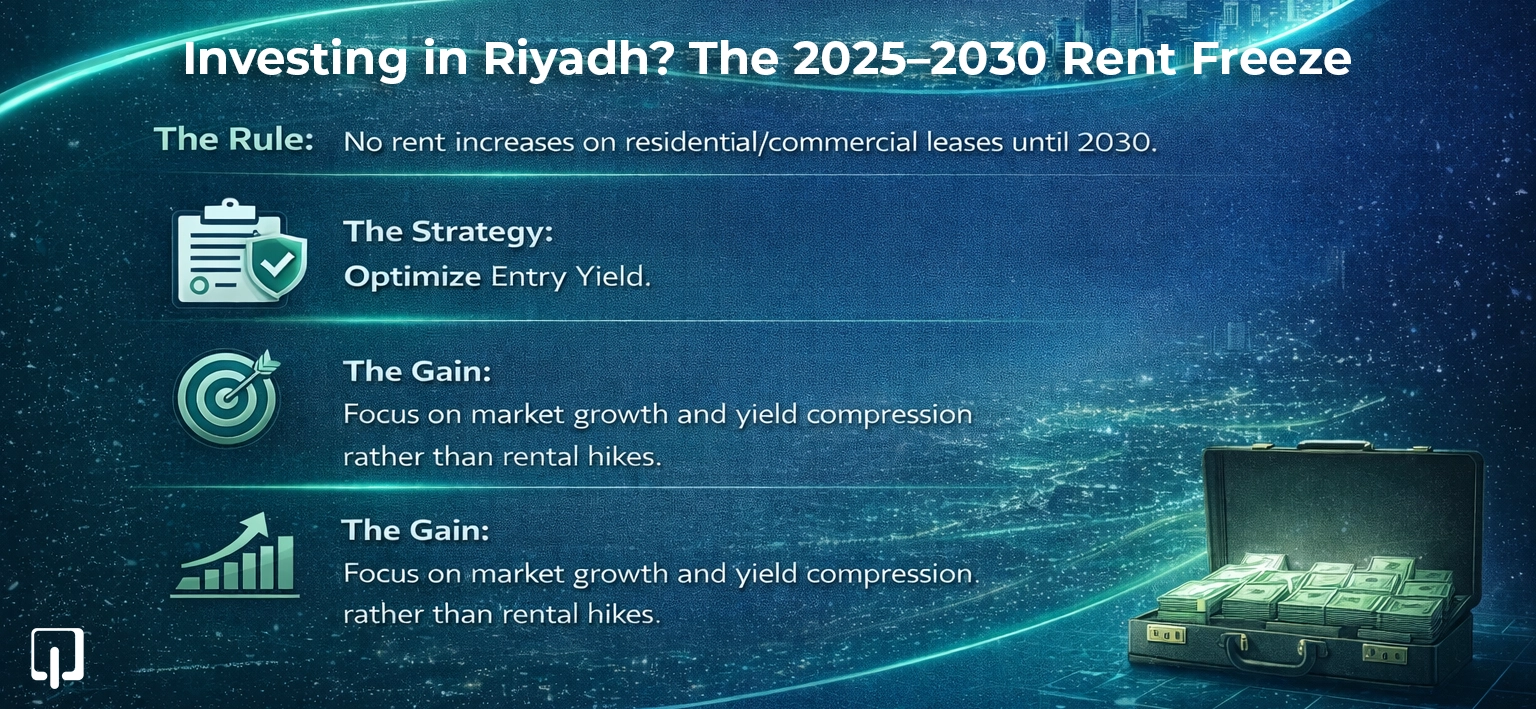
In late September 2025, Saudi Arabia introduced a five-year rent freeze covering residential and commercial properties within Riyadh’s urban boundary, prohibiting rent increases on both existing and new leases until 2030.
From a compliance standpoint, REITs benefit from a mature, well-defined CMA framework and exchange-level disclosure rules. Tokenized fractional models sit in a newer regime where core principles are clear but detailed product classifications and secondary-market rules are still being refined.
Saudi Arabia approved a landmark Law of Real Estate Ownership by Non-Saudis in July 2025, which entered into force on 22 January 2026.
· Scope: Non-Saudi individuals and legal entities, whether resident or non-resident, can own or hold real-estate rights in designated zones across the Kingdom.
· Definition: “Non-Saudi” includes foreign individuals, foreign companies, funds, nonprofits, and certain Saudi companies with non-Saudi shareholders.
· Transfer Fee: REGA can levy a real-estate transfer fee on disposals by non-Saudis, capped at 5% of the property’s value.
· Zones: High-demand urban areas like parts of Riyadh and Jeddah are expected to feature among designated zones.
Neither the law nor public guidance carves out separate rules for tokenized or fractional property interests. However, REGA and RER explicitly describe the national tokenization infrastructure as a way to enable fractional and international investment into Saudi real estate. This suggests that compliant tokenized structures can be used by foreign investors, subject to foreign-ownership caps and approvals.
A compliance-ready fractional platform that wishes to onboard foreign non-resident investors must ensure that properties lie within authorized zones, aggregate foreign holdings do not exceed caps, and all AML/KYC checks are performed, leveraging Nafath for resident investors and equivalent checks for non-residents.
In late September 2025, Saudi Arabia introduced a five-year rent freeze covering residential and commercial properties within Riyadh’s urban boundary, prohibiting rent increases on both existing and new leases until 2030.
· Yield Dynamics: Investors can no longer rely on systematic rental growth for returns over the five-year horizon and must instead optimize entry yield.
· Lease Pricing: If a unit has been rented before, any new lease must match the last registered lease value. New units can be rented at freely agreed prices for their first lease.
· Ejar Integration: Leases must be registered on the national Ejar platform, making integration with Ejar operationally important for verifying lease terms.
· Capital Gains: Capital gains may still arise from yield compression and broader market growth, but stable nominal rents cap the direct rental-growth component.
For platform operators, this translates into a need to adapt disclosures, risk factors, and financial modeling tools. Smart-contract logic (such as rental indexation clauses) must be aligned with the legal reality of frozen rents to avoid mis-selling risks.
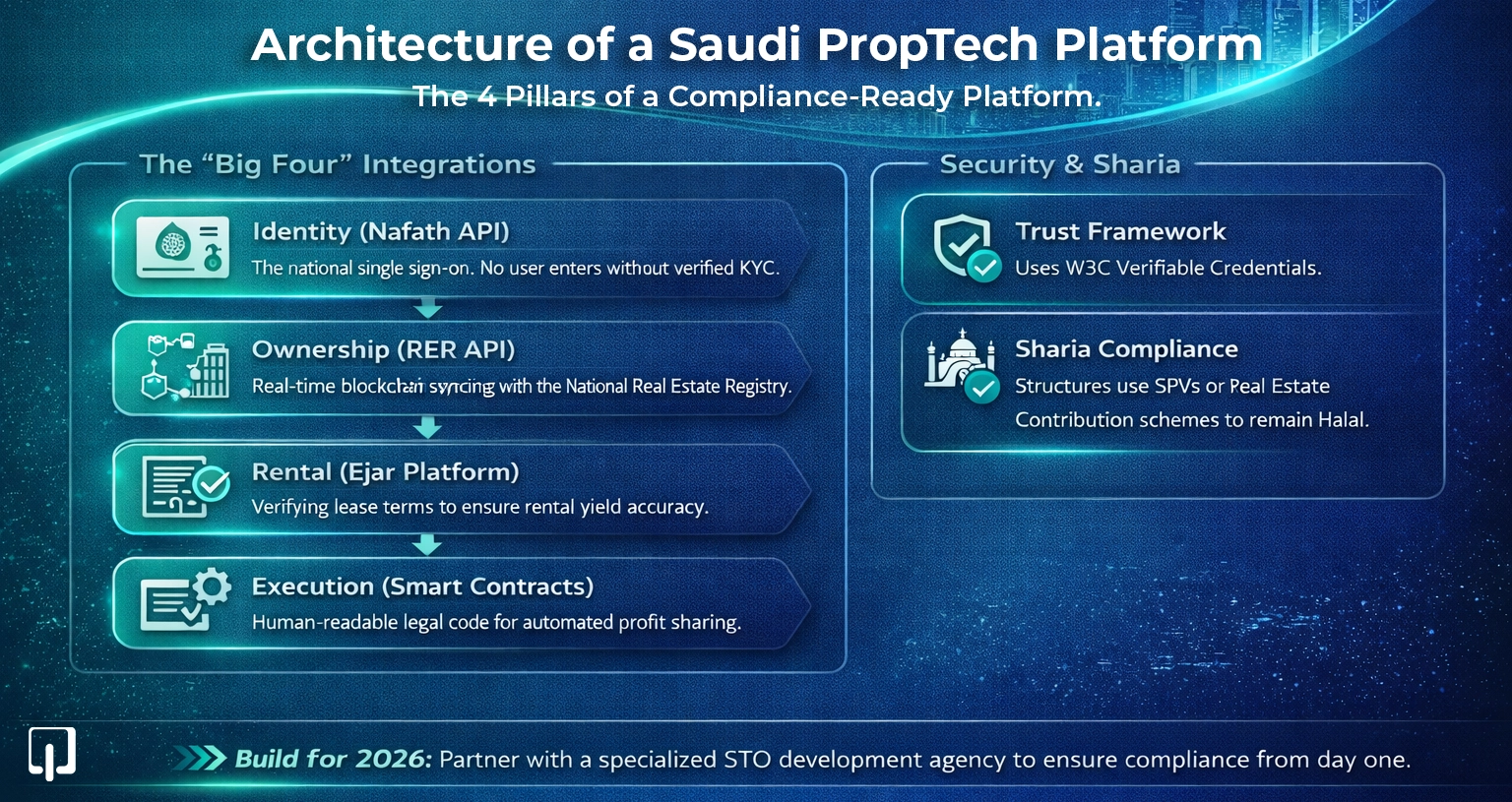
Building a Saudi Arabia real estate tokenization platform requires integration with multiple national systems. Here is what the technical architecture must include. For a detailed breakdown of platform costs, see our guide on cost to build a real estate tokenization platform.
· Real Estate Registry API: Direct connectivity for title verification and token anchoring. Every digital token must be anchored to a real property record in the national registry. For integration details, see our guide on how to integrate with Saudi Arabia’s Real Estate Registry.
· Nafath API Integration: The national single sign-on system for verifying investor identities (KYC). Nafath API integration services are critical for compliance-ready platforms.
· Ejar Platform: Integration for digital lease registration and verification of rental terms on income-generating properties.
· Smart Contract Layer: Automates token issuance, transfer, and income distribution. Must operate within Saudi contract and property law. For technical details on building this layer, see our smart contract development services.
Public sources do not fixate on a specific public blockchain brand. Instead, the emphasis is on a government-operated, standards-compliant infrastructure where legal enforceability is anchored in national law. The system uses standards such as W3C Verifiable Credentials and eIDAS-style trust frameworks.
Sandbox participants may deploy their own blockchain components, but to be compliance-ready they must sync ownership and transaction records with the national registry’s environment.
· Open API layer for PropTechs, banks, and developers to integrate services like tokenized lending, digital escrow, and cross-border property transactions.
· Secure custody of tokens linked to legal title.
· Detailed audit trails matching on-chain events to off-chain legal and tax records.
· Human-readable legal documentation that matches the behavior coded into smart contracts.
For businesses looking to build a fractional real estate platform in KSA or develop a white-label fractional ownership software solution, partnering with an experienced real estate tokenization development agency like Webmob Software Solutions ensures that both the regulatory integration and blockchain infrastructure are handled from
day one. With expertise in STO platform development for real estate Saudi Arabia, web3 real estate development, and Nafath API integration services, Webmob provides end-to-end fractional ownership platform development services that align with REGA tokenization standards 2026.
The national infrastructure is explicitly described as leveraging existing Sharia-compliant fractional ownership models, integrating them into a digital registry that supports tokenized structures while maintaining adherence to Islamic finance principles.
However, Sharia compliance is not automatic. Structures must be reviewed and certified by appropriate Sharia boards. Regulators have deliberately aligned tokenization frameworks with familiar Sharia-compliant asset types, such as income-generating real estate held through SPVs or contribution schemes.
Tax and Zakat analyses treat tokenized real-estate holdings within the established framework of Sharia-based Zakat obligations, distinguishing between trading and long-term investment positions.
REITs are CMA-regulated investment funds traded on Tadawul, required to distribute at least 90% of net income annually. Fractional tokenized ownership involves direct or SPV-based property interests tokenized into digital shares under REGA/RER’s framework, traded on authorized tokenization platforms with no statutory income distribution requirement yet.
Yes, under the Law of Real Estate Ownership by Non-Saudis (effective 22 January 2026), non-Saudi individuals and entities can own property in designated zones. REGA and RER describe tokenization as a channel for international investment, subject to foreign-ownership caps, zone restrictions, and KYC checks.
The freeze prohibits rent increases on existing and new leases until 2030. Fractional investors must optimize entry yield at acquisition since projected rental escalations should be modeled conservatively or set to zero for affected contracts. Capital gains from yield compression and market growth remain possible.
Operators need REGA/RER sandbox approval and registry integration, potential CMA licensing if tokens resemble securities, ZATCA registration for RETT/VAT/Zakat compliance, and foreign-ownership controls where applicable. Governance, transparency, and investor protection standards must be met.
Smart contracts serve as an execution layer within the national blockchain registry. Legal enforceability flows from the registry and governing legislation. Compliant platforms must ensure human-readable legal documentation matches the behavior coded into smart contracts.
Public sources do not specify a single public blockchain brand. The infrastructure is a government-operated, standards-compliant platform using W3C Verifiable Credentials and eIDAS-style trust frameworks, with legal enforceability anchored in national law.
Token prices are commercially set rather than fixed by statute. Examples show entry points as low as 1,000 SAR per token, with some platforms allowing investors to become partners from around 5,000 SAR by purchasing multiple tokens.
REGA and the Real Estate Registry are the primary regulators, operating the sandbox and tokenization framework. The CMA may be involved if tokens qualify as securities or fund units.
Yes. REGA’s sandbox approvals are required, and operators must integrate directly with the Real Estate Registry. Where offerings resemble collective investment schemes, CMA licensing may also be triggered.
Formal regulations are expected by around June 2026. Current standards require sandbox participation, registry integration, governance compliance, and investor
protection measures. Platforms must ensure each token corresponds to a properly registered title deed.
Fractional ownership of real estate in Riyadh sits at the intersection of a maturing regulatory framework and a rapidly developing technical infrastructure. With REGA and RER operating the world’s first national-scale real estate tokenization system, the Kingdom has laid the groundwork for a regulated, Sharia-compliant model of property co-ownership. However, both legal and technical requirements remain demanding.
From ZATCA tax compliance and CMA classification to Real Estate Registry API integration and Nafath-based KYC, building a compliant platform requires deep expertise across regulation, blockchain, and Saudi property law. For businesses seeking to enter this market, working with an experienced fractional ownership platform development partner like Webmob Software Solutions can bridge the gap between regulatory complexity and technical execution, ensuring your platform is built for compliance from day one.

Let’s discuss and plan how we can accelerate your growth. Fill out this form and take the first step towards constant advancement.

We will respond to you within 24 hours.
Access to dedicated product specialists.