What if you could own a piece of a Manhattan high-rise for the price of a coffee machine? That’s the promise driving asset tokenization.
Asset tokenization refers to converting ownership rights of physical or financial assets into digital tokens on a blockchain, unlocking benefits such as fractional ownership, enhanced liquidity, and automated compliance. (rwa.io)
As demand grows, the need to select the right asset tokenization platform development company becomes paramount to build secure, compliant, and scalable platforms that serve investors globally.
This blog provides an in-depth look at some of the top asset tokenization platform development companies, explores asset tokenization platform development services, and offers guidance on how to choose an asset tokenization platform development company for your business.
Asset tokenization is a technological process where ownership rights of an asset, such as real estate, funds, bonds, art, or commodities, are converted into digital tokens recorded on a blockchain. These digital tokens can represent a fractional share of an asset and are tradable or transferable with secure, transparent records. (rwa.io)
This approach facilitates:
· Fractional ownership, making costly assets accessible to more investors
· Improved liquidity, enabling secondary trading markets
· Automated compliance, integrating KYC/AML checks into issuance logic
· Global access, bypassing geographical investment barriers
Modern enterprises view asset tokenization development as a strategic move to modernize asset management and to unlock new capital flows and investment ecosystems. For enterprises seeking to build such infrastructure, partnering with the right development agency is the first critical step.
Before we dive into the list of companies, it’s useful to understand what asset tokenization platform development services typically include:
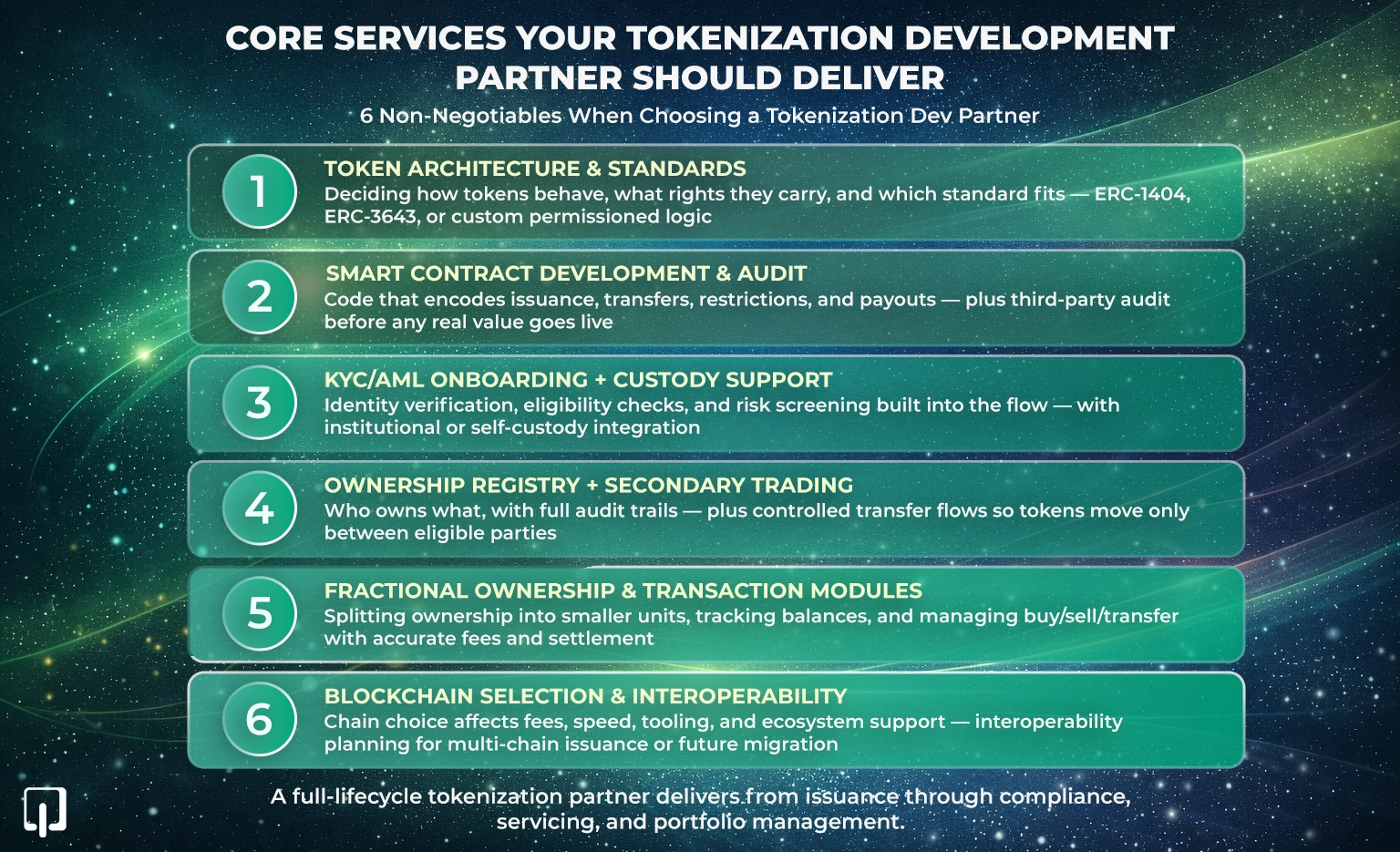
This is where the team decides how tokens behave, what rights they represent, and which standard fits the asset and compliance model. Standards like ERC-1404/ ERC-3643 are commonly used when you need permissioning and transfer rules, not just basic transfers like ERC-20.
Smart contracts encode issuance, transfers, restrictions, and payouts so the platform runs consistently without manual intervention. Audits review that code for security issues and logic flaws before real value is issued and traded. Learn more about the process in our guide on smart contract development.
The platform needs onboarding flows that verify identity, eligibility, and risk checks before someone can buy or hold tokens. Custody integrations ensure assets can be held securely (self-custody or institutional custody) and align with compliance requirements.
You need a reliable record of who owns what, with audit trails for reporting and disputes. Secondary trading needs controlled transfer flows (and sometimes approvals) so tokens can move between eligible parties without breaking rules.
These modules handle splitting ownership into smaller units, tracking fractional balances, and managing buy/sell/transfer activity. They also support the transaction logic that keeps balances, fees, and settlement states accurate.
Chain choice affects fees, speed, tooling, ecosystem support, and how easily the platform integrates with exchanges, wallets, and custodians. Interoperability planning matters when you expect multi-chain issuance, bridging, or future migration.
A robust real-world asset tokenization platform development company will be able to deliver a full lifecycle tokenization solution. One that extends from issuance to ongoing asset servicing, compliance, and portfolio management.
Knowing what services a vendor offers is useful, but buyers also need clarity on what the final platform should actually do once it goes live. This is where many tokenization projects fall short. A company may offer smart contract development and dashboard design, but the delivered platform may still lack the operational controls required for long-term use.
A production-ready platform should support the full asset lifecycle, not just token issuance. That includes issuer-side controls, investor-side workflows, and backend compliance visibility.
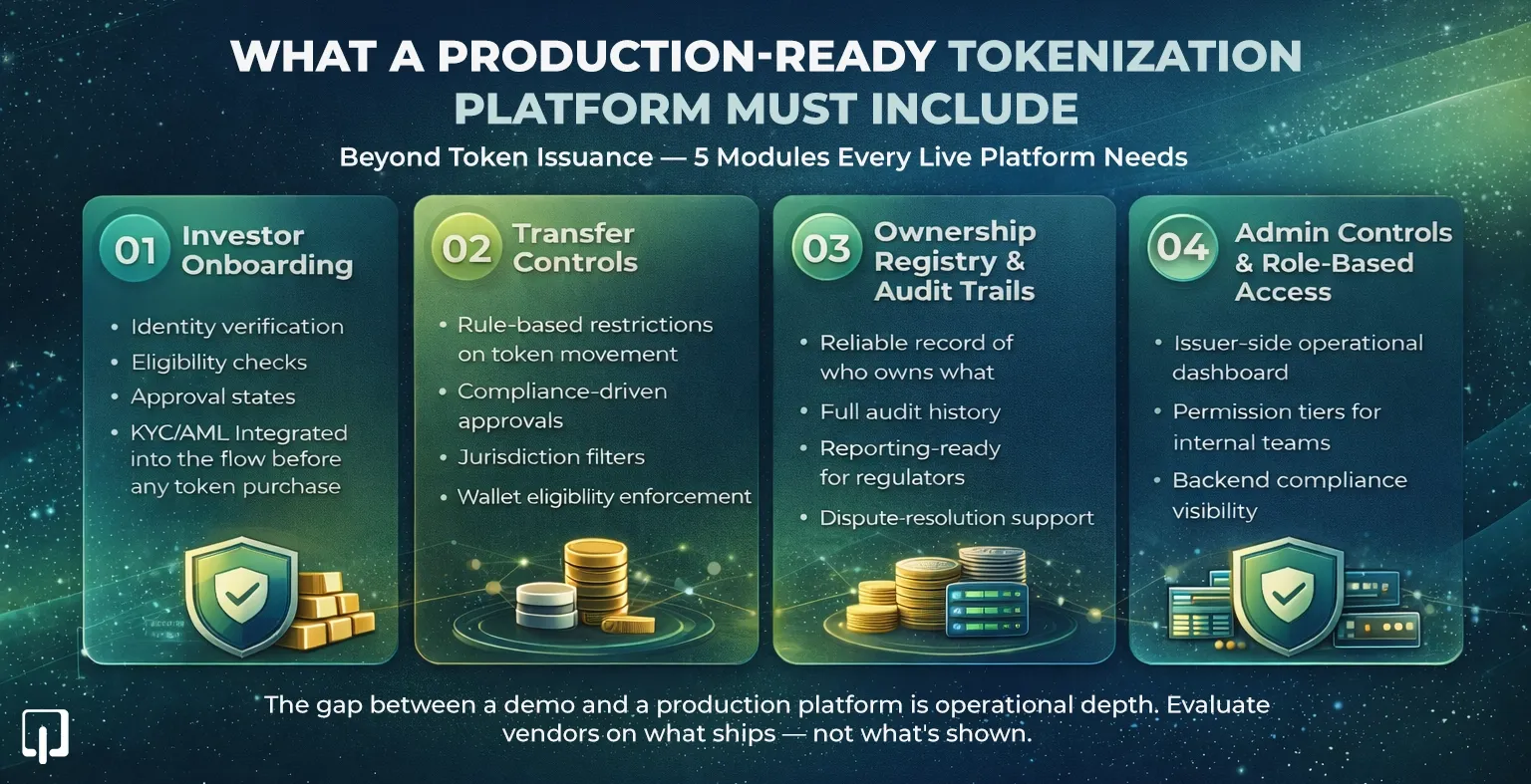
At a minimum, decision-makers should verify whether the platform supports:
· Investor onboarding workflows with identity verification, eligibility checks, and approval states
· Transfer controls to restrict token movement based on compliance rules
· Ownership registry and audit trails for reporting, reconciliation, and investor records
· Distribution and payout workflows for income-sharing or periodic returns
· Admin controls and role-based access so internal teams can operate the platform securely
This section adds value because it shifts the conversation from “Who can build it?” to “What must be built correctly?” That distinction helps readers evaluate vendors more practically and reduces the risk of choosing a development partner based only on front-end demos or marketing claims.
Tokenized assets have crossed the tipping point. What started as a blockchain experiment now drives real capital flows across trillion-dollar markets. In 2026, tokenization is being adopted by both traditional financial institutions and innovative tech-first firms:
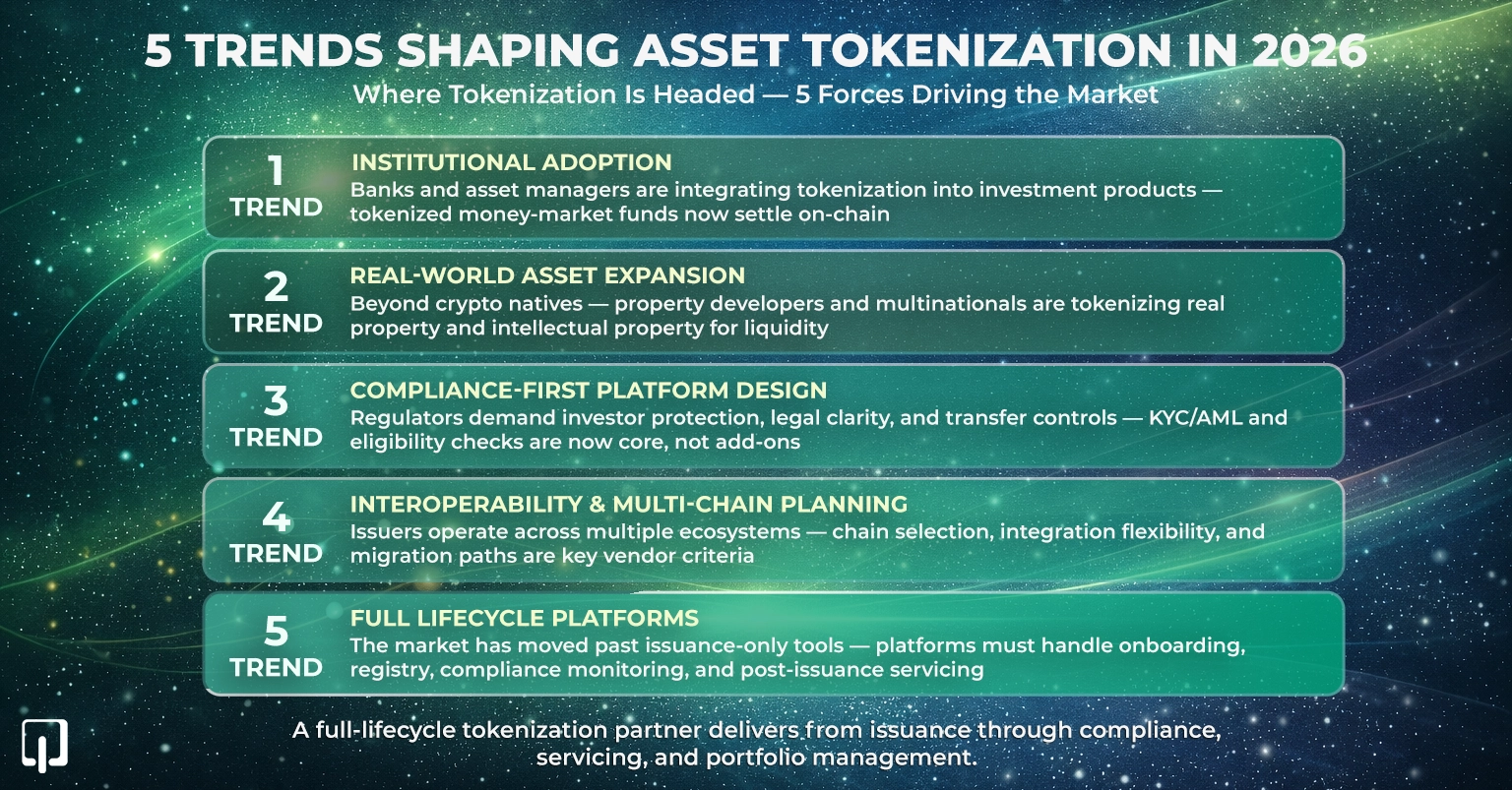
Banks and asset managers are integrating tokenization into investment products. For example, major players have launched tokenized versions of money-market funds that settle on blockchain networks, reflecting deepening institutional interest in digital asset models.
Tokenization now reaches well past blockchain natives. Property developers and multinational firms are exploring how tokenized ownership models can unlock liquidity for real property and intellectual property alike. (Reuters)
As tokenization enters regulated markets, compliance is becoming a core platform requirement instead of a later add-on. Regulators and market bodies are placing stronger emphasis on investor protection, legal clarity, and transfer controls, which is pushing issuers to prefer platforms with built-in KYC/AML, eligibility checks, and audit-ready workflows.
Tokenization activity is growing across multiple blockchain networks, which is increasing the need for interoperability planning. As more issuers and platforms operate across different ecosystems, businesses are paying closer attention to chain selection, integration flexibility, and future migration paths when choosing a development partner.
The market is moving beyond issuance-only tools toward platforms that support the full asset lifecycle. Businesses increasingly expect tokenization platforms to handle investor onboarding, ownership registry, compliance monitoring, and post-issuance servicing alongside token creation.
Below is a curated list of leading companies recognized for their contributions to tokenization platform development.
These companies provide diverse solutions, from consulting and platform builds to full-stack issuance and operational infrastructure. All names below have publicly verifiable offerings and services.
Best for: Production-ready asset tokenization platforms
Webmob Software Solutions provides asset tokenization platform development focused on real-world execution, including tokenizing assets like bonds, invoices, and private equity, with support for fractional ownership and compliance-oriented builds.
What sets Webmob apart:
· Platform development for real-world asset tokenization (not only smart contracts)
· Public portfolio examples tied to tokenization platform work
· Coverage that emphasizes end-to-end tokenization platform delivery and operational usability
Ideal for enterprises seeking structured asset tokenization platform development with real-world asset scope and production-focused implementation.
Best for: Compliant issuance, management, and trading infrastructure for tokenized securities
Securitize positions itself as a tokenization platform for compliant issuance and management of tokenized assets, and also operates regulated-market infrastructure through subsidiaries (broker-dealer, transfer agent, and an SEC-regulated ATS, per SEC filing).
Key features:
· Tokenization platform for issuance and lifecycle management
· Regulated-market infrastructure (ATS / broker-dealer / transfer agent) stated in SEC filing
· Focus on compliant digital securities workflows
Relevant for teams prioritizing regulated issuance + secondary market pathways.
Best for: Customized enterprise tokenization systems
SoluLab provides asset tokenization platform development services, including smart contract creation, multi-asset token frameworks, and investor dashboard modules. Its solutions are structured to support fractional ownership models and real-world asset integrations.
Core capabilities:
· Tokenization framework development
· Custom platform builds with compliance considerations
· Security-focused infrastructure implementation
Suitable for enterprises seeking structured asset tokenization development with configurable architecture.
Best for: Compliant token issuance and lifecycle management
Tokeny Solutions focuses on regulated token issuance and lifecycle controls within asset tokenization platform development. The company emphasizes compliance-first infrastructure and secondary market transfer restrictions.
Key features:
· Token issuance aligned with regulatory standards
· Investor onboarding and custody integrations
· Transfer control mechanisms for regulated markets
Often selected by firms prioritizing governance and compliance controls at issuance stage.
Best for: RWA tokenization builds and tokenization marketplaces
Blockchain App Factory offers real-world asset tokenization services covering asset tokenization, smart contracts, and tokenization platform development for multiple asset categories.
Core capabilities:
· RWA tokenization services across multiple asset types
· Tokenization platform development with compliance-focused positioning
· Smart contract-driven platform workflows and trading features
Suitable for teams looking to build tokenization platforms with issuance + marketplace components.
Best for: Enterprise tokenization tooling in the Ethereum ecosystem
ConsenSys provides tokenization and digital asset tooling through its Codefi/asset platform stack, designed for digitizing and managing financial products and related workflows.
Core capabilities:
· End-to-end digital asset management capabilities (Codefi Assets)
· Tooling designed for asset lifecycle workflows on blockchain networks
· Smart contract deployment support aligned with financial asset standards
Relevant for enterprise teams building tokenization programs with Ethereum-based infrastructure.
Best for: Real estate, art, and private equity tokenization
Antier delivers real-world asset tokenization platform development with modular architecture and white-label infrastructure. The company provides cross-chain compatibility and integrated compliance tooling within its tokenization frameworks.
Core capabilities:
· Pre-built tokenization modules
· Integrated KYC/AML and investor management systems
· Support across multiple real-world asset categories
Applicable for organizations requiring white-label tokenization infrastructure with modular deployment options.
Selecting the right company requires a clear understanding of your asset class, regulatory needs, and long-term strategy. Here’s what to consider:
Tokenizing real-world assets involves strict compliance with local and international regulations. Choose a provider that integrates KYC/AML, investor eligibility sets, and compliance audit trails directly into the solution.
A solid tokenization platform development should support evolving needs, whether fractional ownership, secondary trading, cross-chain operations, or interoperability with custodial services. Understanding how blockchain app development is evolving can help inform architecture decisions.
Different assets have different regulatory and structural requirements. Whether it’s real estate, bonds, funds, or commodities, work with a development partner who has domain understanding and project case studies in your asset class.
Ensure that the solution supports flexible governance so that future upgrades and compliance changes can be incorporated while preserving the existing platform architecture.
Your platform should support integration with wallets, custodians, and trust services, ensuring token ownership can be securely safeguarded for institutional and retail clients alike. For deeper context on wallet infrastructure, see our overview of cryptocurrency wallet development.
Digital transformation through tokenization is no longer experimental. With real-world financial markets increasingly embracing digital tokens, building a robust tokenization platform development solution is a strategic necessity for forward-looking enterprises.
Whether your goal is a security token offering platform development, fractional ownership tokenization platform, white-label tokenization provider solution, or a fully custom enterprise build, the partners listed above represent some of the best asset tokenization platform development company options available today.
By understanding your requirements and assessing each provider’s strengths, you can confidently forge a path to digital asset innovation and unlock new horizons in asset liquidity, accessibility, and investor engagement.
An asset tokenization platform is software that helps issuers create and manage digital tokens that represent ownership or rights in real-world or financial assets. It typically includes issuance tools, investor onboarding, ownership records, and transfer controls.
They integrate identity verification (KYC), screening (AML/sanctions), and eligibility checks into onboarding and transaction flows. Many platforms also apply rule-based transfer restrictions so tokens can only move between approved or eligible wallets.
Cost depends on scope (asset class, compliance depth, custody, secondary trading, integrations, and jurisdictions). A basic MVP is usually much cheaper than a full lifecycle platform with regulated transfer rules, custody connectors, and marketplace features.
An MVP can be built in a shorter cycle when it focuses on one asset type and limited features (issuance + onboarding + basic transfers). A full platform takes longer because it includes audits, deeper compliance workflows, custody/exchange integrations, and post-issuance servicing modules.
There isn’t one “best” chain—choice depends on regulatory model, costs, ecosystem support, tooling, and the partners you need (custody, wallets, exchanges). Ethereum is widely used and well-supported, while other networks can be selected for cost, performance, or enterprise requirements.
Often yes, especially when institutions are involved or when regulations require secure key management and controlled ownership processes. Some platforms support both self-custody and third-party custody so issuers can choose based on investor profile and jurisdiction.
Yes, platforms can include secondary trading modules, but the design usually depends on compliance rules and who is allowed to trade. In regulated setups, secondary transfers often require eligibility checks, transfer restrictions, and full audit trails.

Let’s discuss and plan how we can accelerate your growth. Fill out this form and take the first step towards constant advancement.

We will respond to you within 24 hours.
Access to dedicated product specialists.