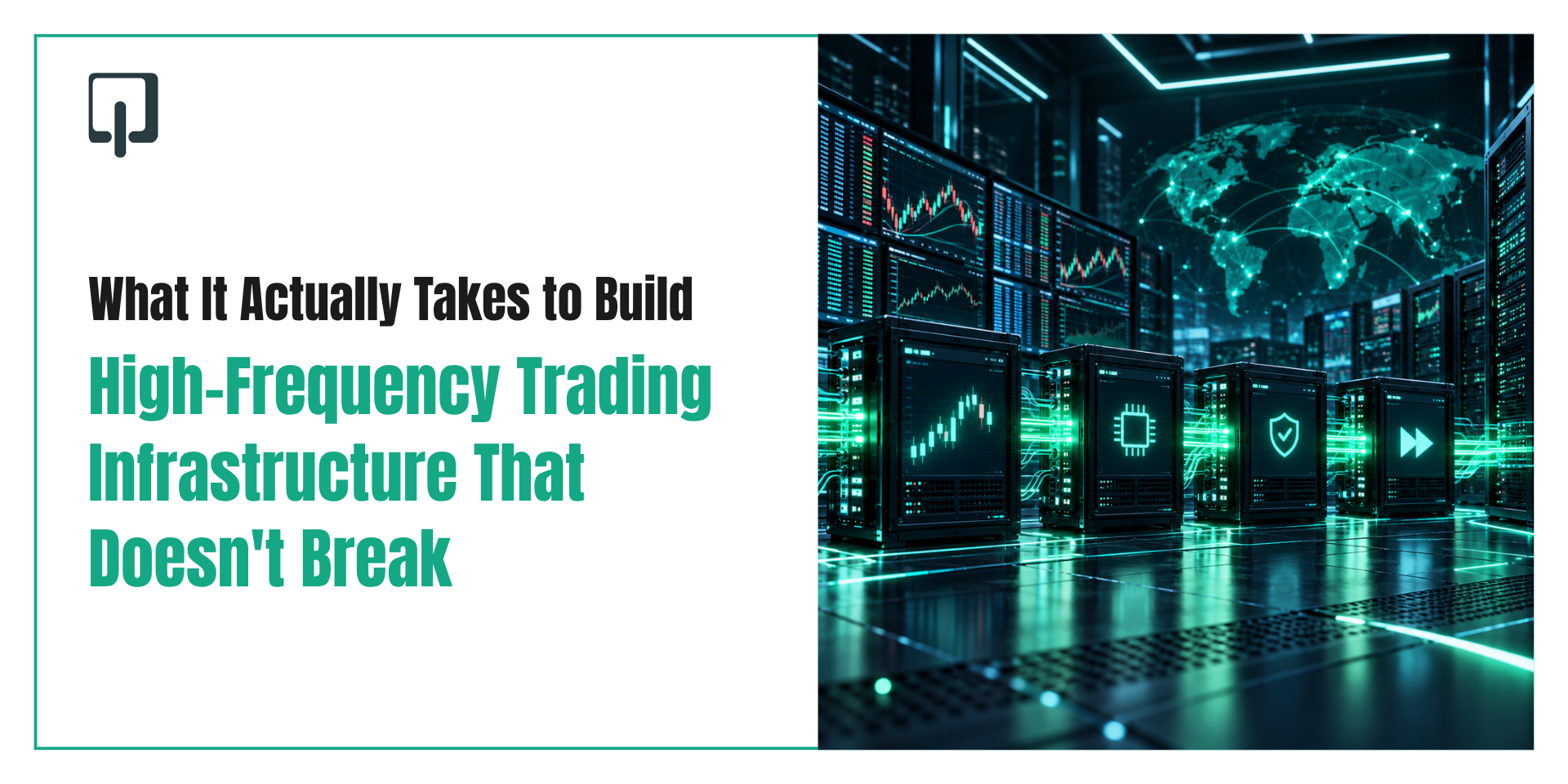
Market making provides liquidity to financial markets by continuously quoting buy and sell prices. The concept is straightforward, but running these strategies reliably requires a sophisticated technology infrastructure. A market-making platform needs to process high-frequency market data, calculate and update quotes, manage orders across multiple venues, track inventory and exposure, and enforce risk controls in real time.
In addition to monitoring prices across many venues, a market maker may also be managing inventories, monitoring exposure, updating quotes as the market moves, and responding to orders. What appeared to be a profitable trade can become a loss due to a slight delay or a stale price.
This is why building a market-making system is not just about connecting to an exchange and sending orders. For teams who are working with Swiss financial markets, the infrastructure also needs to fit the firm's trading model, risk requirements, reporting needs, and the venues it operates on.
Here are some of the engineering lessons that matter when building this kind of system.
There is no single market-making architecture that works for every firm. A crypto market maker providing liquidity across several exchanges has different requirements from a firm quoting a smaller set of instruments on a regulated venue. Before choosing technologies, we need to understand how the strategy actually works.
For example:
These answers determine the infrastructure. A strategy that updates quotes every few seconds may not need the same architecture as one reacting to market changes in milliseconds. That sounds obvious, but building the technology first and trying to fit the strategy into it later can create unnecessary complexity.
A market maker cannot quote well using old information. The system needs a reliable stream of market data and needs to process it quickly for the strategy to work.
A typical flow might look like:
Exchange feed → market data handler → normalized order book → strategy → quote engine → order management → exchange
The difficult part is that different venues do not always provide data in exactly the same format. One exchange may send full order-book snapshots. Another may send incremental updates. The connection drops can leave the local order book out of sync.
The system therefore needs to know when its view of the market is no longer trustworthy. If the local book says an asset is trading at $100 but the latest valid exchange update is a few seconds old, continuing to quote as if nothing happened is a risk. Good market maker infrastructure development therefore starts with reliable market data handling, not just the trading algorithm.
A market maker is not simply trying to buy low and sell high. Suppose the strategy has accumulated too much of an asset. Continuing to offer aggressive buy quotes may increase the position further when the firm actually needs to reduce it. The quoting logic may therefore change based on inventory.
For example:
Inventory too high → reduce bid size / make offers more attractive
Inventory too low → reduce offer size / make bids more attractive
The exact logic depends on the strategy, but the principle is important: the quote engine needs to understand the firm's current exposure. This is also why the trading strategy and risk engine should not be treated as completely separate systems.
Sending an order is easy and knowing exactly what happened to that order is harder. An order might be:
Now imagine the strategy sends a cancel request, but the order gets filled before the cancellation reaches the exchange. The internal system cannot simply assume that the cancellation succeeded. It needs to process exchange events and maintain an accurate state of every order. This becomes even more important when quotes are being updated frequently.
A market making platform development project therefore needs a strong order management layer that can handle acknowledgements, fills, cancellations, retries, and unexpected exchange responses.
A market-making system needs more than a strategy that knows when to trade. It also needs to know when not to trade. Useful controls can include:
Consider a situation where a market-data feed becomes stale. The strategy may still calculate quotes from the last known price. If those quotes continue reaching the market, the firm could be trading against information that is no longer valid. A risk layer can detect the stale feed and stop or reduce quoting until valid data returns. This kind of defence mechanism is not an optional add-on. It needs to be part of the core architecture.
An exchange connection can look perfectly stable during testing and still behave differently in production. For example, a market-data connection may drop while the strategy is still running. The system now has an old view of the order book, but if it keeps quoting against that data, those quotes may already be wrong.
The same problem can happen with orders. A cancel request may be sent just before an order gets filled. When the response comes back, the platform needs to know whether the order was actually cancelled, partially filled, or filled before the cancellation reached the exchange. That means reconnecting is not simply a matter of opening the connection again.
A safer flow is:
Connection lost → protect quoting → reconnect → refresh market data → check open orders → confirm actual exchange state → resume
This recovery logic becomes even more important when a crypto market making software development project connects to several venues. Each exchange has different APIs, order types, limits, and response behaviour, so the platform needs to handle those differences without letting one venue's failure affect the entire trading operation.
A strategy can make a trading decision in a few milliseconds and still end up being slow. Say the strategy calculates a new quote in 2 milliseconds. That sounds fast, but the quote still has to pass through the risk checks, order management system, network, and exchange before anything happens in the market. If one of those steps takes another 40 or 50 milliseconds, the advantage of the fast strategy is largely lost. This is why we don't look at latency in one service alone. We look at the full path:
Market-data update → strategy decision → risk check → order creation → network → exchange → confirmation
That also makes performance problems easier to find. If a quote consistently takes too long to reach the exchange, the problem may not be in the strategy at all. It could be sitting in the order management layer, network connection, or exchange response. For a market-making system, measuring this complete path gives a much more useful picture of how quickly the platform actually reacts to the market.
When a market-making system loses money unexpectedly, “the service is running” is not a useful answer. The team needs to know:
A useful monitoring setup connects these events. A unique order or strategy identifier can help trace a trade across market data, strategy decisions, risk checks, order management, and exchange responses. This becomes especially valuable when investigating a loss after the fact.
Connecting one venue is very different from connecting five or ten. Each venue may have its own:
Instead of allowing every strategy to communicate with every venue differently, a better architecture usually introduces a common interface. The strategy can work with a normalized order and market-data model, while venue-specific adapters handle the differences underneath. That makes adding another venue much easier without rewriting the trading logic.
Crypto markets introduce additional infrastructure considerations. Markets operate around the clock, assets can trade across many venues, and prices can move sharply within short periods. A crypto market making platform therefore needs to handle continuous monitoring, rapid position changes, exchange connectivity, wallet or custody considerations, and stronger operational safeguards.
For example, if one exchange becomes unavailable while the strategy continues quoting elsewhere, the system needs to account for the resulting change in available liquidity and exposure.
The strategy should not continue operating as though all venues are healthy. That is where architecture, risk controls, and operations come together.
At WebMob, we approach market-making systems by looking at the complete trading flow rather than treating the strategy as the entire product. That means understanding:
For a market making software development company, the value is not simply in writing services that send orders. It is in building infrastructure that remains predictable when markets move quickly, connections fail, orders behave differently than expected, or risk limits are reached.
A market-making system is as strong as the infrastructure supporting the strategy. Fast market data is not enough if orders are poorly managed. A good quoting model is not enough if inventory risk is ignored. Multiple exchange connections are not useful if the system cannot recover when one goes down.
The better approach is to design the entire trading path together: market data, strategy, risk, execution, connectivity, and monitoring. For Swiss market makers and firms building digital-asset liquidity systems, the foundation matters just as much as the strategy itself.
When the infrastructure is designed around real trading conditions rather than ideal ones, the platform has a much better chance of staying reliable when the market does what markets usually do: move quickly and behave unexpectedly.
There is no single component that matters most. Market data, strategy, risk controls, order management, exchange connectivity, and monitoring need to work together. A weakness in one part can affect the entire trading flow.
The system should be able to detect the failure, protect or stop affected quoting, reconnect, resynchronize market data, and reconcile open orders before resuming normal activity. It should not simply assume that the local order state is still correct.
Not necessarily. The required latency depends on the strategy, instruments, venues, and competition. A strategy that updates quotes every few seconds has very different requirements from one reacting to millisecond-level market changes.
Market makers continuously place and cancel orders, so an error or stale data feed can result in unwanted exposure very quickly. Position limits, loss limits, price checks, rate limits, and kill switches provide ways to stop or restrict trading when conditions fall outside acceptable boundaries.
Crypto markets operate continuously and often involve multiple venues with different APIs, trading rules, liquidity, and operational behaviour. The infrastructure therefore needs strong venue connectivity, continuous monitoring, position management, and recovery mechanisms.
When the trading strategy depends on liquidity or pricing across multiple venues, multi-exchange support becomes important. The architecture should use a common trading interface with venue-specific adapters so that adding or changing an exchange does not require rewriting the core strategy.
Look beyond whether the team can connect to an exchange. Ask how they approach market-data handling, order state management, risk controls, latency, failure recovery, multi-venue connectivity, monitoring, and the specific requirements of the trading strategy.

Let’s discuss and plan how we can accelerate your growth. Fill out this form and take the first step towards constant advancement.

We will respond to you within 24 hours.
Access to dedicated product specialists.



.png)