


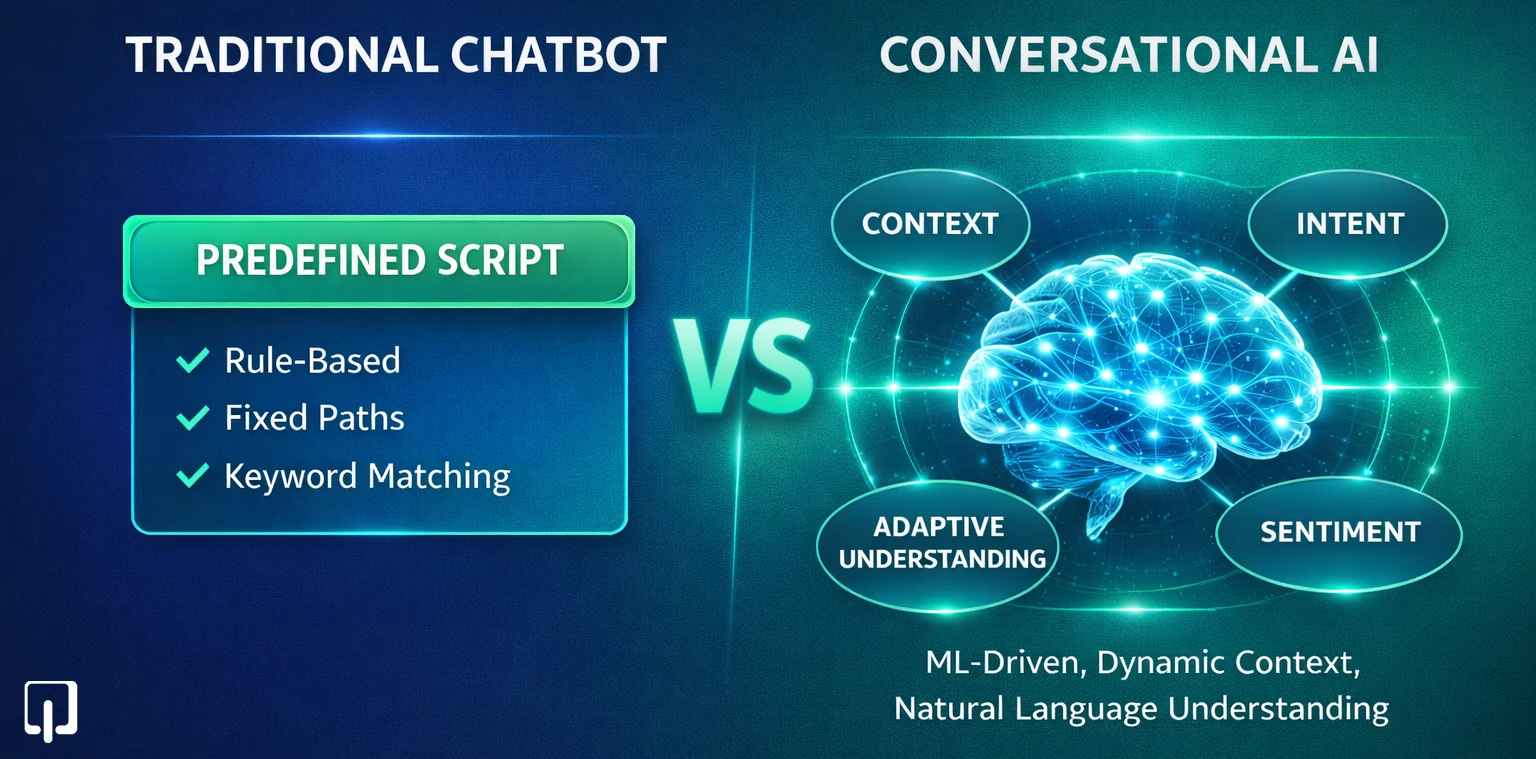
The debate around conversational AI vs chatbot solutions has intensified as businesses seek smarter ways to interact with customers. While many organizations use these terms interchangeably, the technologies operate on fundamentally different principles. Traditional chatbots follow rule-based systems with predefined scripts and keyword patterns, making them suitable for simple, repetitive tasks. Conversational AI, however, leverages natural language processing (NLP), natural language understanding (NLU), machine learning, and advanced dialogue management to create human-like conversations that adapt and learn in real-time.
The global chatbot market reached USD 7.76 billion in 2024 and is projected to grow to USD 27.29 billion by 2030, reflecting a compound annual growth rate of 23.3%. Meanwhile, the broader conversational AI market stands at USD 11.58 billion in 2024, with expectations to reach USD 41.39 billion by 2030 at a 23.7% CAGR. Consumer adoption has accelerated significantly, with 87.2% of users reporting positive or neutral experiences with chatbots, and 62% actively preferring bot interactions over waiting for human agents.
The most critical distinction in the chatbots vs conversational AI comparison lies in their underlying technology. Traditional chatbots operate on if-then-based rule systems and decision trees that require exact keyword matching. When a customer asks "Where is my package?" a rule-based bot executes perfectly. However, rephrasing the question as "My shipment hasn't arrived" or "Item not delivered" may confuse the system because it lacks semantic understanding.
Conversational AI systems utilize sophisticated machine learning architectures that enable genuine language comprehension. These systems employ three critical technical components:
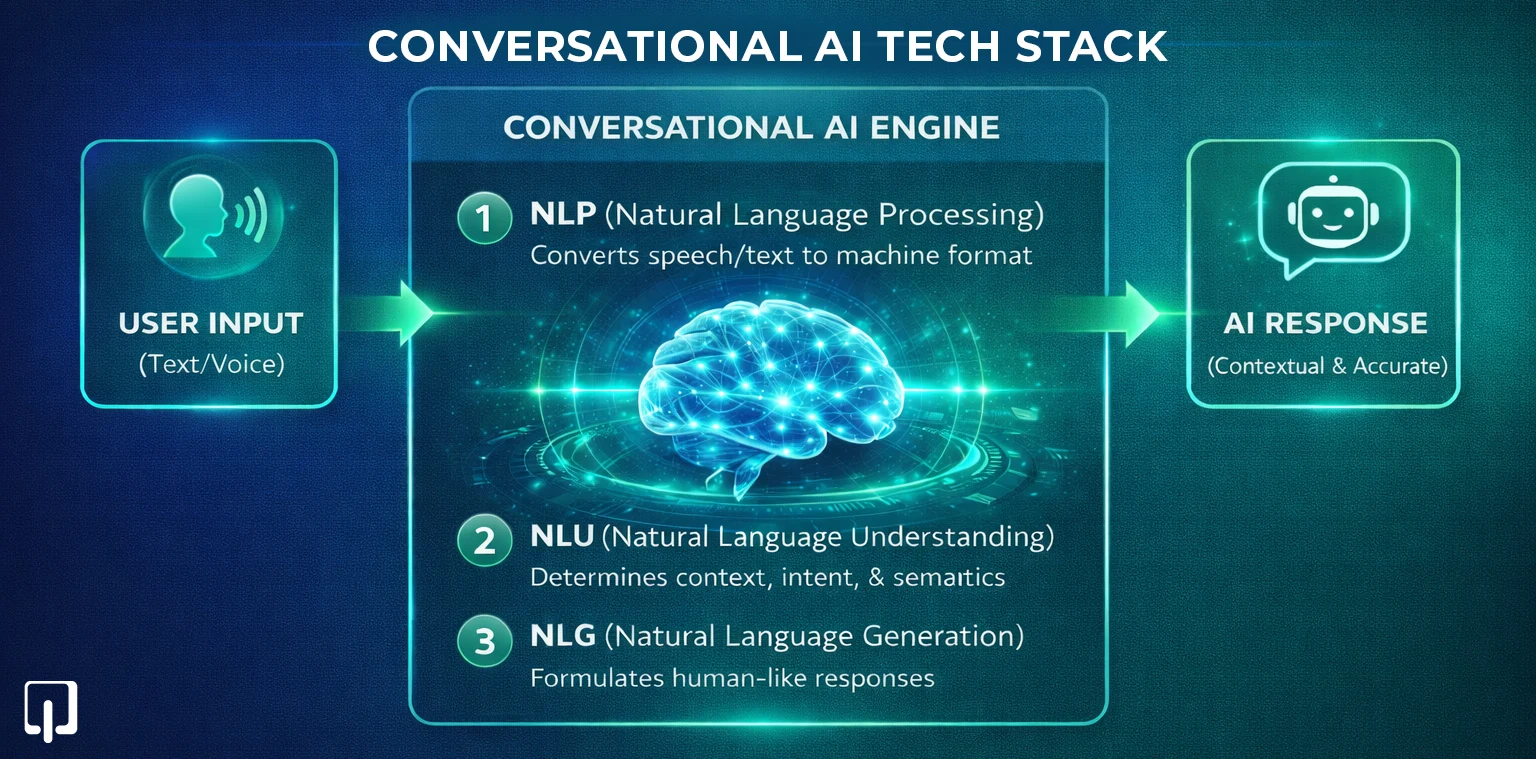
Traditional chatbots generate responses by matching user input against predefined patterns in their knowledge base. This approach is inherently rigid. If a customer inquiry doesn't explicitly match a programmed scenario, the chatbot either returns a generic message or routes the customer to a human agent.
Conversational AI systems analyze incoming customer queries using machine learning algorithms that learn from patterns in historical data and past customer interactions. Rather than matching keywords, conversational AI understands intent and sentiment, enabling responses even when phrasing differs significantly from training examples.
A defining characteristic of conversational AI is context retention across multiple conversation turns. If a customer mentions an issue in message one, then asks a follow-up question in message three without restating the original problem, conversational AI maintains understanding of the complete conversation thread. Traditional chatbots, lacking this contextual memory, typically require customers to repeat information.
Research indicates that 56% of consumers report higher satisfaction when conversational AI systems demonstrate contextual awareness by referencing prior discussions, transactions, and purchase history. Traditional chatbots, constrained by their linear interaction models, cannot deliver this personalized experience.
The global conversational AI and chatbot markets represent one of the fastest-growing segments in enterprise software. The chatbot market was valued at USD 7.76 billion in 2024 and is expected to reach USD 9.56 billion in 2025. The broader conversational AI market stands at USD 11.58-15.5 billion, with projections reaching USD 14.29 billion by 2025. Some analysts combine both markets, resulting in a total addressable market exceeding USD 19 billion in 2024-2025.
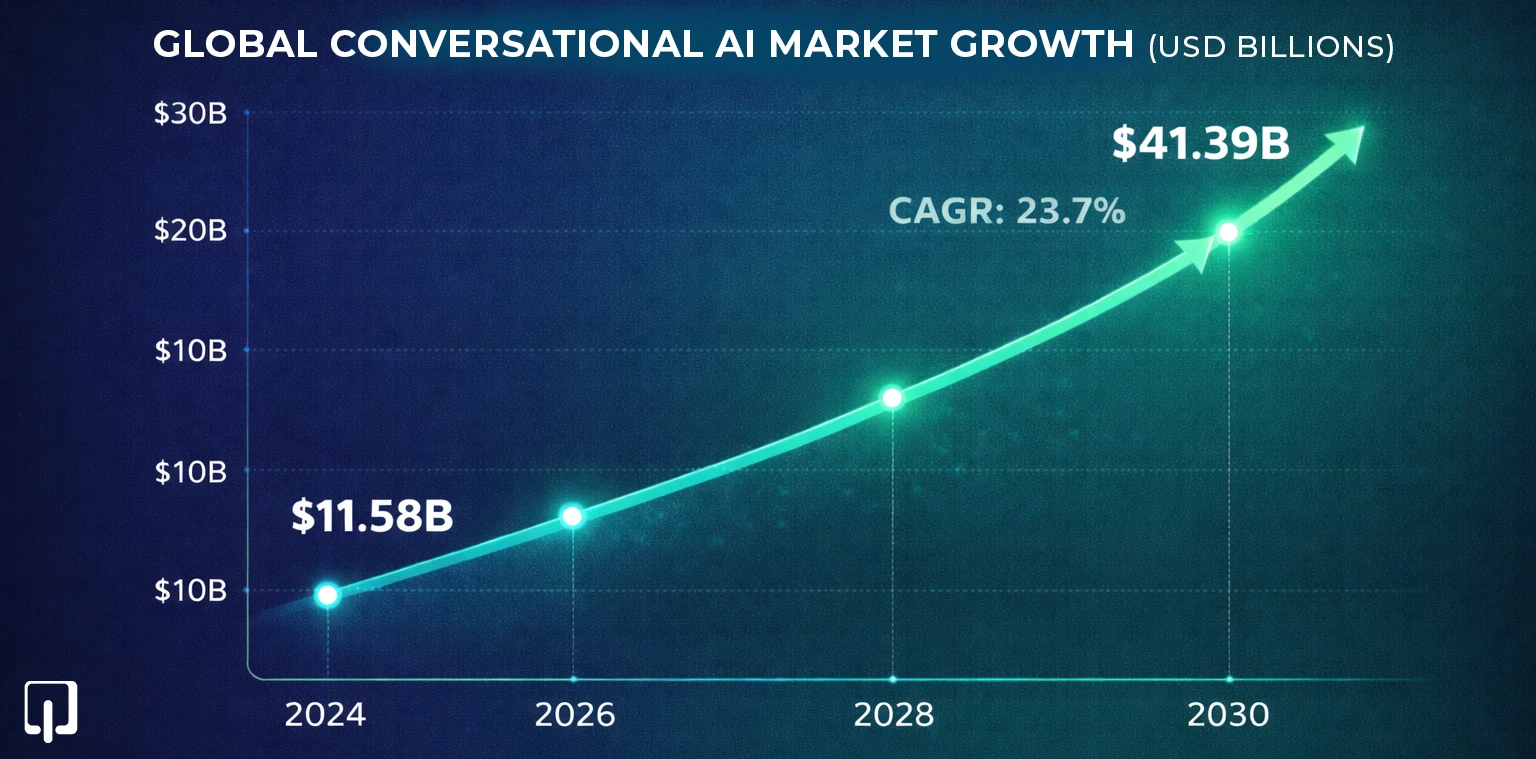
Long-term projections through 2030 show the chatbot market reaching USD 27.29 billion (23.3% CAGR) while the conversational AI market is expected to hit USD 41.39 billion (23.7% CAGR). Combined, this represents approximately USD 68.68 billion by 2030. Extended forecasts to 2033-2034 predict even more dramatic expansion, with some research firms projecting the market reaching USD 132.86 billion by 2034 at a 23.97% CAGR.
North America dominates with approximately 29.3-33.62% of global market value, driven by significant investments from technology giants including Amazon, Microsoft, Apple, IBM, and Google. The region's leadership stems from concentration of AI research at leading universities, established venture capital ecosystems, and enterprise demand for automation solutions.
Customer Service: Conversational AI handles complex, multi-faceted customer inquiries that require context, personalization, and nuanced responses. According to MIT Technology Review research, more than 90% of businesses reported significant improvements in complaint resolution, call processing, and customer satisfaction after implementing conversational AI chatbots.
Healthcare: Conversational AI assists patients in describing symptoms, reducing wait times, and providing preliminary guidance. The technology can recognize emotional states and provide empathetic support, particularly valuable for sensitive health inquiries.
Financial Services: Banks leverage conversational AI to handle complex account inquiries, detect fraud through behavioral analysis, and provide personalized financial advice while maintaining strict compliance and security protocols.
Lead Generation and Sales: Conversational AI engages prospective customers, qualifies leads using predefined criteria, and seamlessly routes high-potential prospects to sales teams.
Employee Support and HR: Organizations deploy conversational AI to automate routine HR processes including credential review during recruitment, benefits enrollment, and policy inquiries, freeing human teams for strategic initiatives.
Organizations deploying conversational AI must address several challenges:
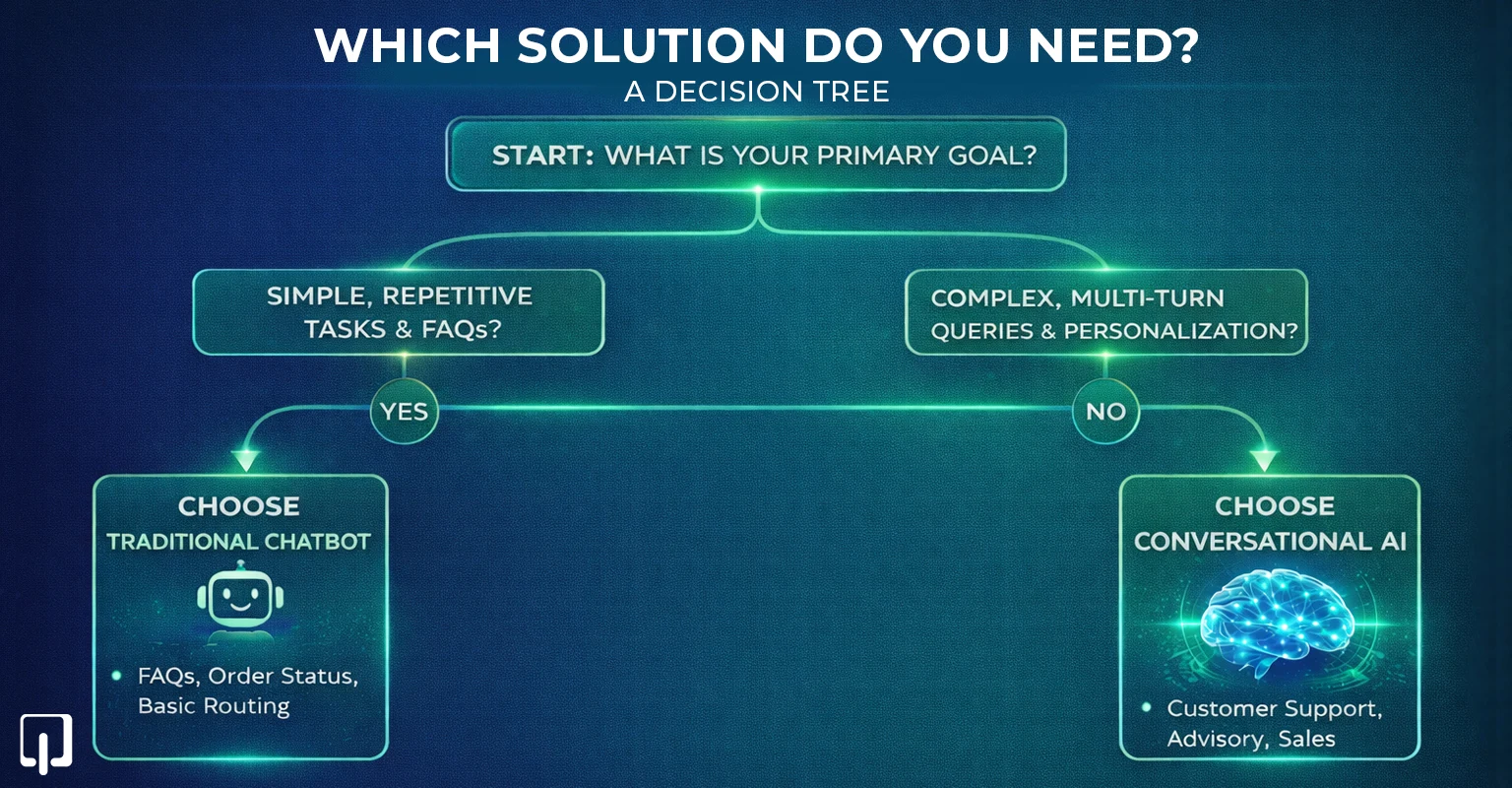
Many enterprise organizations adopt hybrid models using rule-based chatbots for simple, high-volume inquiries (FAQs, status checks, routing) while deploying conversational AI for complex, value-intensive interactions. This approach balances cost efficiency with experience differentiation.
Market data demonstrates strong consumer acceptance of both chatbot technologies. Research shows that 87.2% of consumers report positive or neutral experiences with chatbots, while 62% of respondents actively prefer engaging with digital customer service assistants rather than waiting for human agents. Additionally, 56% report higher satisfaction when conversational AI references prior interactions and personalizes responses.
However, satisfaction differential emerges when comparing technology types. Research indicates that conversational AI chatbots consistently outperform rule-based systems in user perception metrics including competence, warmth, trustworthiness, engagement, and emotional expressiveness.
A randomized controlled trial examining colorectal cancer screening messaging found that both AI-generated messages and conversational chatbots significantly outperformed expert-written materials in changing health behaviors, increasing stool test intentions by 12.9-13.8 points compared to 7.5 points for professional materials. Notably, the more complex conversational chatbot did not outperform simpler AI messages, suggesting diminishing returns for complexity in certain applications.
The conversational AI market stands at an inflection point, with technologies that were speculative five years ago now delivering measurable business value across diverse industries. The fundamental difference between traditional chatbots and conversational AI represents not an incremental improvement but a transformative shift in human-computer interaction.
Market projections indicate the conversational AI market will reach USD 41.39 billion by 2030, growing at 23.7% annually, with conservative estimates suggesting markets could expand well beyond USD 100 billion by the early 2030s. This growth reflects genuine business demand rather than speculative hype. Organizations consistently report improved customer satisfaction, reduced operational costs, and enhanced competitive positioning through conversational AI adoption.
For businesses evaluating implementation, the strategic question is not whether to adopt these technologies, but which approach (traditional chatbots, conversational AI, or hybrid systems) best aligns with organizational capabilities, customer expectations, and long-term competitive positioning. As these systems mature, the ability to understand nuance, maintain context, and personalize interactions will increasingly become table stakes rather than competitive advantage in customer-facing operations.
The primary difference lies in their underlying technology. Traditional chatbots use rule-based systems with predefined scripts and keyword matching, making them suitable for simple, repetitive tasks. Conversational AI employs natural language processing (NLP), natural language understanding (NLU), and machine learning to understand context, intent, and sentiment, enabling human-like conversations that adapt and learn from interactions.
Neither is universally "better" as each serves different purposes. Traditional chatbots excel at handling frequently asked questions, account inquiries, and simple workflows in cost-conscious scenarios. Conversational AI is superior for complex customer interactions requiring personalization, multi-turn conversations, contextual understanding, and emotional intelligence. Organizations should choose based on use case complexity, budget, and customer experience goals.
Traditional chatbots typically have lower upfront costs due to their simpler rule-based architecture. Conversational AI requires significant investment in infrastructure, data annotation, model training, and continuous optimization. However, conversational AI delivers long-term cost reduction through automation, with organizations reporting up to 51% reduction in chat traffic routed to human agents within six months, potentially offsetting higher initial costs.
Conversational AI chatbots offer operational efficiency by handling thousands of simultaneous interactions without quality degradation, personalization at scale through user data analysis, continuous improvement via machine learning, complex problem resolution beyond simple scenarios, omnichannel deployment across web, mobile, and messaging platforms, and 24/7 support availability. More than 90% of businesses report significant improvements in complaint resolution and customer satisfaction after implementation.
Yes, conversational AI systems can support multiple languages, though capabilities vary by platform. Many leading conversational AI companies offer multilingual support. However, systems trained primarily on English may struggle with non-English speakers and regional dialects. Implementation challenges include language translation accuracy, contextual ambiguity in different languages, and ensuring culturally appropriate responses across diverse markets.
Customer service sectors see the most significant benefits, with more than 90% reporting improvements in complaint resolution. Healthcare uses conversational AI for symptom description and preliminary guidance. Financial services leverage it for complex account inquiries and fraud detection. Lead generation and sales teams use it to qualify prospects automatically. HR departments deploy conversational AI for recruitment, benefits enrollment, and policy inquiries.
Leading conversational AI development companies implement strict data privacy and security protocols to comply with regulatory requirements including GDPR, HIPAA, and SOC 2. Customer interactions must be processed, stored, and protected according to regional regulations. Organizations should verify that their chosen conversational AI software solutions include encryption, secure data handling, access controls, and audit trails to maintain compliance and protect sensitive information.
The conversational AI market stands at USD 11.58 billion in 2024 and is projected to reach USD 41.39 billion by 2030, reflecting a compound annual growth rate of 23.7%. The traditional chatbot market is valued at USD 7.76 billion in 2024, expected to grow to USD 27.29 billion by 2030 at 23.3% CAGR. Combined, the total addressable market is approximately USD 68.68 billion by 2030, with extended forecasts suggesting expansion beyond USD 100 billion by the early 2030s.
Implementation timelines vary based on complexity, organizational readiness, and use case scope. Simple chatbot deployments can take weeks, while comprehensive conversational AI solutions requiring custom training, integration with legacy systems, CRMs, and databases may take several months. Organizations must also account for workforce skill gaps in machine learning, NLP, and conversational design, which can extend implementation periods. Continuous optimization and refinement occur even after initial deployment.
Yes, many conversational AI development companies recommend hybrid approaches. Organizations can deploy rule-based chatbots for simple, high-volume inquiries such as FAQs, status checks, and basic routing, while implementing conversational AI for complex, value-intensive interactions requiring personalization and contextual understanding. This hybrid model balances cost efficiency with experience differentiation, allowing businesses to optimize resource allocation across different customer interaction types.
The distinction between conversational AI vs chatbot technologies represents a fundamental evolution in business communication. While traditional chatbots serve specific purposes with their rule-based, cost-effective approach, conversational AI chatbots offer sophisticated capabilities that transform customer interactions through natural language understanding, contextual awareness, and continuous learning.
Organizations must carefully evaluate their specific needs, technical capabilities, and strategic objectives when choosing between these technologies. The conversational AI companies and conversational AI services market continues to expand, offering diverse solutions from enterprise giants to specialized providers. Whether implementing basic chatbot functionality or comprehensive conversational AI solutions, businesses should focus on delivering genuine value to customers while maintaining realistic expectations about implementation complexity and resource requirements.
As the market grows toward USD 68.68 billion by 2030, conversational AI development services will become increasingly accessible. The future belongs to organizations that strategically deploy AI conversational chatbots to enhance customer experiences, optimize operational efficiency, and build sustainable competitive advantages in an increasingly digital marketplace.

Let’s discuss and plan how we can accelerate your growth. Fill out this form and take the first step towards constant advancement.

We will respond to you within 24 hours.
Access to dedicated product specialists.





.png)

