Tokenization systems have started becoming more and more designed to complement existing financial frameworks instead of substituting them completely. There are currently systems used by banks, asset managers, custodians, and payment companies to perform functions such as account management, payments, compliance, ownership management, and financial accounting. When tokenized assets are added to this system, it becomes necessary to integrate blockchain workflows with existing frameworks.
According to EY's 2026 Institutional Investor Digital Assets Survey, 63% of surveyed institutions are very interested in tokenized assets, while 59% identify integration challenges as a barrier to investing in or holding them. More than 60% also expect blockchain rails to have a significant impact on trading, clearing, and settlement over the next three to five years.
For instance, whenever an investor buys a tokenized bond, the platform might have to authenticate the user, ensure that they meet the requirements, settle the payment, send out the token, update the ownership and make sure that the transactions appear on the institution’s financial records. However, with independent functioning of these processes, this institution might end up with duplicated records.
This makes tokenization platform integration a critical part of building digital asset infrastructure. The challenge is not just transferring tokens on a blockchain. It's connecting that transfer to the financial operations that support the underlying asset.
Most financial institutions have an existing system to manage customers, accounts, transactions, compliance, custody, and reporting. However, the introduction of a tokenization system may create another layer for handling transactions, and yet the existing systems will continue to be accountable for many aspects of the financial process.
Consider a bank offering tokenized investment products. The tokenization platform may manage asset issuance and ownership transfers, but the bank's existing systems may still handle customer accounts, payment processing, investor records, and financial reporting.
Without proper integration, the same transaction may be recorded differently across systems. A token transfer could be completed on-chain while the bank's internal ledger still shows the previous ownership state. A payment could be confirmed in the banking system but remain pending in the tokenization platform.
The BIS Annual Economic Report 2023, Chapter III discusses connecting existing payment systems to programmable platforms through standardized APIs and remote procedure calls (RPC). This illustrates how traditional payment infrastructure can interact with tokenized platforms without requiring every system to operate on the same ledger.
The goal of banking system integration is therefore to ensure that tokenized transactions fit into existing financial operations while maintaining clear ownership of data and transaction responsibilities.
Not every tokenization platform needs the same integrations. The required connections depend on the asset, transaction model, and financial institution involved. A typical architecture may connect the following systems:
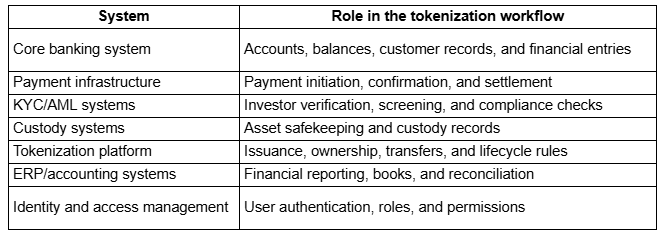
For instance, tokenized bond issuance could involve verifying the investor through the onboarding process of the bank, payment confirmation through the payment infrastructure, token issuance through the blockchain process, and transaction history to the accounting system.
It is important that the integration architecture clarifies which system owns the information. While the core banking system could be considered the owner of the account balances, the tokenization platform would be the owner of the tokens. In addition, the compliance system could decide if the investor is allowed to take part in the process.
This way the blockchain will not be seen as the owner of information which it does not really own.
After the required systems have been determined, the developer must determine how the flow of information happens between them.
The tokenization platform can integrate its system with the financial systems using APIs, event-driven messages, webhooks, and other technologies depending on the urgency of receiving the data, response required for the process, and failure-handling capabilities.
For instance, after an investor subscribes to the tokenized investment fund, the platform can launch a process that includes the following steps:
Investor request → Eligibility validation → Payment initiation → Payment confirmation → Token issuance → Ownership record update → Financial reporting
Each step may involve a different system.
A payment request might be sent to the banking system through an API. Once the payment is confirmed, an event can notify the tokenization platform that the issuance conditions have been met. The platform then executes the token issuance workflow and updates the transaction status.
However, integration requires more than passing data between APIs. Developers need to account for:
The BIS report on the next-generation monetary and financial system discusses how tokenization can integrate messaging, reconciliation, and asset transfer into more coordinated financial processes, while also highlighting the need to ensure interoperability between existing account-based systems and tokenized infrastructure.
Two of the critical processes that any tokenization platform must coordinate are payment and asset transfer.
For example, imagine that an investor is buying some security in token form. The investor makes a payment via traditional payment networks, while the platform deals with asset transfer.
In case the payment is completed and asset transfer fails, the investor has already paid for the security but hasn't got the asset. On the other hand, if the asset has been transferred and payment hasn't been made, then the seller would have to transfer ownership without receiving payment.
This is why platforms need clearly defined settlement conditions and transaction states. A typical workflow might include:
In situations where coordination is possible between the payment and the asset through a supported settlement process, DvP may decrease settlement risk by coordinating the exchange of the asset and payment.
However, where one of the legs is executed through an external banking system, then the application has to deal with confirmation, failure, and reconciliation.
The BIS tokenization report explains how programmable platforms can support conditional execution, including DvP, and how bringing tokenized money and assets together could reduce manual reconciliation and settlement steps.
Even with the automated process, however, financial institutions must make sure that the transactions that take place through the blockchain technology are recorded in the financial books of accounts. This implies that, when there is a transaction that takes place on the tokenization platform, the bank can make the corresponding recording of payment, accounting entry or transaction on their side. It is not certain that the two processes would be completed simultaneously.
In other words, even when there has been a confirmation of token transfer, the accounting books may not yet have registered the corresponding entry. The implication is that the process may not necessarily have been unsuccessful.
Reconciliation will involve matching of records, which include:
When records don't match, the system should flag the discrepancy instead of automatically assuming one record is correct.
The reconciliation process also needs to determine whether the transaction can be retried, corrected, reversed through a supported workflow, or escalated for manual review.
This is especially important for institutions managing tokenized assets alongside traditional financial products, where transaction records may exist across several systems.
Integrating tokenization service platforms with financial systems provides new avenues and new streams of data. Every integration requires proper measures to ensure that financial data is protected and that there are no fraudulent transactions.
A payment integration should never allow an external application to start sending money through the API alone. There must be certain controls depending on the type of transaction involved. Developers should consider:
Compliance checks must also be a part of the transaction flow. While the controls related to investor eligibility, sanctions list checking, transaction caps, etc., can potentially be taken care of by the existing systems, there must be a mechanism that allows receiving their outputs for the tokenization platform.
The design must address what will happen in case the compliance check is unavailable. The nature of the transaction will determine whether it is necessary to halt the issuance or transfer.
Financial integrations don't always return a clear response. A banking API may time out after receiving a payment request. A webhook may arrive twice. A token transfer may complete while an internal system is temporarily unavailable. These scenarios require the platform to maintain transaction state and recover without creating duplicate operations.
For example, if a payment request times out, the platform should verify its status before submitting another request. If a token transfer has already completed, the application should not repeat the issuance simply because the accounting system hasn't received its update.
A reliable integration architecture should include:
The system should also distinguish between a transaction being initiated, accepted, completed, rejected, and reconciled. These are different states, and treating them as interchangeable can lead to incorrect financial records.
Before development begins, teams should define the following:
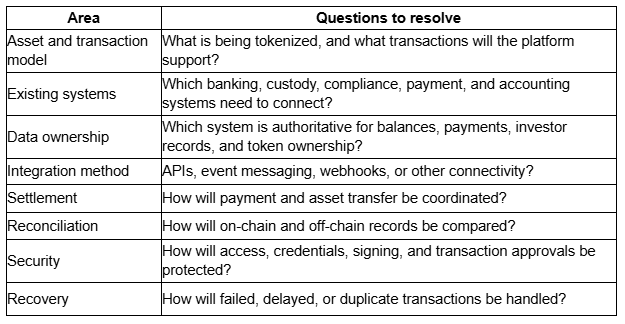
These decisions help prevent the tokenization platform from becoming a separate operational system that requires manual intervention to keep financial records aligned.
Integrating tokenization with existing financial systems requires understanding both the blockchain workflow and the institution's current operating environment.
WebMob approaches tokenization platform development by identifying the systems involved, defining data ownership, mapping transaction flows, and establishing how payment, asset transfer, compliance, and reporting will interact.
The architecture is designed around the asset type, financial institution's requirements, transaction model, and existing infrastructure. This helps organizations introduce tokenized workflows while keeping their banking, custody, and financial operations connected.
Tokenization systems do not work outside of the financial ecosystem that underpins them. The role of banking, payment solutions, custodial systems, regulatory compliance systems, and accounting software remains significant in the handling of assets and transactions.
The successful integration of core banking with digital assets is achieved through setting system responsibilities, exchange of information, transaction synchronization, and reconciliation procedures.
For those firms developing tokenized financial instruments, the decision about integration will determine how the blockchain transaction becomes a working process in a financial system.
They need to connect tokenized asset transactions with existing systems that manage payments, customer accounts, compliance, custody, and financial reporting.
Common integrations include core banking, payment systems, KYC/AML services, custody platforms, accounting systems, identity management, and financial reporting tools.
The tokenization platform exchanges relevant information with the bank's core systems through APIs or messaging interfaces. The core banking system may continue to manage customer accounts and balances, while the tokenization platform manages token issuance and ownership.
The platform defines settlement conditions, confirms the payment status, and executes the asset transfer when the required conditions are met. If payment and asset settlement operate on separate systems, the integration needs transaction tracking, exception handling, and reconciliation.
Common challenges include inconsistent data, system latency, failed API requests, duplicate messages, transaction-state mismatches, payment settlement, security, and reconciliation between on-chain and off-chain records.
Not necessarily. Many tokenization architectures are designed to connect to existing financial infrastructure and extend its capabilities. The required changes depend on the asset, settlement model, and operational requirements.

Let’s discuss and plan how we can accelerate your growth. Fill out this form and take the first step towards constant advancement.

We will respond to you within 24 hours.
Access to dedicated product specialists.