Technology leaders across industries are exploring new ways to accelerate and improve the reliability of software development. Teams are trying to reduce the friction between ideas and execution. Vibe Coding has entered this conversation because it provides both technical and non-technical contributors with a clearer path to building digital products with the help of AI. It is not a replacement for expert engineering, but it reshapes how teams communicate requirements and convert them into working applications.
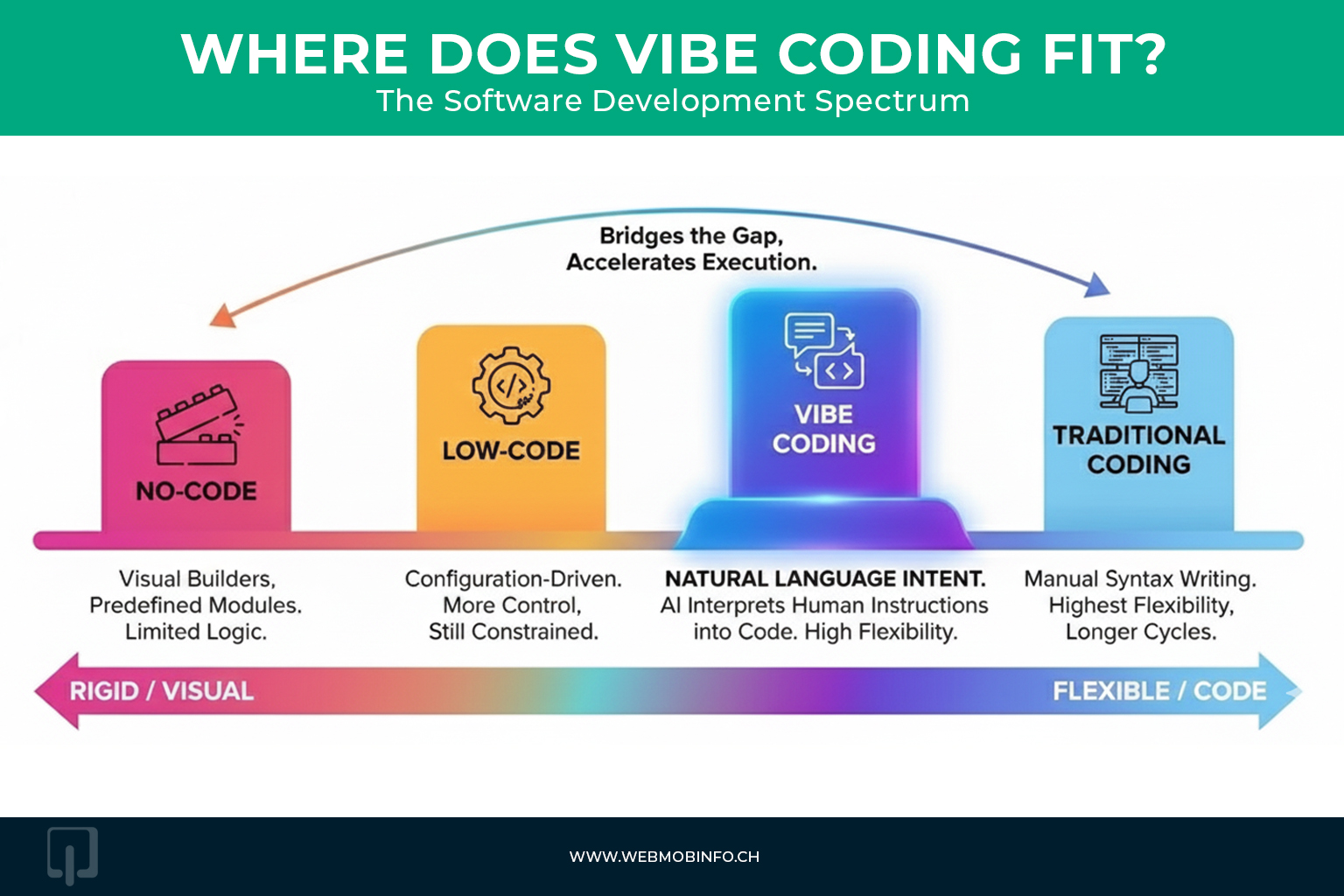
Vibe Coding sits in a distinct space between No-Code, Low-Code, and traditional development. No-Code tools rely on predefined modules, while Low-Code gives slightly more control with configuration-driven logic. Traditional coding gives the highest degree of flexibility, but the build and review cycles can feel longer. Vibe Coding introduces a new approach that lets teams express requirements in natural language and rely on AI Coding systems to interpret that intent.
Growing interest in AI-powered development solutions has placed Vibe Coding at the center of many product discussions. Companies want to maintain speed without losing quality. They want to retain control over logic without being limited by rigid No-Code frameworks. This is why Vibe Coding receives attention. It is supported by Natural Language Programming, meaning that AI can understand human-written instructions in a structured, meaningful way.
With this background in mind, let us examine what Vibe Coding actually represents and why it matters for both technical teams and business units.
Vibe Coding is the process of building and modifying software by describing intent in natural language. Instead of writing syntax, the developer or product owner communicates goals, features, and desired outcomes through plain sentences. The system then converts these inputs into functional code. This creates a smoother path from concept to prototype and later to production-ready systems.
This approach uses context to generate applications rather than relying solely on predefined instructions. Unlike general AI-based code generation, which produces snippets without a full understanding of the broader requirements, Vibe Coding aims to maintain continuity across features. It interprets past instructions, component relationships, and constraints that influence the application as a whole.
Prompt-driven development plays an important role here. The instructions provided by the user guide to the AI engine, but Vibe Coding does not require overly engineered prompts. It depends more on clarity of intent, structured thinking, and consistent feedback cycles. The user explains what they want, the system generates a functional version, and the user refines it step by step.
Vibe Coding fits well within the software development lifecycle because it supports ideation, prototyping, implementation, updates, and documentation. It creates a model where teams can move from concept to functioning modules without fully relying on hand-written code. The result is a more flexible development environment where Vibe Coding development aligns with existing engineering pipelines.
Understanding how vibe coding works requires a closer look at its internal processes. AI interprets natural language commands by breaking them into machine-understandable elements. The system identifies entities, relationships, constraints, and actions. These elements guide the generation of modules, components, or functions.
Vibe Coding transforms user intent into functional components by using pattern recognition models trained on large-scale development data. It identifies typical application structures and adapts them according to user instructions. For instance, if the instruction is to create a login system, the AI understands authentication flows, data rules, and API connections. Several internal processes support the final output.
• Context understanding ensures that each new instruction relates properly to previous steps.
• Pattern recognition identifies common development structures.
• Code generation produces functional output.
• Validation checks for errors, security issues, and misalignments.
• Iterative refinement allows the developer to improve the system through repeated adjustments.
Vibe coding tools guide this workflow. They provide interfaces for reviewing generated code, adjusting instructions, and integrating with deployment environments. Developers continue to play a critical role. They give oversight, validate output, and ensure business logic remains correct. This collaboration builds confidence in the system while improving development speed and clarity.
Vibe Coding works across multiple layers of application development. The front-end components are generated based on the user's UI requirements. The system constructs layout structures, interactions, and state management rules. The back-end logic is generated from natural-language instructions that define APIs, data models, workflows, and integration logic.
Integration with APIs and databases is handled through intent-based instructions. Users explain the purpose of the integration. The system completes the connection details, handles authentication, and sets up endpoint structures.
Reusable components form the foundation of vibe coding software development. The AI uses previously generated modules when similar patterns appear again. This keeps output consistent and reduces errors.
AI-powered development solutions build additional layers of validation and testing into this process. They examine potential issues before deployment and ensure code quality aligns with typical engineering standards. This architecture allows organizations to maintain reliability while adopting a new development method.
Vibe Coding supports a wide variety of applications. It is not limited to one domain or industry. You can build:
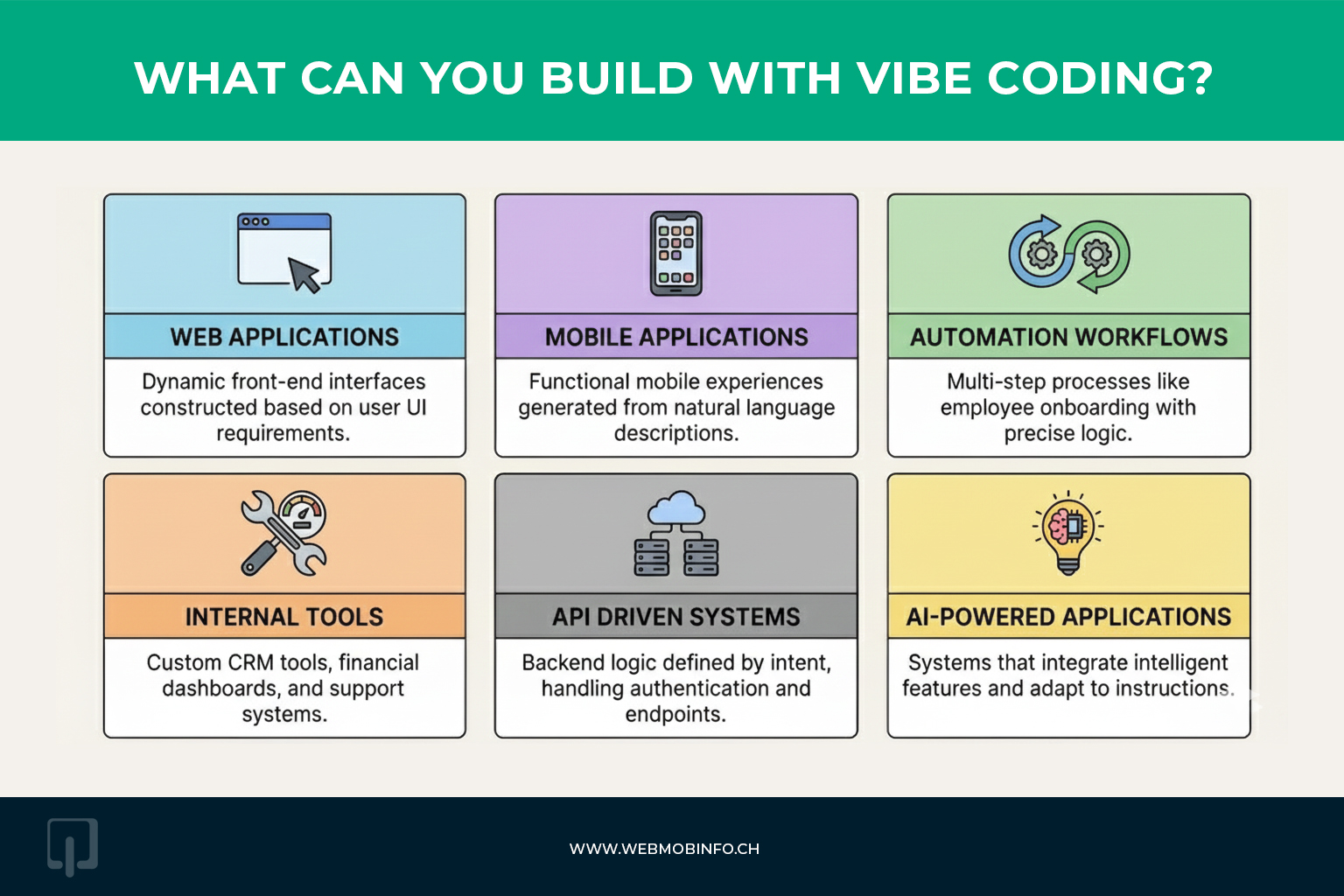
• Web applications
• Mobile applications
• Automation workflows
• Internal tools
• API driven systems
• AI-powered applications
Enterprises use vibe coding development to produce dashboards, CRM tools, workflow systems, financial applications, and more. For instance, a support automation system can be created through natural language instructions. Similarly, a multi-step onboarding workflow can be generated with precise logic based on the team’s requirements.
The system's flexibility shows its potential. It supports both small tasks and broader systems that require multiple integrations.
Teams exploring how to build apps with vibe coding will find the process simple yet structured.
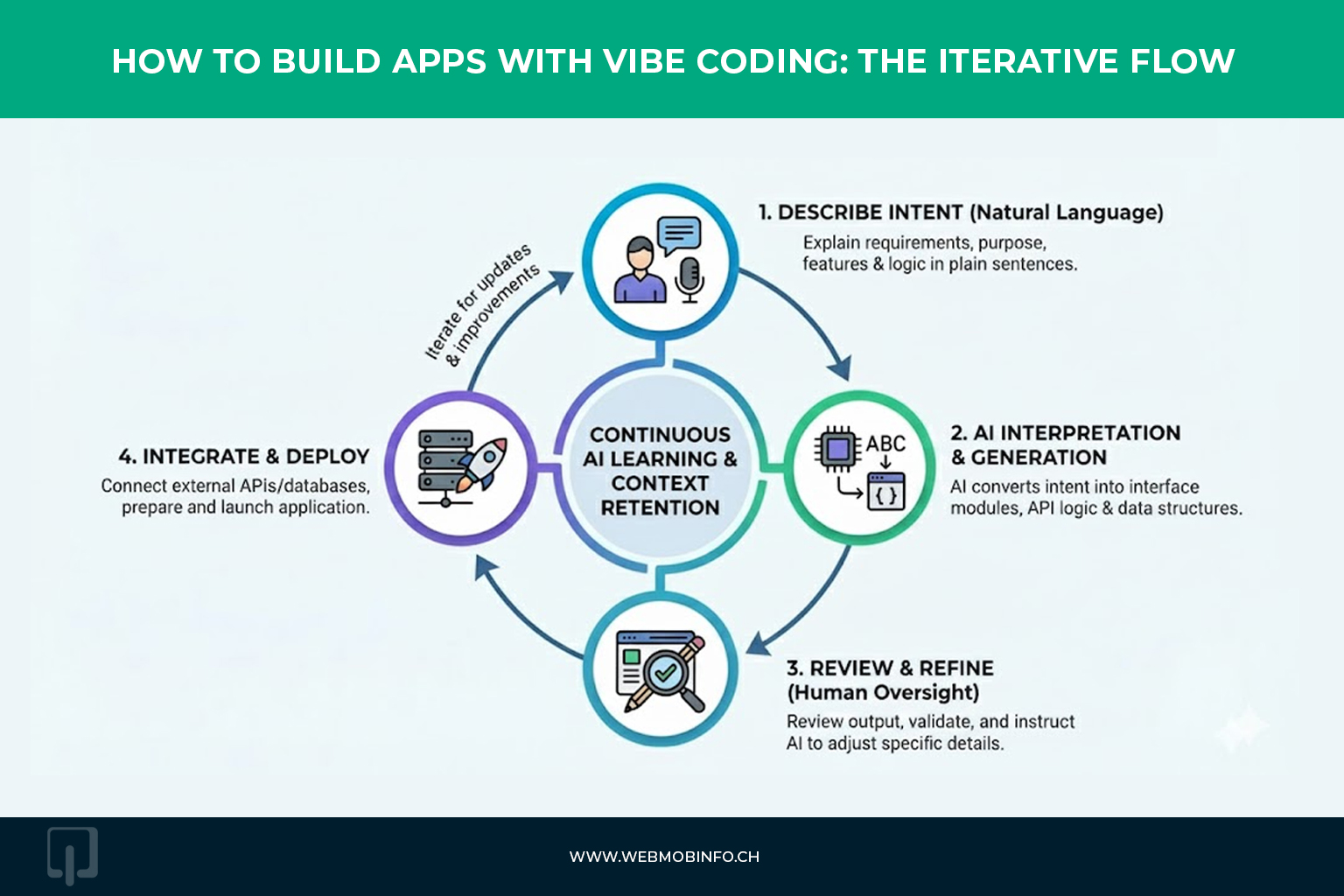
The user explains the requirements with clear sentences. They outline the purpose, features, and logic.
The system analyzes the description and generates interface modules, API logic, data structures, and other elements.
The human reviews the generated system and instructs the AI to adjust specific details. Small refinements improve quality.
The user instructs the system to connect with third-party APIs, payment gateways, or internal databases.
The system prepares deployment files and sends the code to a hosting environment.
For better results, teams maintain clarity in instructions and review each step with the same care they would apply to traditional development. Several popular platforms now offer Vibe Coding services. These tools vary in complexity, so organizations choose depending on their needs.
Multiple companies now provide AI-powered development tools that support Vibe Coding. These include general AI coding assistants, platform-specific Vibe Coding interfaces, and hybrid systems that combine No-Code elements with natural language processing.
When evaluating vibe coding tools, companies consider factors such as:
• Speed of generation
• Context retention
• Customization options
• Integration support
• Security controls
• Deployment systems
Selecting the right tool depends on the project's complexity. Smaller teams may prefer all-in-one systems. Larger enterprises may choose advanced platforms that integrate with existing CI and CD pipelines.
While Vibe Coding has strong potential, it comes with a few limitations. Understanding natural language boundaries remains important. If the instructions are unclear, the output may not meet expectations.
Complex logic can still require human oversight. AI may need guidance from developers when workflows involve advanced conditions or specialized algorithms. Security is another key consideration. Organizations must ensure that the systems they generate meet internal and regulatory standards.
Large projects also need technical supervision. Vibe Coding AI helps accelerate many aspects of development, but expert review ensures the system remains reliable and maintains long-term performance.
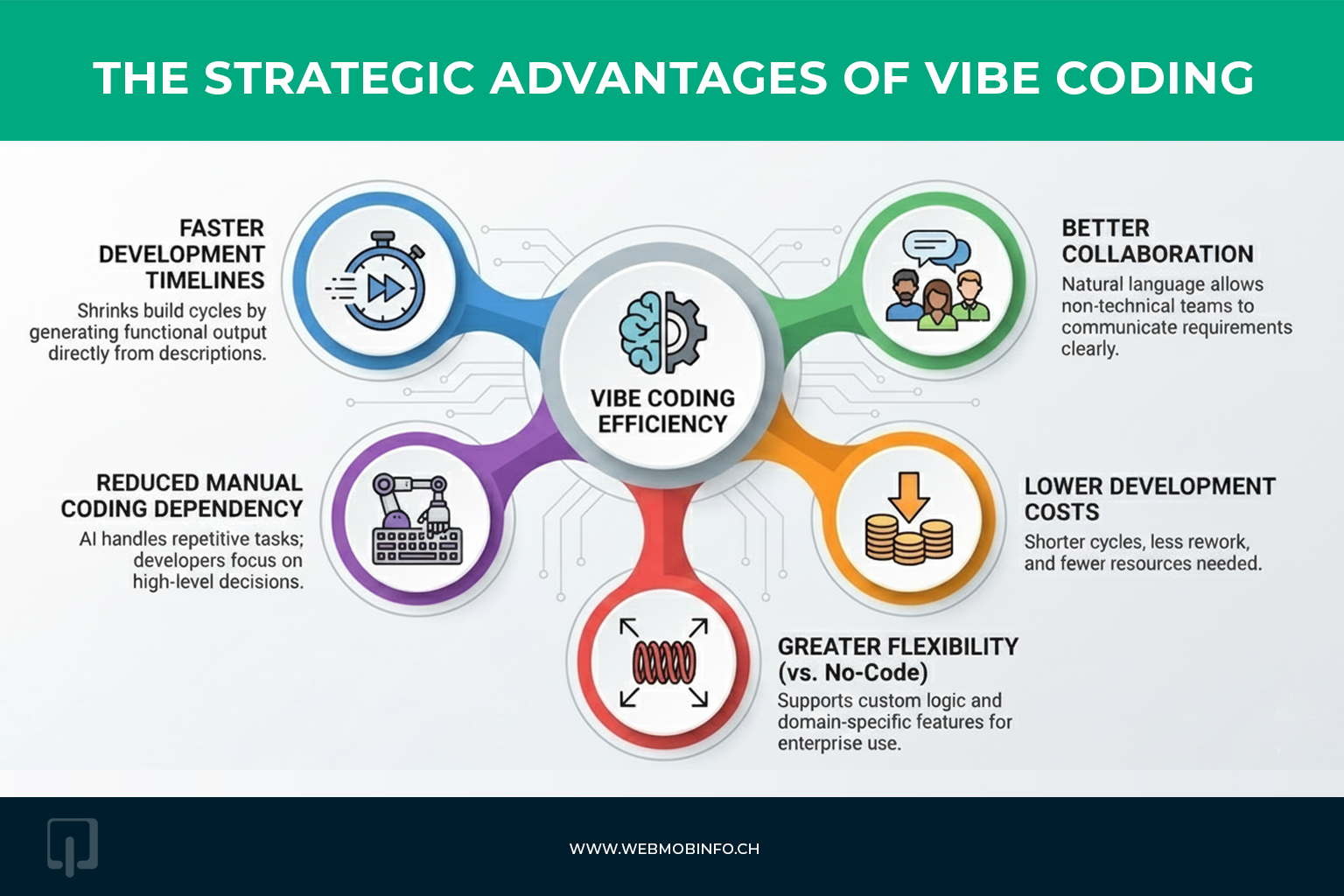
Vibe Coding reduces the gap between concept and execution by allowing teams to describe features in natural language, and the system generates functional output in a much shorter cycle.
Repetitive tasks that usually require hand-written code are handled by the AI, allowing developers to focus on higher-level decisions and improving overall efficiency.
Product managers, designers, analysts, and engineering teams can communicate requirements more clearly. The natural language approach helps non-technical contributors participate without confusion.
Shorter build cycles, fewer manual tasks, and less rework contribute to meaningful cost savings. Organizations can release features with fewer resources and maintain steady output.
Unlike rigid No-Code systems, Vibe Coding supports custom logic, API integrations, and domain-specific features, which makes it more suitable for enterprise use.
Vibe Coding continues to attract interest across industries. Businesses want development methods that blend speed with reliability. The use of Natural Language Programming will grow because it makes communication between humans and AI more consistent.
AI Coding systems will support broader enterprise use cases. Companies will expect Vibe Coding development to integrate with legacy systems, multi-cloud environments, and large-scale databases.
Vibe Coding's development services will become increasingly important for organizations seeking support from specialized teams. Consultants and engineering partners who understand Vibe Coding can help companies build frameworks, refine workflows, and improve performance.
Organizations consider Vibe Coding development services when speed is critical. When product teams want to bring ideas to life quickly, Vibe Coding provides a direct path. It also helps when non-technical departments need to participate in shaping workflows.
Businesses also use Vibe Coding when No-Code proves too limiting. They want flexibility without having to write everything from scratch. AI-powered development solutions help create systems that adapt to business needs without sacrificing control.
Enterprises that want consistency across updates, faster prototype cycles, and better communication between teams will find value in Vibe Coding services.
In today’s fast-paced digital landscape, businesses are looking for ways to stay competitive while reducing development time and costs. Vibe Coding has emerged as a groundbreaking approach that bridges the gap between no-code platforms and traditional software development. By allowing teams to define requirements in natural language, vibe coding streamlines the development process and unlocks a new level of efficiency. With the power of AI coding and natural language programming, Vibe Coding enables organizations to build sophisticated, custom applications without writing complex code.
With our deep expertise in AI-powered development solutions, we help businesses accelerate their application development processes while ensuring high-quality, customized outputs. Our Vibe Coding services are designed to meet the unique needs of each project, combining the power of AI with intuitive, natural language-driven development. Whether you're exploring how Vibe Coding works or need help with Vibe Coding AI, our team of experienced Vibe Coding developers is ready to bring your vision to life.
Ready to bring your ideas to life with Vibe Coding? Reach out to us today and discover how we can transform your development process with our comprehensive Vibe Coding services.
Get in touch with our experts now and take your development to the next level!
Vibe Coding is a software development approach that uses natural language instructions to generate functional code. By leveraging AI-powered development solutions and Natural Language Programming, users can describe features in plain language, enabling faster, more flexible application creation than with traditional coding or No-Code platforms.
While No-Code platforms allow users to build applications through visual interfaces, Vibe Coding enables more flexibility by converting natural language descriptions into code. Unlike No-Code, which relies on pre-built modules, Vibe Coding offers customizable workflows and logic that scale more easily for complex projects and enterprise solutions.
AI plays a central role in Vibe Coding by interpreting natural language instructions and converting them into functional code. Vibe Coding AI continuously adapts to user input, providing customized outputs while maintaining context. This AI-powered development solution helps teams build applications faster without sacrificing flexibility or control.
Vibe Coding works by interpreting natural-language user commands. The AI breaks these commands into components, generates code, and validates it. Vibe Coding developers refine and test the output, ensuring it meets the required business logic. It integrates with existing systems and APIs for seamless workflows.
Vibe Coding accelerates software development by enabling teams to turn ideas into functional applications quickly. It reduces manual coding, increases flexibility, and supports better collaboration between technical and non-technical teams. With Vibe Coding services, organizations can develop custom solutions faster and more efficiently than with traditional methods.

Let’s discuss and plan how we can accelerate your growth. Fill out this form and take the first step towards constant advancement.

We will respond to you within 24 hours.
Access to dedicated product specialists.