The business intelligence sector is experiencing a fundamental shift as conversational AI analytics reshapes how organizations interact with data. The global conversational AI market reached $11.58 billion in 2024 and is projected to grow to $41.39 billion by 2030, representing a compound annual growth rate of 23.7%. By 2026, market estimates position the sector between $17.3 billion and $20.7 billion, marking a critical transition where conversational AI for analytics moves from experimental technology to essential business infrastructure.
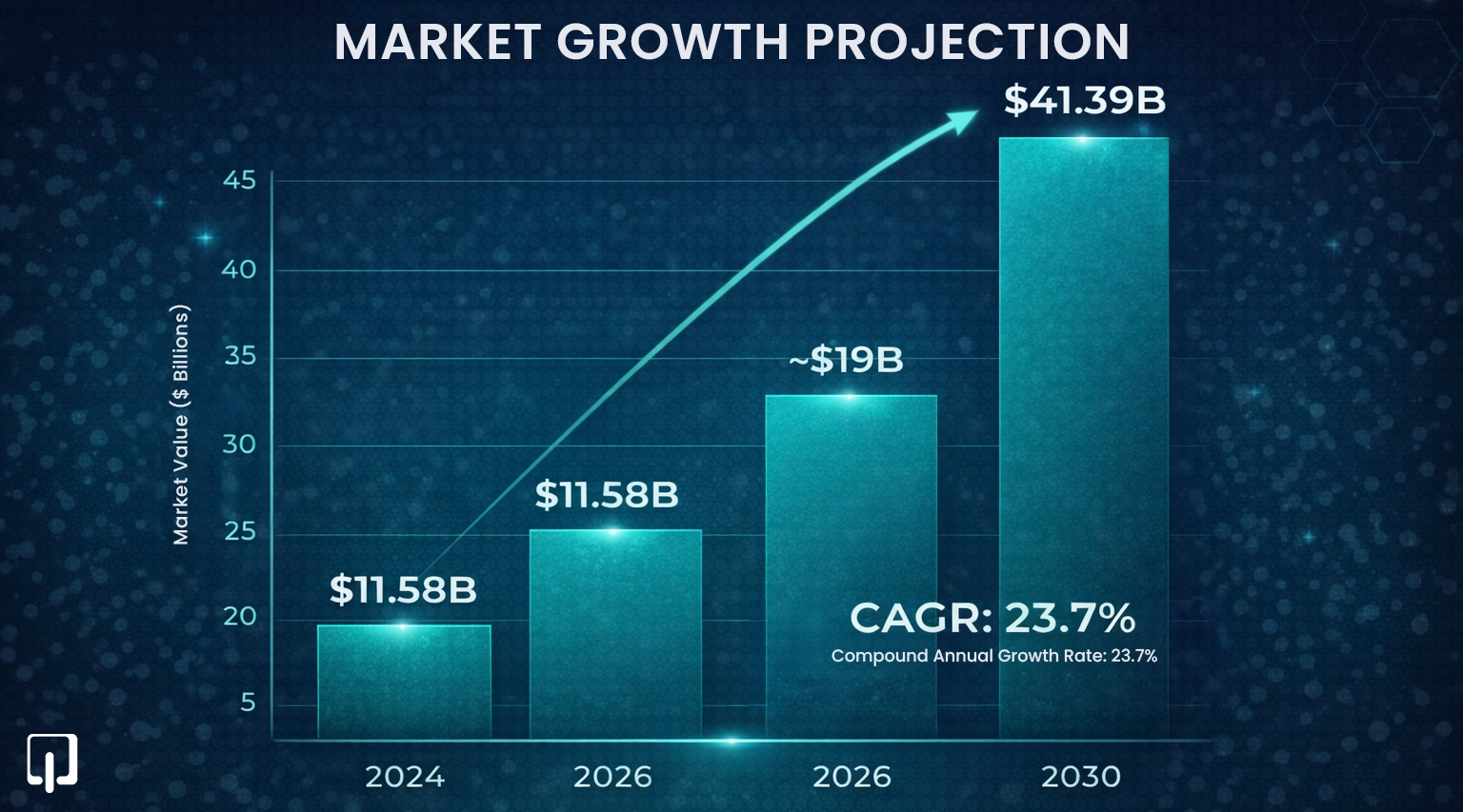
This growth reflects genuine economic value rather than speculative enthusiasm. Organizations implementing AI conversation analytics software report 40% faster insight discovery, 60% cost reductions, and ROI ranging from 300% to 500% within the first year. As 52% of organizations have already invested in conversational analytics technologies, with adoption rates projected to surge from 17% to 76% by 2026, understanding this technology becomes critical for competitive positioning.
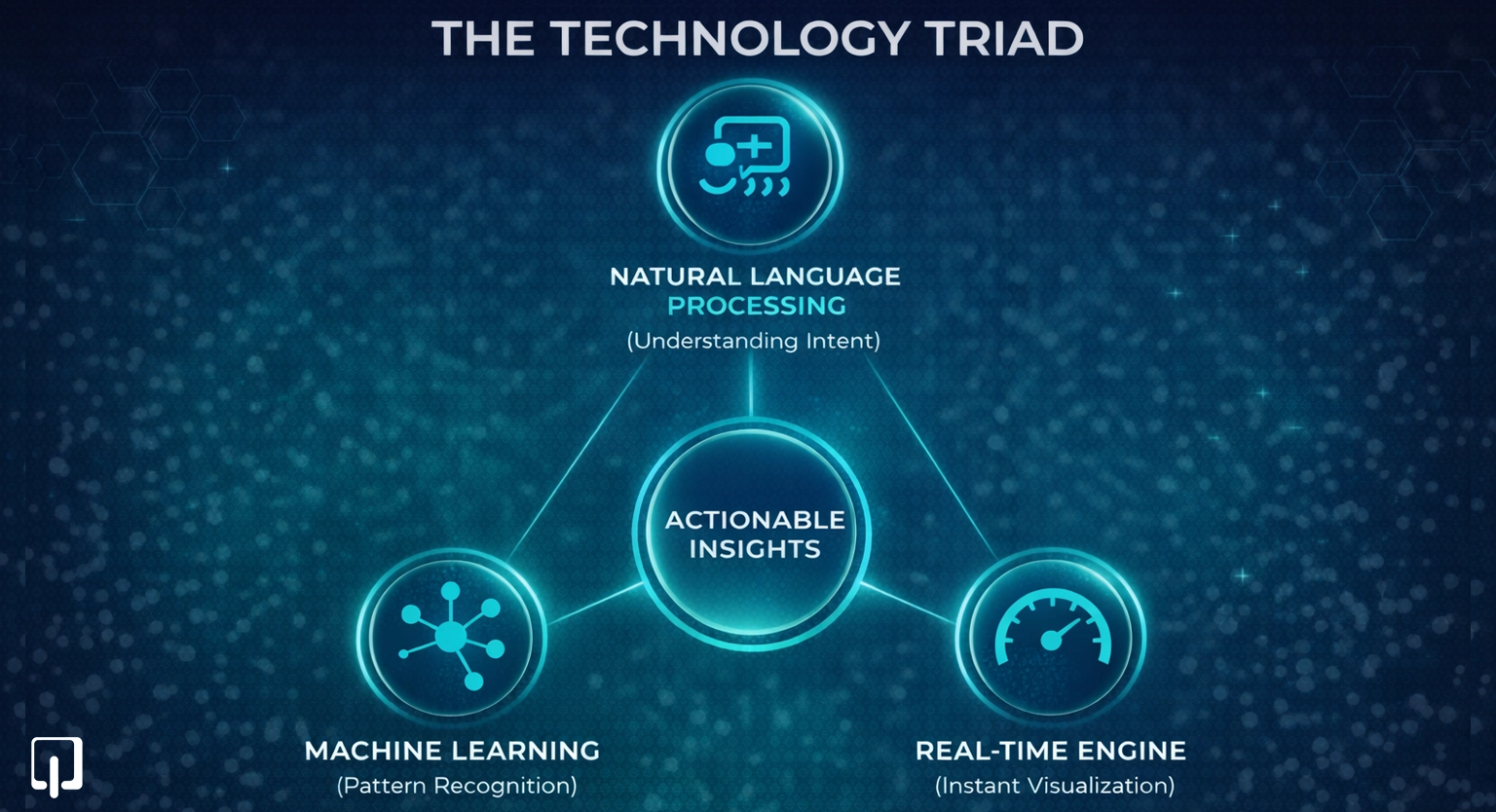
Conversational AI analytics represents a paradigm shift from traditional business intelligence systems. Instead of requiring SQL expertise or waiting days for analyst-generated reports, business users can now ask natural language questions and receive immediate, contextual answers from their data.
The technology combines three foundational components working in synchronization:
For voice-based conversational analytics, speech-to-text processing achieves streaming speech recognition with 300 milliseconds latency, speaker diarization identifying who said what in multi-party conversations, domain-specific optimization adapting to industry terminology, and accent handling processing diverse linguistic variations.
The distinction between AI conversational chatbots and traditional customer analytics tools extends beyond features to fundamental architectural differences. Traditional analytics systems operate retrospectively on structured data, while conversational AI analytics enables real-time, adaptive intelligence from multi-modal sources.
Leading conversational AI models demonstrate varying accuracy rates depending on task complexity:
Review sentiment detection achieves 90-95% accuracy because customer opinions are often explicit, while emotion detection requiring subtle inference ranges from 72-80%. Organizations migrating from rule-based keyword matching to neural network models typically observe accuracy improvements from 60-70% baseline to 85-92%.
Enterprise-grade AI conversation analytics software achieves First Contact Resolution rates of 70-90% for complex enterprise queries and 40-60% for FAQ-focused implementations. Task completion rates for top-performing systems exceed 96-99%, with response latency under 300 milliseconds for streaming systems and under 800 milliseconds for voice interactions.
The advantages of conversational AI for analytics extend across operational, financial, and customer experience dimensions, delivering measurable improvements that traditional systems cannot match.
Organizations implementing conversational AI analytics report substantial operational improvements:
Traditional analytics requires adding staff to handle increased workload. Adding 100 new daily customer interactions requires hiring additional analysts, expanding databases, and implementing new infrastructure costing $500,000+ over months. Conversational AI scales automatically through cloud infrastructure, handling 100,000 new daily interactions through incremental compute costs without architectural changes. Organizations report managing 250-400% higher interaction volumes without proportional cost increases.
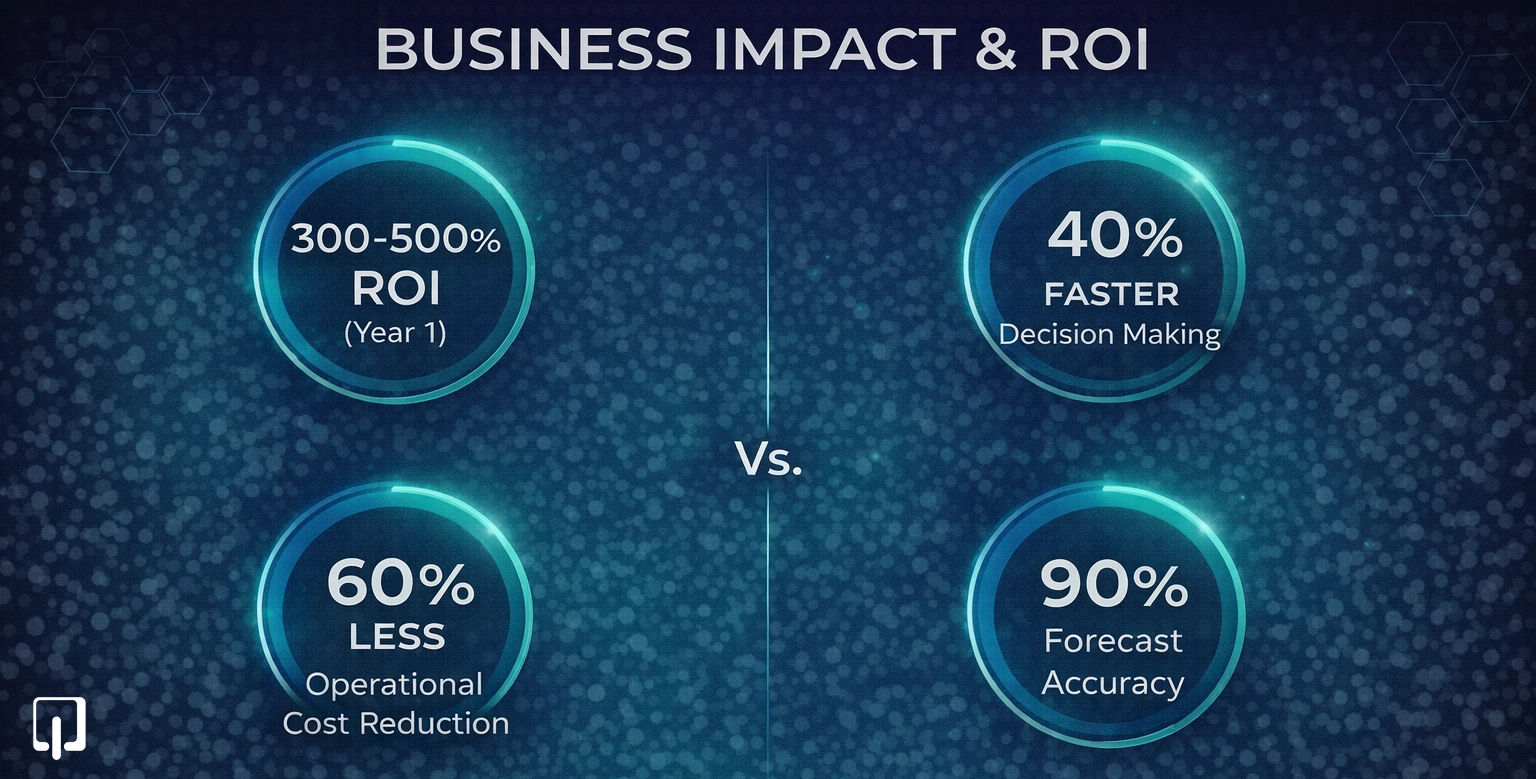
Financial metrics demonstrate clear ROI for properly implemented solutions:
For mid-market organizations with 500-5,000 employees, typical implementation costs include platform licensing at $150,000-$500,000 annually, implementation and customization at $100,000-$300,000, and training at $50,000-$100,000, totaling $300,000-$900,000 in Year 1. Returns include labor cost reduction of $200,000-$600,000, revenue uplift of $500,000-$2,000,000 through better customer insights, and cost avoidance of $300,000-$1,000,000 from churn reduction, delivering total Year 1 benefits of $1,000,000-$3,600,000 with ROI of 233%-500% and payback periods of 3-6 months.
Conversational AI analytics transforms customer interactions:
Contact centers implementing conversational AI achieve 20-30% reduction in Average Handle Time through agent assists and call automation, 15% improvement in First Contact Resolution rates, 80% labor cost reduction at scale by 2026, and 100% monitoring coverage versus traditional 5-10% sampling for quality assurance and compliance.
Conversational AI enables proactive decision-making that traditional delayed-cycle analytics cannot provide. Traditional systems show yesterday's sales data, while conversational AI answers questions like "Which products are trending now?", "Are we tracking to budget this month?", or "Which customers might churn this week?" with current data within seconds.
This capability delivers 40% faster strategic decisions with updated information, 20-25% more opportunities identified through early pattern recognition, and immediate operational adjustments without management delays.
Conversational AI systems continuously monitor conversations for required disclosures, prohibited statements, suspicious patterns indicating fraud or security threats, and quality standards. Traditional quality assurance samples 5-10% of interactions, statistically incapable of catching all violations. AI-based conversational analytics enables 100% monitoring of every conversation, fundamentally changing risk profiles through audit-ready documentation, trend identification of emerging compliance risks, cost reduction from fewer regulatory fines, and leadership certainty that policies are being enforced.
Enterprise conversational AI adoption demonstrates strong momentum across sectors, with adoption patterns varying significantly by industry maturity and use case alignment.
Large enterprises control 68.2% of the current market, but small and medium-sized enterprises are growing at 25.1% CAGR, significantly faster than enterprise growth rates of 8-12%. This divergence reflects declining platform costs through commoditization, pre-built solutions reducing implementation complexity, and transparent ROI through case studies. By 2028, SMEs are projected to capture 40-45% of new conversational AI deployments.
North America maintains 30-40% market share, leading innovation but experiencing maturing growth rates. Asia Pacific captures 25-30% market share, growing at 22.3% CAGR driven by digital transformation in India, China, and Japan. Europe holds 20-25% market share with adoption constrained by GDPR compliance requirements but growing steadily, while the rest of world represents 5-15% market share with emerging adoption in Latin America and Middle East.
Organizations encounter 26 distinct barriers to conversational AI analytics adoption based on analysis of 164 implementation studies. Understanding these challenges and proven solutions increases implementation success rates to 90%.
Poor data quality directly reduces model accuracy. Organizations with inconsistent formats, missing values, and outdated records struggle with AI conversation analytics software performance. Successful implementations require comprehensive data audit and cleansing achieving 80% success rates, system integration planning, API development for custom connections, and data governance framework establishment. Organizations should target data quality score improvements from 60% baseline to 90%+ before full deployment.
Organizations with strong existing analytics tools face employee resistance. Business users trained in traditional report structures may distrust AI-generated insights. Solutions include gradual rollout starting with pilot teams, comprehensive training programs, change champions programs, transparent communication on AI limitations, and hybrid approaches maintaining legacy tools during transition. Proper change management achieves 85-90% adoption rates versus 30-40% without structured programs.
Connecting conversational AI to legacy systems including ERP, CRM, and data warehouses requires sophisticated middleware and API development. Many organizations lack internal technical expertise. Expert implementation support, pre-built integrations from platform vendors, comprehensive API documentation, testing frameworks, and ongoing technical support reduce implementation time from 12-16 weeks to 4-8 weeks.
Model accuracy declines over time as data distributions change through model drift. Continuous learning systems that automatically improve from user interactions, regular model retraining cycles, human-in-the-loop feedback, and performance monitoring dashboards maintain accuracy. Organizations achieve 5-10% annual accuracy improvements through continuous optimization.
Conversational AI systems must comply with industry regulations including HIPAA for healthcare, GDPR for EU operations, and PCI-DSS for financial services. Enterprise-grade platforms with built-in compliance features, role-based access control, audit logging, encryption at rest and in transit, and regular security assessments address these requirements. Platforms like Microsoft Azure Bot Service, IBM Watson, and Teneo include necessary compliance certifications.
Attributing business results specifically to conversational AI proves difficult. Comprehensive analytics frameworks tracking KPIs, A/B testing of new AI features, financial modeling of baseline versus AI-enabled scenarios, and regular ROI reviews enable proper measurement. Organizations achieving clear ROI attribution report 90% implementation success rates and 300-500% documented returns.
The conversational AI platform market spans multiple provider categories, each offering distinct advantages for different organizational needs.
Organizations should buy SaaS platforms when use cases align with platform capabilities, time-to-market is critical requiring implementation in weeks, multi-channel deployment is required, compliance certifications are important, and technical expertise is limited.
Custom development makes sense when unique industry terminology requires specialized models, integration with proprietary systems is mandatory, data privacy requirements prohibit cloud solutions, custom workflows differ significantly from standard platforms, and volume justifies investment with millions of interactions.
Custom implementation costs range from $100,000-$250,000 for small implementations handling 50,000 interactions monthly, $250,000-$750,000 for mid-size implementations managing 5-10 use cases with 1 million interactions monthly, and $750,000-$2,000,000+ for enterprise implementations supporting 20+ use cases with 10+ million monthly interactions.
Organizations with unique requirements benefit from custom NLP software development that addresses specific industry terminology, proprietary workflows, and specialized compliance needs that standard platforms cannot accommodate.
Generic sentiment models trained on social media often misclassify technical support conversations. Custom models trained on industry-specific data achieve significantly better accuracy:
Custom model development requires data collection of 5,000-10,000 labeled customer interaction examples, human annotation of sentiment, emotions, and intent, model training through fine-tuning pre-trained models on industry data, evaluation testing on held-out datasets, and deployment integration into production systems. Timeline spans 8-12 weeks for production-ready custom models.
Comprehensive custom AI analytics solutions include:
Technology stacks for custom development typically include NLP frameworks like spaCy, NLTK, Hugging Face Transformers, and Apache OpenNLP, machine learning tools including scikit-learn, TensorFlow, PyTorch, and XGBoost, data processing with Apache Spark, Pandas, and Dask, deployment using Docker, Kubernetes, and Apache Kafka for streaming, and analytics through Apache Spark, Elasticsearch, and Tableau or Power BI for visualization.
Several technological developments are accelerating conversational AI capabilities and expanding addressable use cases throughout 2026 and beyond.
Autonomous AI agents capable of multi-step reasoning, planning, and task execution without human intervention represent the next evolution. Current projections indicate 1 in 10 customer service interactions will be fully automated by agentic AI by 2026, with 23% of organizations already scaling agentic AI systems and 39% actively experimenting with agentic capabilities.
Capabilities include conducting independent research to answer complex questions, executing transactions like booking appointments or transferring funds, coordinating across multiple systems and data sources, and escalating intelligently when human expertise is required. Organizations deploying agentic AI report 35-40% higher deflection rates for issues resolved without human intervention and 50-60% cost reductions compared to traditional chatbots.
Conversational AI is expanding beyond text and voice to incorporate visual analysis of screenshots, images, and diagrams for troubleshooting, document understanding of PDFs, contracts, and regulations for compliance analysis, code understanding enabling software engineers to query codebases, and real-time video for live customer interaction analysis.
Organizations increasingly deploy multimodal systems answering questions like "Show me all customer interactions from today mentioning product issue X, broken down by region, sentiment, and resolution status."
The voice AI agents market is projected to grow from $7.63 billion in 2025 to $139 billion by 2033, significantly faster than text-based conversational AI. Growth drivers include improved speech recognition with word error rates below 3% for domain-specific audio, natural speech synthesis producing human-quality voice responses, hands-free interaction increasingly critical for contact centers and customer service, and compliance advantages as voice records provide clear audit trails.
Healthcare organizations report 37.79% CAGR growth in voice-based conversational AI driven by ambient clinical documentation analyzing doctor-patient conversations, patient appointment reminders and post-visit follow-ups, telehealth integration and virtual visits, and medication adherence monitoring.
Nearly 50% of large enterprises now opt for on-premises deployments to protect proprietary customer data and maintain compliance with strict data residency requirements under GDPR Article 32 and HIPAA Business Associate Agreements. Technology solutions include local LLM deployment running large language models on enterprise infrastructure, federated learning training models across distributed data sources without centralizing data, and privacy-preserving techniques including differential privacy and secure multi-party computation.
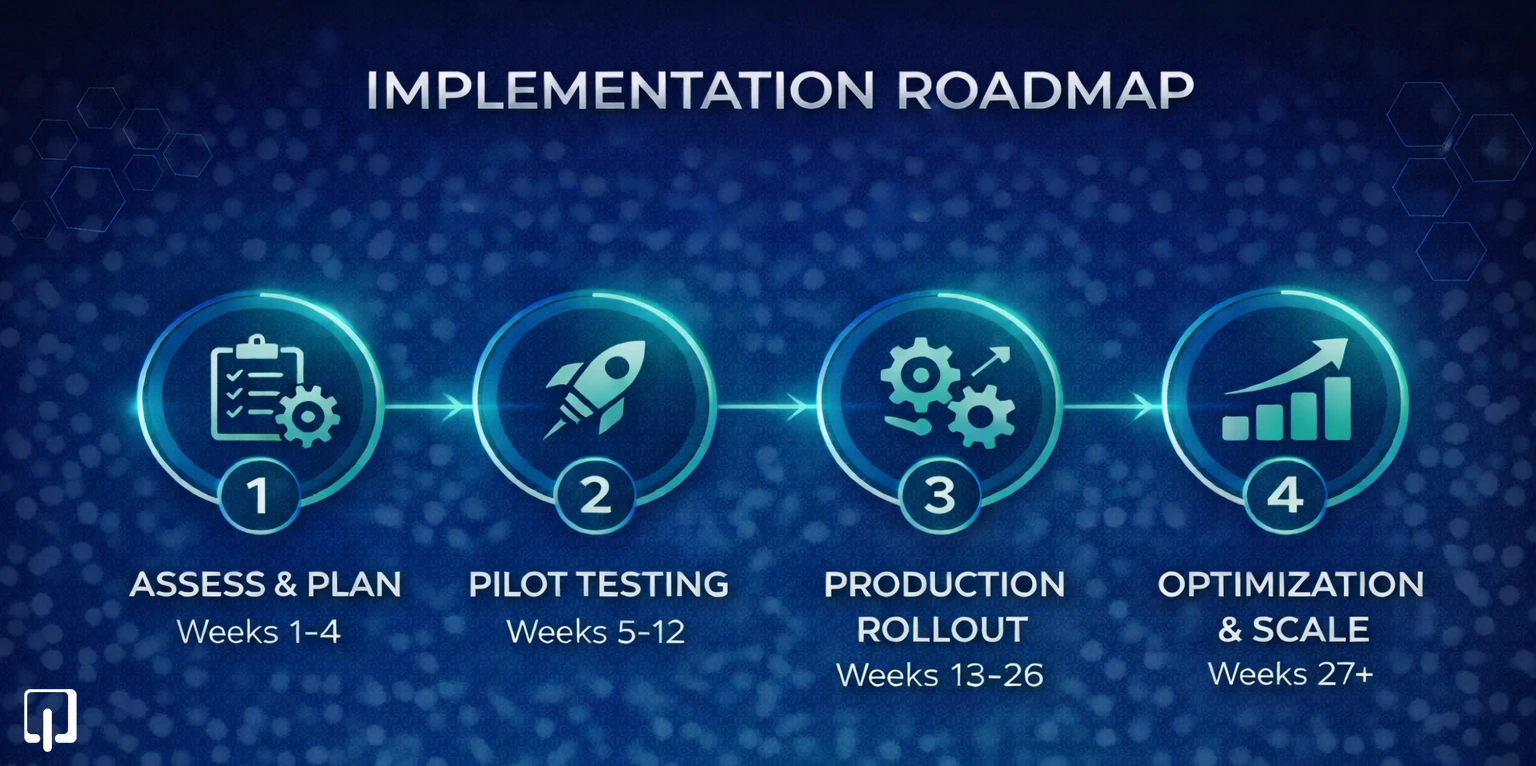
Successful conversational AI analytics implementation follows structured phases that minimize risk while accelerating time-to-value.
Map current analytical workflows and identify pain points requiring immediate attention. Define specific use cases with measurable success metrics tied to business objectives. Conduct vendor evaluation against technical and business requirements including scalability, compliance, and integration capabilities. Secure executive sponsorship and budget allocation with clear ROI projections.
Select 2-3 pilot teams representing different business functions to test diverse use cases. Implement core conversational AI capabilities on non-critical datasets to minimize operational risk. Measure baseline metrics including current process time, accuracy, and cost for comparison. Gather user feedback and refine system based on pilot learnings before broader deployment.
Expand to full organization with phased team onboarding ensuring adequate training and support. Implement robust monitoring, logging, and audit trails for compliance and performance tracking. Establish governance structure for ongoing model management including retraining schedules and performance thresholds. Document best practices and create training materials for continuous onboarding.
Maintain continuous performance monitoring and model retraining to prevent accuracy degradation. Expand to new use cases and data sources based on proven ROI and user demand. Integrate with downstream systems and decision workflows to maximize business impact. Track ROI and refine business cases for executive reporting and budget justification.
Conversational AI analytics enables users to query data using natural language questions and receive immediate, contextual answers through voice or text interfaces. Unlike traditional analytics requiring SQL expertise and manual report generation, conversational AI processes both structured and unstructured data in real-time, democratizing data access to 95% of business users without technical training. The technology achieves 40% faster insight discovery and sub-second response times compared to traditional systems requiring hours or days.
Organizations implementing conversational AI analytics typically achieve 300-500% ROI within 18-24 months with payback periods of 3-6 months. Specific returns include 60% reduction in operational costs through automation, 90% forecast accuracy versus 70-80% with traditional methods, 27% boost in customer satisfaction scores, and 21% improvement in collection rates. Mid-market organizations investing $300,000-$900,000 in Year 1 typically realize $1,000,000-$3,600,000 in quantified benefits through labor cost reduction, revenue uplift, and churn prevention.
Healthcare shows fastest growth at 20.1% CAGR with 70% reporting operational improvements through patient scheduling, symptom checking, and insurance claims processing. Financial services demonstrates highest current adoption at 85% driven by fraud detection, compliance monitoring, and risk assessment requirements. Retail and commerce holds largest market share at 21.2% leveraging conversational AI for product recommendations, order management, and inventory optimization. All industries benefit, but highly regulated sectors with high transaction volumes see greatest impact.
Leading conversational AI models achieve sentiment analysis accuracy ranging from 72% to 95% depending on task complexity and model architecture. Review sentiment detection reaches 90-95% accuracy for explicit opinions, while emotion detection requiring subtle inference ranges from 72-80%. Enterprise-grade systems achieve 70-90% First Contact Resolution rates for complex queries and 96-99% task completion rates with response latency under 300 milliseconds. Organizations migrating from rule-based systems typically see accuracy improvements from 60-70% baseline to 85-92%.
Implementation timelines vary by organizational size and complexity. SME deployments targeting quick time-to-value complete in 4-6 weeks. Mid-market implementations with integration requirements span 8-12 weeks. Enterprise deployments with custom models and multiple use cases require 12-16 weeks without expert support, reduced to 4-8 weeks with experienced implementation partners. Organizations following structured phases including assessment (4 weeks), pilot (8 weeks), production rollout (14 weeks), and optimization achieve 90% implementation success rates.
Organizations encounter six major barriers: data quality and integration issues requiring comprehensive audit and cleansing, user adoption resistance necessitating structured change management achieving 85-90% adoption rates, technical complexity connecting to legacy systems requiring expert implementation support, performance optimization maintaining accuracy through continuous model retraining, security and compliance requirements demanding enterprise-grade platforms with certifications, and ROI measurement requiring comprehensive analytics frameworks. Organizations addressing these systematically achieve 90% implementation success versus 40-50% for ad-hoc approaches.
Organizations should buy SaaS platforms when use cases align with standard capabilities, time-to-market is critical, multi-channel deployment is required, and technical expertise is limited. SaaS implementations complete in weeks at $150,000-$500,000 annually. Custom development makes sense when unique industry terminology requires specialized models, proprietary system integration is mandatory, or volumes justify investment with millions of interactions. Custom implementations cost $100,000-$2,000,000+ depending on scope but achieve 16-24% accuracy improvements through industry-specific models compared to generic platforms.
Enterprise implementations must include role-based access control limiting data exposure, comprehensive audit logging tracking all system interactions, encryption at rest and in transit protecting sensitive data, compliance certifications for applicable regulations including SOC 2, HIPAA, GDPR, and PCI-DSS, 100% conversation monitoring versus traditional 5-10% sampling for quality assurance, and on-premises or hybrid deployment options for data sovereignty. Nearly 50% of large enterprises now choose on-premises deployments to maintain compliance with strict data residency requirements under regulations like GDPR Article 32.
Conversational AI scales linearly through cloud infrastructure, handling 100,000x volume increases without architectural changes through automatic compute scaling. Organizations report managing 250-400% higher interaction volumes without proportional cost increases. Traditional analytics requires hiring additional staff, expanding databases, and implementing new infrastructure costing $500,000+ over months for modest volume increases. Conversational AI adds incremental compute costs only, enabling organizations previously handling 100,000 calls monthly to process 250,000-400,000 calls with identical team sizes.
Agentic AI systems capable of autonomous multi-step reasoning will automate 1 in 10 customer service interactions by 2026 with 23% of organizations already scaling implementations. Multimodal analytics expanding beyond text and voice to incorporate visual analysis, document understanding, and real-time video will enable comprehensive interaction analysis. Voice AI market growth from $7.63 billion in 2025 to $139 billion by 2033 will accelerate adoption through improved speech recognition achieving under 3% word error rates. Privacy-preserving on-premises solutions with local LLM deployment and federated learning will address data sovereignty requirements for 50% of large enterprises.
Conversational AI analytics has transitioned from experimental technology to business-critical infrastructure throughout 2026. The market's 23.7% CAGR and projected growth to $41.39 billion by 2030 reflects fundamental economic value demonstrated through 40% faster decisions, 60% cost reductions, and 300-500% ROI that organizations consistently achieve through proper implementation.
Organizations implementing AI-based conversational analytics thoughtfully gain lasting competitive advantages through faster decision-making, improved customer experiences measured through 27% satisfaction increases, and operational efficiency delivering 60% cost reductions. Those delaying implementation risk falling behind competitors leveraging these technologies to redefine customer engagement and business operations fundamentally.
Success requires executive commitment to organizational change beyond technology deployment, data investment proportional to AI investment ensuring quality foundations, phased approaches starting with high-impact use cases demonstrating clear value, platform selection based on specific organizational needs rather than generic features, and continuous optimization monitoring accuracy and business impact throughout deployment lifecycles.

Let’s discuss and plan how we can accelerate your growth. Fill out this form and take the first step towards constant advancement.

We will respond to you within 24 hours.
Access to dedicated product specialists.