


As technology advances, businesses are constantly seeking ways to improve customer interactions. Conversational AI has emerged as a game-changer, offering intelligent, automated communication solutions.
AI-powered conversational chatbots are revolutionizing the way businesses interact with customers, offering quick responses, personalized service, and seamless experiences. Whether it's for customer support, sales, or marketing, conversational AI chatbots are setting a new standard for how businesses communicate and operate.
In this blog, we’ll explore the power of conversational AI chatbots, their benefits, and how enterprises can leverage these solutions to stay ahead in today’s competitive market.
Conversational AI refers to the use of artificial intelligence to enable machines to understand, process, and respond to human language in a natural, intelligent way. Unlike traditional automated systems, conversational AI uses machine learning (ML) and natural language processing (NLP) to improve interaction quality.
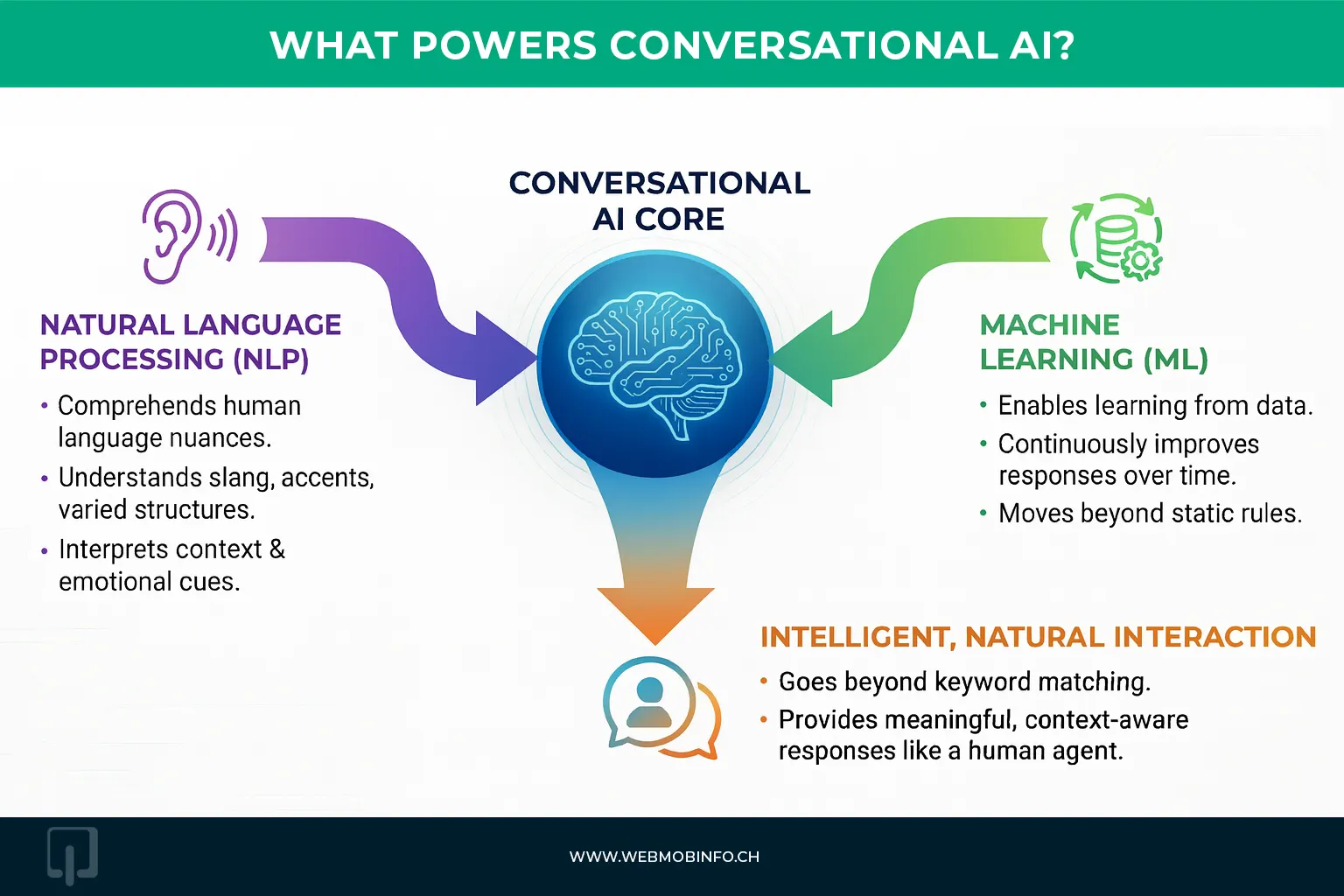
The key technologies behind conversational AI are:
Conversational AI goes beyond simple keyword matching to understand context, intent, and even emotional cues in conversations. It’s a vast leap forward compared to traditional chatbots, which often fail to comprehend nuance or provide meaningful responses.
AI chatbots help enterprises automate repetitive tasks, streamline processes, and improve efficiency. In customer service, for example, they can handle inquiries, process bookings, and resolve complaints without human intervention.
In industries like Retail, Healthcare, and Finance, AI-powered chatbots are becoming indispensable. Retailers use them to provide personalized shopping experiences, while healthcare providers rely on them to offer quick responses to patient inquiries. Financial institutions use conversational AI to guide customers through account management and other services.
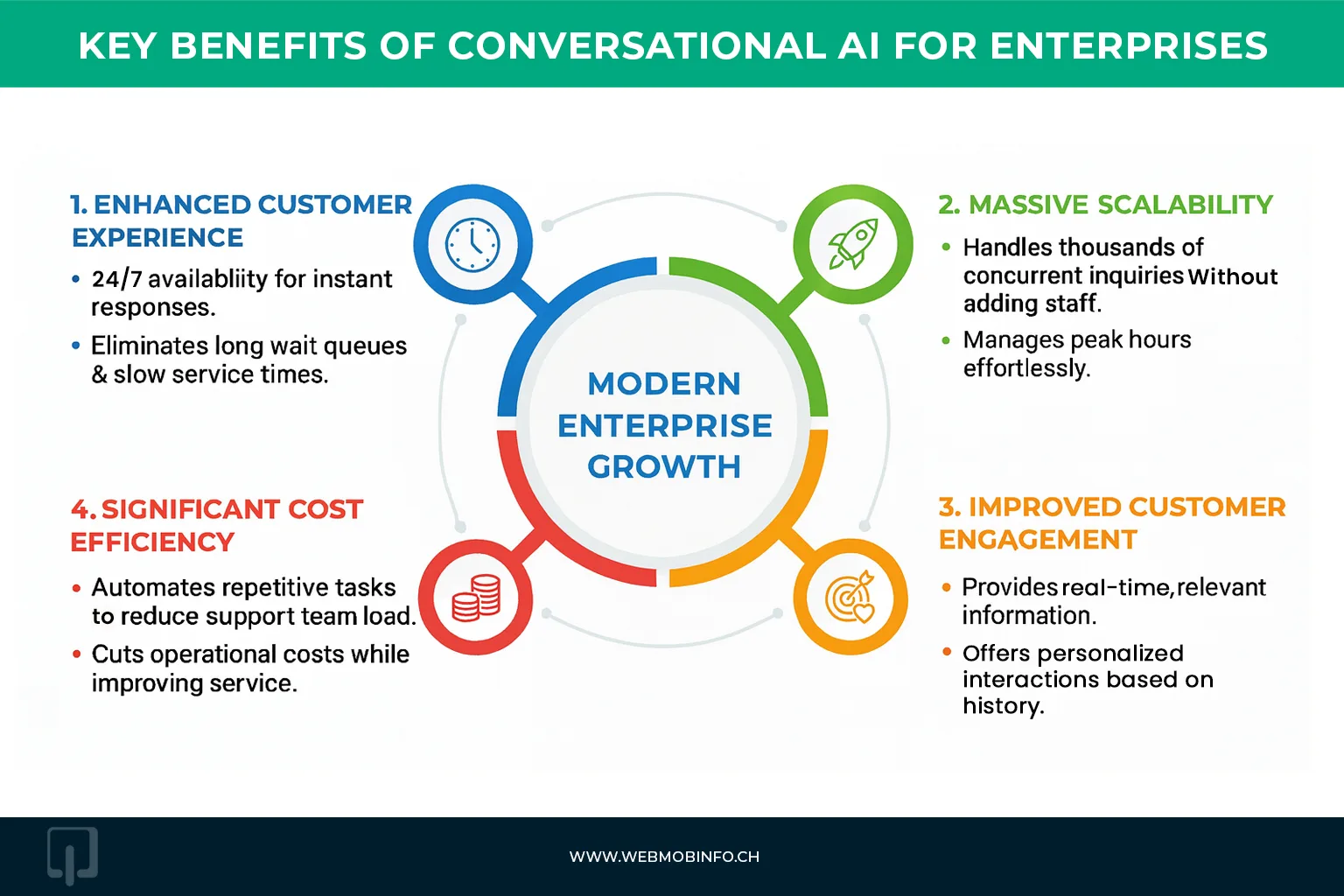
These bots allow businesses to operate at scale without expanding their workforce, handling thousands of inquiries simultaneously, even during peak hours.
While both conversational AI and traditional chatbots aim to automate customer interactions, their core differences lie in their capabilities:
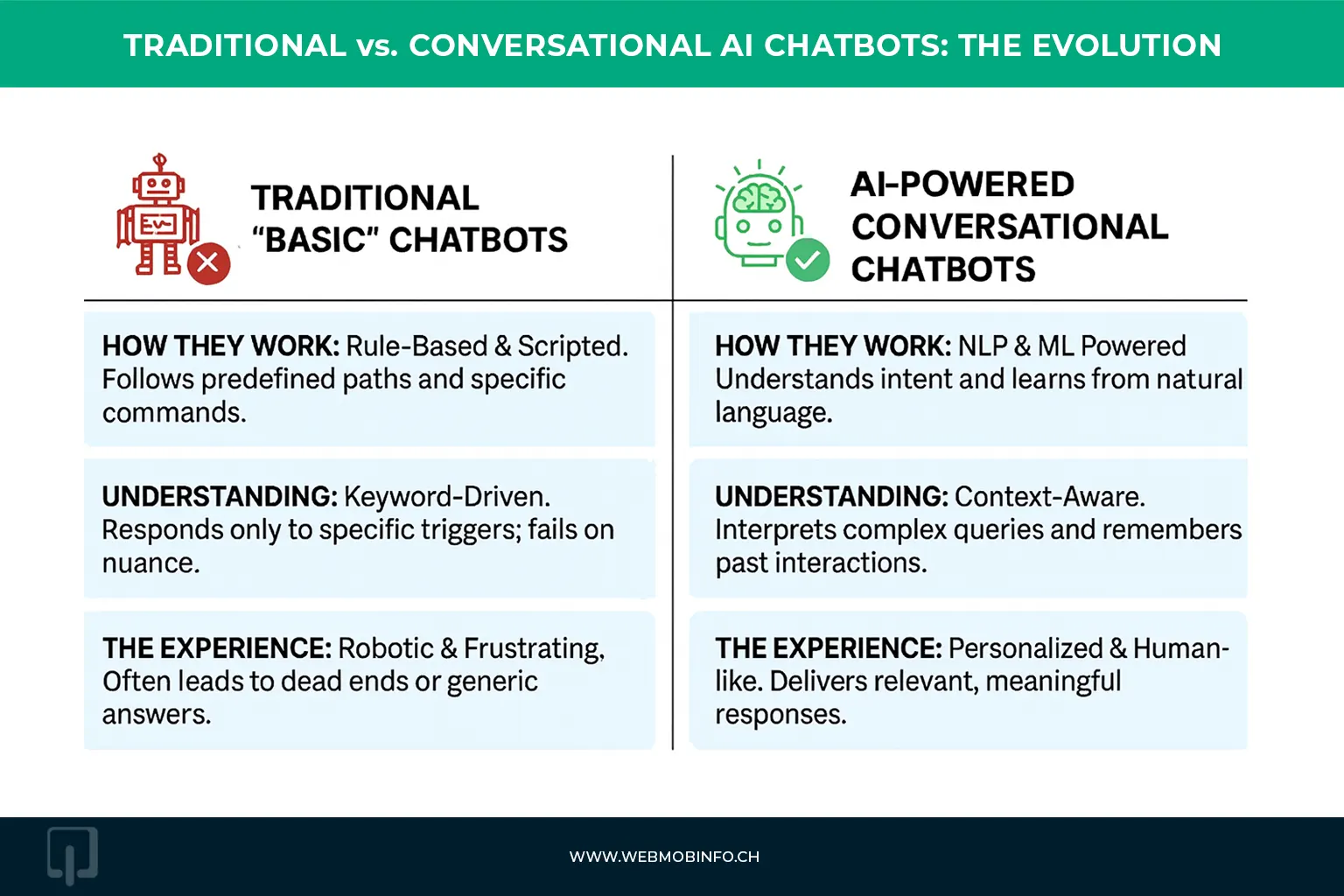
The intelligence of Conversational AI allows it to interpret more sophisticated requests, understand the context of past interactions, and deliver highly relevant responses, something that traditional chatbots struggle with.
Implementing conversational AI chatbots offers several benefits for enterprises:
There are numerous solutions available for enterprises looking to integrate conversational AI. These solutions can be fully customized to meet specific business needs and integrate with existing systems such as CRMs, websites, or mobile apps.
Popular platforms and tools include:
For enterprises, selecting the right chatbot solution requires balancing ease of use, integration capabilities, and scalability.
When businesses decide to implement conversational AI chatbots, working with a skilled development team is essential. A reliable conversational AI chatbot development service will handle everything from initial requirements gathering to AI training and deployment.
The development process typically includes:
The pricing of conversational AI chatbots can vary based on several factors, including solution complexity, the technology stack, and ongoing support requirements.
Some factors that influence the cost include:
In general, while the initial investment may seem significant, businesses often see a strong return on investment (ROI) through enhanced customer satisfaction and cost savings from automation.
Several companies have successfully integrated conversational AI chatbots into their operations, leading to improved customer service and greater efficiency.
For example, Bank of America uses its chatbot, Erica, to help customers manage their finances, offering services like bill payment reminders, balance checks, and spending insights.
Similarly, H&M uses a conversational AI chatbot to help customers find clothing, making shopping more personalized and efficient. These examples show how conversational AI can streamline operations and enhance customer satisfaction.
The cost of building a conversational AI chatbot varies depending on several factors, including:
On average, businesses should expect to pay between $5,000 and $50,000 for a basic conversational AI chatbot, with more advanced features or ongoing services raising costs.
As AI technology advances, conversational AI chatbots will continue to expand their capabilities. Emerging trends include:
The future of conversational AI is bright, and businesses that adopt this technology now will be well-positioned to lead their industries in the years to come.
Conversational AI is reshaping how enterprises interact with customers, streamline communication, and manage operational demands. As businesses compare chatbots vs conversational AI, it becomes clear that modern conversational AI chatbots create meaningful, context-aware conversations that traditional systems cannot match. With capabilities such as natural language understanding, intelligent automation, and personalized engagement, an AI-powered conversational chatbot delivers real value across B2B and B2C environments.
Whether a company needs a simple AI chatbot for support or a complete conversational AI chatbot solution integrated with CRM systems, the potential span is wide. From answering how much a conversational AI chatbot costs to evaluating conversational AI chatbot pricing models or reviewing conversational AI chatbot examples across industries, one thing remains consistent: enterprises benefit greatly when they adopt the right Conversational AI approach.
At Webmob Software Solutions, we stand among the leading firms delivering high-quality Conversational AI chatbot development services. Our team builds reliable and smart AI conversational chatbot systems that help businesses improve customer experience, reduce support pressure, and run more efficient digital operations. If you are exploring conversational AI and chatbots for your organization, we can guide you with confidence through strategy, development, integration, and growth.
Ready to build your next intelligent interaction system? Contact us today and speak directly with our Conversational AI experts. Let’s create something impactful together.

Conversational AI and chatbots differ mainly in intelligence and context handling. Traditional chatbots follow predefined rules and struggle with complex queries, while Conversational AI chatbots use NLP and machine learning to understand intent, context, and natural language. This makes a Conversational AI chatbot solution far more accurate, flexible, and suitable for enterprise-level interactions.
Conversational AI chatbots enhance customer experience by providing instant responses, consistent availability, and more human-like conversations. An AI conversational chatbot understands context from past interactions and offers relevant information without long wait times. This leads to higher satisfaction, reduced support load, and smoother engagement across websites, apps, and support channels for customers and employees.
Yes. An AI-powered conversational chatbot can handle complex, multi-step, and industry-specific queries by learning from real interactions and adapting to new patterns. Whether in finance, healthcare, retail, or logistics, enterprises can rely on conversational AI chatbots to accurately interpret intent and respond with actionable, context-aware information, even when the question goes beyond basic scripts.
Many industries use Conversational AI chatbots, including banking, insurance, retail, telecom, travel, and healthcare. These sectors rely on AI chatbot solutions to manage inquiries, onboarding, claims, product recommendations, and service requests. With conversational AI and chatbots improving accuracy and reducing manual workload, enterprises across B2B and B2C environments see measurable gains in efficiency and customer satisfaction.
When businesses ask how much a conversational AI chatbot costs, the answer depends on complexity, integrations, languages, and required automation. Conversational AI chatbot pricing may range from a few thousand dollars to enterprise-level budgets, depending on whether advanced features or custom workflows are included. Ongoing training, maintenance, and analytics also influence long-term investment and ROI.

Let’s discuss and plan how we can accelerate your growth. Fill out this form and take the first step towards constant advancement.

We will respond to you within 24 hours.
Access to dedicated product specialists.




.png)

