Real estate tokenization platform development has emerged as a critical innovation in property investment, enabling fractional ownership through blockchain technology. By 2035, the global real estate tokenization market is projected to reach $19.3 billion, growing at a compound annual growth rate of 20.2%. This comprehensive guide examines how to tokenize real estate assets, covering technical architecture, development costs, legal compliance, and proven implementation strategies for 2026.
The transformation from traditional property investment to tokenized real estate platforms represents more than technological advancement. It addresses fundamental inefficiencies in real estate markets, including high capital requirements (traditionally $100,000+ minimums), illiquidity requiring months to execute transactions, and geographic limitations restricting global participation. Building a real estate tokenization platform solves these challenges by converting property ownership rights into compliant digital tokens that investors can trade 24/7 across borders.
Planning a Compliant Real Estate Tokenization Platform?
Don't let technical debt slow down your launch. Our team specializes in building secure, ERC-3643 compliant infrastructures that satisfy regulators and streamline operations for asset managers.
Understanding Real Estate Tokenization Platform Development
How to build a real estate tokenization platform begins with understanding the core technological components and business model. Real estate tokenization software converts property assets into blockchain-based digital tokens representing fractional shares. Each token is backed by legal ownership claims verified through smart contracts, creating transparent and immutable ownership records.
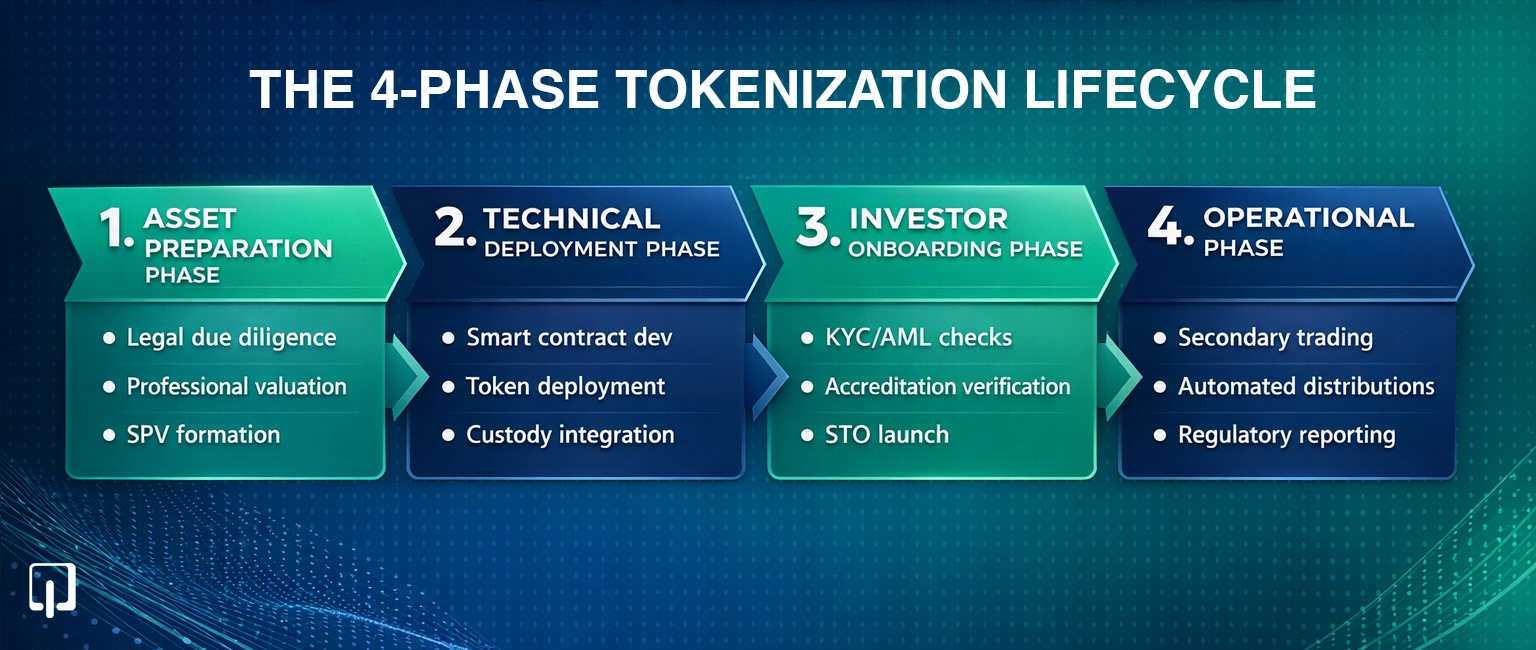
The process flow for tokenized real estate platforms follows four critical phases:
Asset Preparation Phase: Property selection, legal due diligence, professional valuation, and Special Purpose Vehicle (SPV) formation establish the legal foundation. The SPV structure ensures tokens are backed by legitimate ownership claims, protecting investor interests and satisfying regulatory requirements.
Technical Deployment Phase:Smart contract development, token contract deployment on blockchain networks, and integration with custody solutions create the technical infrastructure. This phase determines platform scalability, security, and compliance capabilities.
Investor Onboarding Phase: KYC/AML verification systems, investor accreditation checks, and primary Security Token Offering (STO) launches enable compliant capital raising. On-chain identity verification through standards like ERC-3643 automates compliance while maintaining investor privacy.
Operational Phase: Secondary trading functionality, automated distribution mechanisms for rental income or profits, and ongoing regulatory reporting ensure platform sustainability and investor satisfaction.
Market Opportunities in Real Estate Tokenization Software
The cost to build a real estate tokenization platform in 2026 must be evaluated against substantial market opportunities. Commercial real estate dominates with over 60% market share due to institutional adoption, while residential properties, single trophy assets, and development rights represent growing segments.
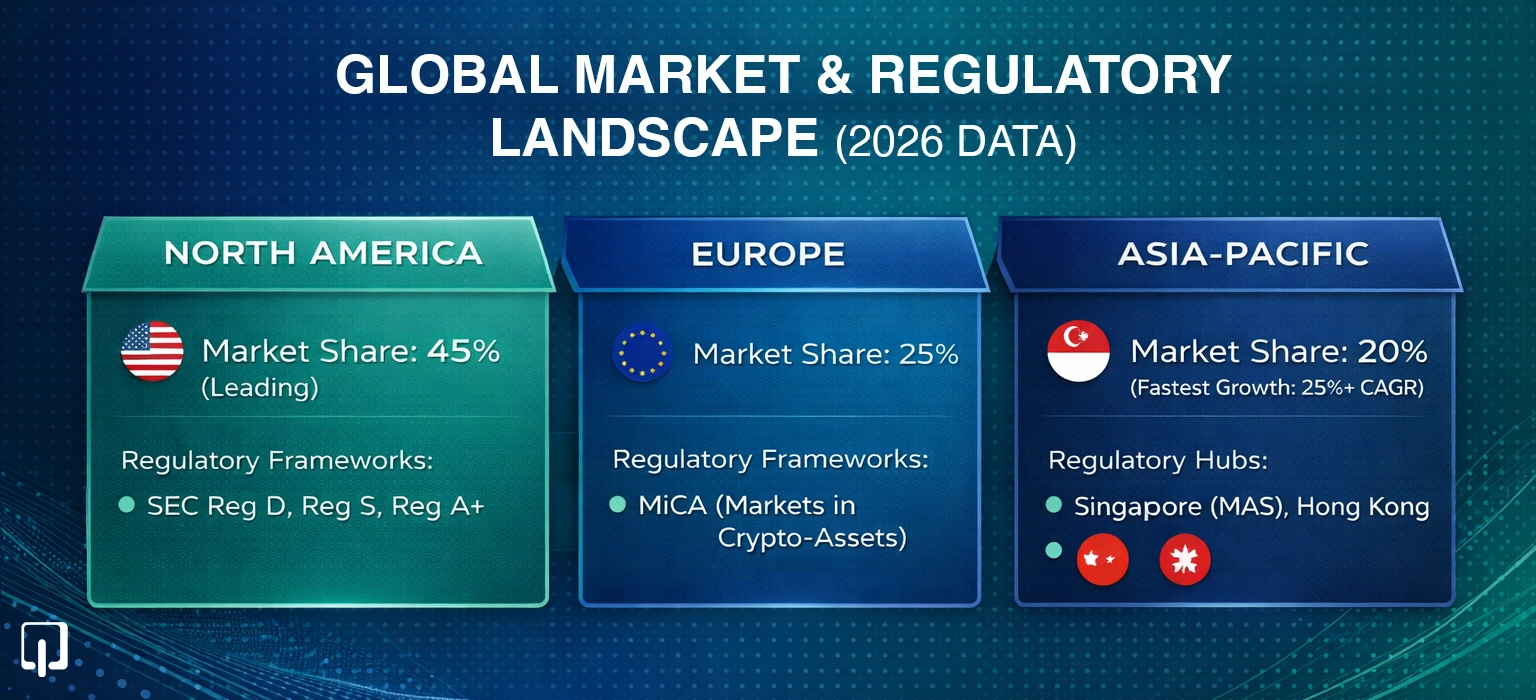
Regional market distribution shows North America leading with 45% market share, benefiting from established SEC frameworks including Regulation D, Regulation S, and Regulation A+ pathways. Europe captures 25% market share with the Markets in Crypto-Assets (MiCA) regulation driving ERC-3643 adoption. The Asia-Pacific region, though currently at 20% market share, demonstrates the fastest growth at 25%+ CAGR, led by Singapore and Hong Kong regulatory clarity.
Platforms successfully tokenized over $100 million in assets during 2025, targeting 10% of the $500 billion commercial real estate market for 2026. This trajectory validates both market demand and technological maturity for real estate tokenization development services.
Technical Architecture for Tokenized Real Estate Platforms
Building robust real estate tokenization software requires integrating five core technical layers:
Frontend Layer: User-facing interfaces built with React or Vue.js enable wallet connectivity through MetaMask or WalletConnect, investor dashboards displaying portfolio holdings and performance, and KYC/AML verification workflows. Professional UI/UX design reduces friction in complex blockchain interactions.
Smart Contract Layer: Token contracts implementing ERC-3643 or ERC-1400 standards encode ownership rights, compliance rules managing transfer restrictions, and automated distribution mechanisms ensuring transparent profit sharing. Smart contracts for real estate eliminate intermediaries while maintaining regulatory compliance.
Blockchain Layer: Ethereum Layer 2 solutions like Polygon offer optimal balance of security, cost efficiency, and transaction speed. Alternative blockchains including Hedera Hashgraph and XRP Ledger provide specific advantages for commercial real estate tokenization requiring high throughput.
Off-Chain Integration Layer: Oracle systems fetch real-time property valuations, custody solutions manage legal ownership documentation, and SPV structures maintain legal separation between tokenized assets and platform operations.
Data Storage Layer: IPFS (InterPlanetary File System) stores immutable legal documents and property information, while PostgreSQL databases manage metadata, user profiles, and transaction histories requiring rapid querying.
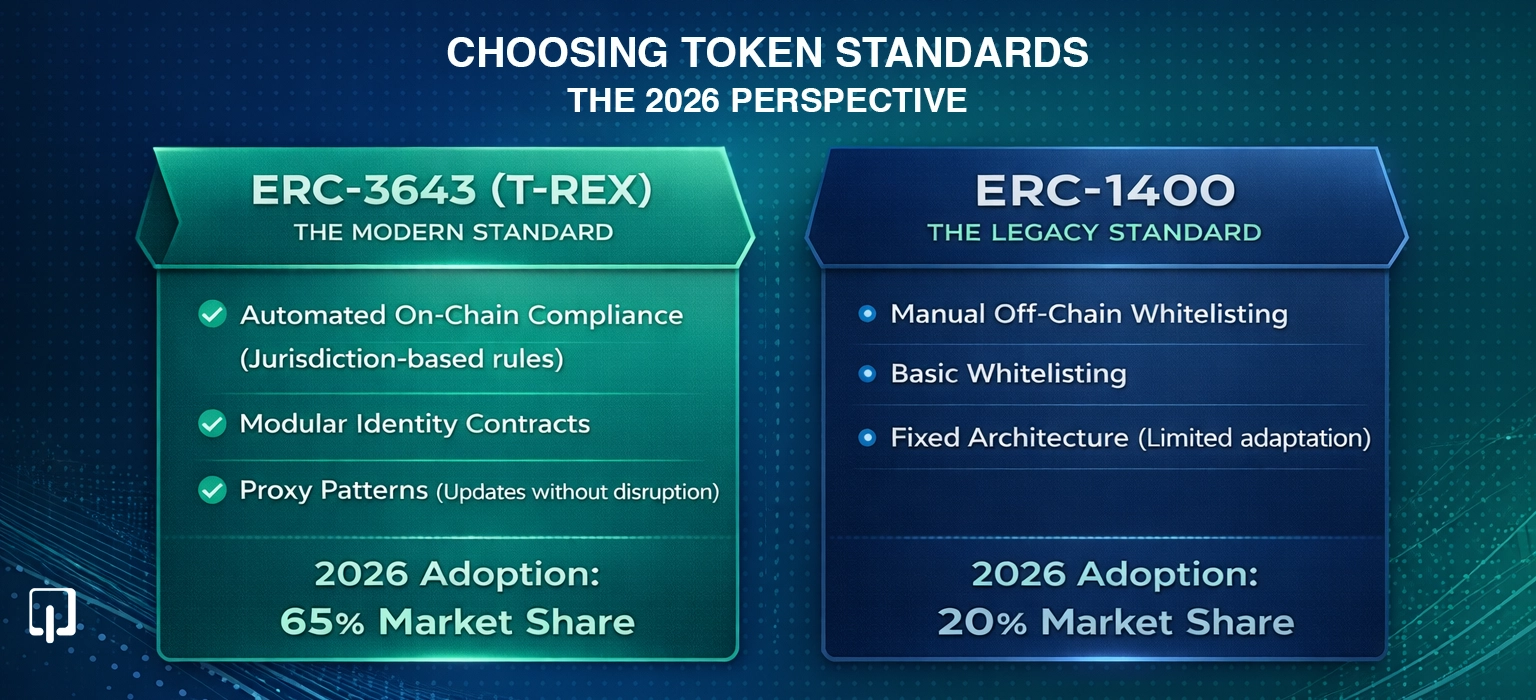
The decision between ERC-3643 and ERC-1400 token standards significantly impacts platform compliance capabilities and operational efficiency. ERC-3643, also known as T-REX (Token for Regulated EXchanges), has emerged as the superior choice for real estate tokenization platform development in 2026.
Compliance Architecture: ERC-3643 implements on-chain KYC/AML verification through modular identity contracts, enabling automated compliance checks during every transfer. The standard supports jurisdiction-based transfer rules, automatically blocking transactions that would violate securities regulations. ERC-1400 relies on basic off-chain whitelisting, requiring manual intervention for complex compliance scenarios.
Identity Management: ERC-3643's modular approach allows platforms to choose between on-chain and off-chain identity storage based on privacy requirements and regulatory frameworks. This flexibility proves essential when operating across multiple jurisdictions with different data protection laws.
Upgradability: ERC-3643 utilizes proxy patterns enabling smart contract upgrades without disrupting token ownership. As regulations evolve, platforms can update compliance logic while maintaining token addresses and investor holdings. ERC-1400's fixed architecture limits adaptation to regulatory changes.
Adoption Trajectory: By 2026, 65% of RWA tokenization platforms have adopted ERC-3643, recognizing its superior compliance automation. Only 20% continue using legacy ERC-1400 implementations, primarily platforms built before ERC-3643 maturation.
A simplified compliance check in ERC-3643 demonstrates automated verification:
function canTransfer(address from, address to, uint256 amount)
This single function automatically validates sender verification, recipient verification, jurisdictional compliance, and investor limit rules before executing transfers.
Development Roadmap and Timeline
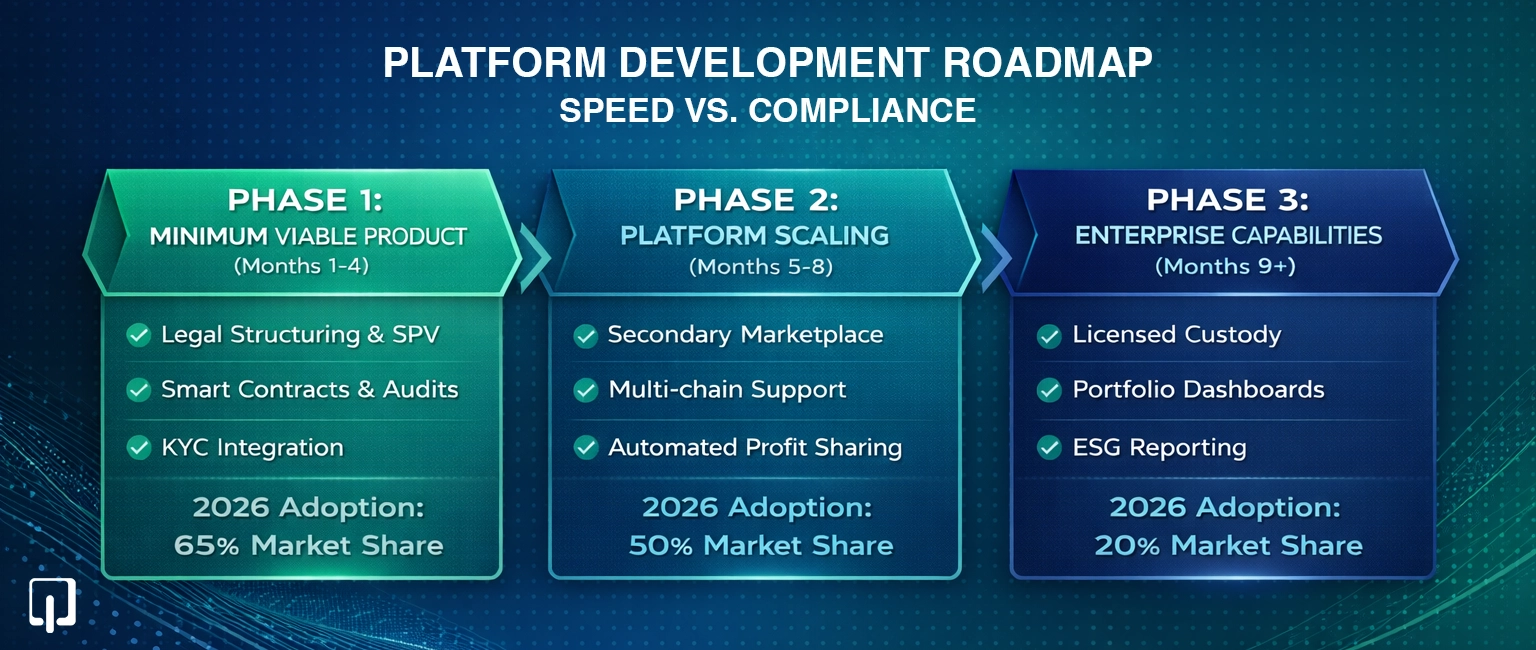
How to build a real estate tokenization platform follows a phased approach balancing speed to market with regulatory compliance:
Phase 1: Minimum Viable Product (3-4 months) establishes core functionality. Weeks 1-4 focus on legal structuring and SPV formation with securities attorneys. Weeks 5-8 cover smart contract development, security audits, and KYC/AML system integration. Weeks 9-12 deliver frontend development and wallet integration testing. Weeks 13-16 complete comprehensive testing and initial STO launch.
Phase 2: Platform Scaling (Months 5-8) adds competitive features including secondary marketplace development for token liquidity, multi-chain support expanding investor accessibility, and automated distribution systems for rental income or profit sharing.
Phase 3: Enterprise Capabilities (Months 9+) introduces institutional-grade features such as licensed custody integration, portfolio management dashboards for multiple properties, and ESG (Environmental, Social, Governance) reporting for sustainable investment tracking.
Cost to Build Real Estate Tokenization Platform 2026
The tokenized real estate platform cost varies significantly based on scope, compliance requirements, and customization needs. Understanding component-level expenses enables accurate budget planning:
MVP vs Enterprise Cost Breakdown
Showing 6 rows
Component
MVP Cost Range
Enterprise Cost Range
Legal & Compliance
$5,000 - $15,000
$20,000 - $50,000
Smart Contracts
$8,000 - $20,000
$30,000 - $60,000
Frontend & Backend
$10,000 - $25,000
$40,000 - $80,000
Blockchain Infrastructure
$2,000 - $5,000
$10,000 - $25,000
KYC/AML Integration
$3,000 - $8,000
$15,000 - $30,000
Total Investment
$28,000 - $73,000
$115,000 - $245,000
Legal and compliance costs cover securities attorney consultation, SPV formation documentation, regulatory filing preparation, and ongoing compliance advisory. These expenses represent critical investments preventing future regulatory challenges.
Smart contract development includes token contract programming, compliance logic implementation, security audits by specialized firms, and automated distribution mechanisms. Professional audits from firms like CertiK or OpenZeppelin cost $15,000-$40,000 but prevent vulnerabilities that could compromise entire platforms.
Frontend and backend development encompasses user interface design, wallet integration, KYC dashboard creation, administrative panels, and API development for third-party integrations.
Blockchain infrastructure covers node setup, gas fee management systems, multi-chain integration, and monitoring tools ensuring platform reliability.
White label real estate tokenization platforms reduce development time by 40-60% and costs by similar margins. Providers like Blocktunix ($25,000-$50,000, 4-6 weeks), Blockchain App Factory ($30,000-$60,000, 6-8 weeks), and Brickken ($40,000-$80,000, 8-10 weeks) offer pre-built solutions with customization options.
Return on Investment Analysis
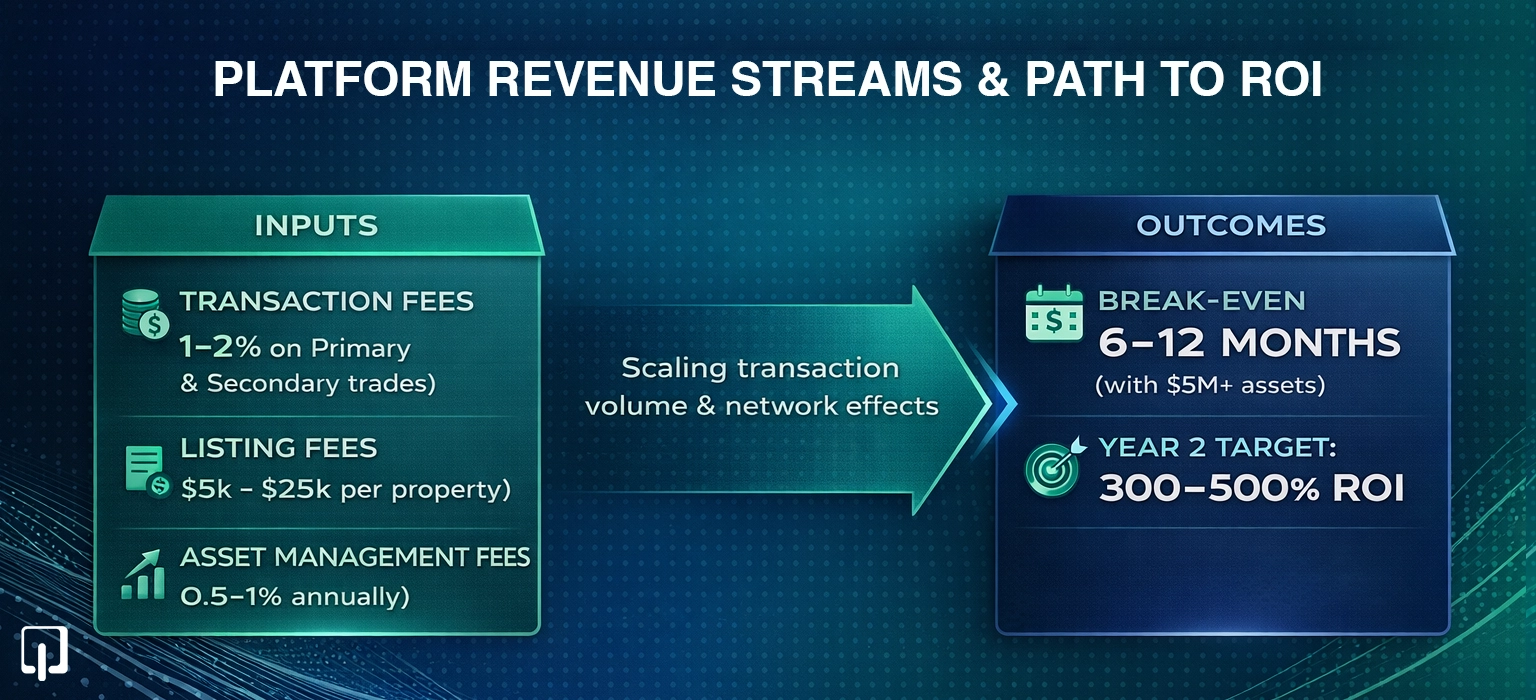
Real estate tokenization platform development delivers compelling ROI through multiple revenue streams. Platforms typically charge 1-2% transaction fees on both primary offerings and secondary market trades. With $5 million in tokenized assets and 10% annual trading velocity, platforms generate $50,000-$100,000 annual revenue from transaction fees alone.
Additional revenue sources include listing fees from property owners ($5,000-$25,000 per property), asset management fees (0.5-1% annually on total tokenized value), and technology licensing to white-label partners.
Break-even typically occurs within 6-12 months for platforms tokenizing $5+ million in assets. By year two, successful platforms achieve 300-500% ROI as network effects drive transaction volume growth and reduced per-transaction costs improve margins.
Legal Compliance and Regulatory Framework
Real estate tokenization legal compliance represents the most critical success factor. Platforms must satisfy securities regulations in every jurisdiction where they offer tokens or allow trading.
United States: The Securities and Exchange Commission classifies real estate tokens as securities, requiring registration or exemption qualification. Regulation D (Rule 506b, 506c) allows private placements to accredited investors. Regulation A+ enables public offerings up to $75 million annually with simplified reporting. Regulation S permits offshore offerings to non-US investors.
European Union: The Markets in Crypto-Assets (MiCA) regulation, effective 2024, establishes comprehensive framework for asset-referenced tokens. Platforms must obtain authorization, maintain capital requirements, and implement investor protection measures.
Singapore: The Monetary Authority of Singapore regulates tokenized securities under the Capital Markets Services license framework, requiring platforms to satisfy rigorous operational, financial, and compliance standards.
United Arab Emirates: Dubai's Virtual Asset Regulatory Authority (VARA) provides progressive regulatory framework attracting regional tokenization platforms while maintaining investor protection standards.
Critical compliance requirements span all jurisdictions:
SPV Structure: Tokens must be backed by legal entities (LLC, Trust, or similar) holding actual property ownership, ensuring token holders possess enforceable rights.
KYC/AML Verification: On-chain identity verification prevents money laundering while maintaining compliance with FATF (Financial Action Task Force) recommendations.
Tax Reporting: Automated generation of Forms 1099, K-1, or equivalent tax documents ensures investor compliance and reduces platform liability.
Audit Trails: Immutable blockchain records provide regulatory authorities complete transaction transparency while protecting investor privacy.
White Label vs Custom Development Strategy
The decision between white label real estate tokenization platforms and custom development depends on strategic priorities:
Speed Priority: Organizations requiring rapid market entry (under 3 months) benefit from white label solutions offering pre-built compliance frameworks, tested smart contracts, and established custody partnerships.
Compliance Priority: Platforms operating across multiple jurisdictions or serving institutional clients may require custom ERC-3643 implementations with jurisdiction-specific compliance logic that white label solutions cannot accommodate.
Budget Constraints: Organizations with budgets under $50,000 should prioritize white label solutions, reserving custom development for unique competitive features rather than core infrastructure.
Long-term Scalability: Custom development provides greater architectural flexibility for platforms planning significant feature expansion, multi-chain deployment, or white-labeling their own solutions to third parties.
Implementation Success Stories
Zoniqx Commercial Real Estate Platform has tokenized over $100 million in commercial assets using XRP Ledger and Hedera blockchain networks. The platform achieved 10x liquidity improvement compared to traditional commercial real estate investments, demonstrating fractional ownership viability for institutional-grade properties.
RealT Residential Platform has tokenized 500+ US properties, migrating from basic ERC-20 tokens to ERC-3643 for enhanced compliance. Monthly rental distributions are automated through smart contracts, providing investors passive income with complete transparency. The platform proves residential real estate tokenization scalability.
Regulatory Change Risk (High Probability): Multi-jurisdiction compliance frameworks and modular smart contract architecture enable rapid adaptation to regulatory updates without platform disruption.
Oracle Failure Risk (Medium Probability): Multi-oracle redundancy using Chainlink, Band Protocol, and manual verification for critical valuations prevents single points of failure in price discovery.
Smart Contract Vulnerability (Low Probability): Professional security audits, bug bounty programs, and phased deployment with locked contracts minimize exploitation risks.
Liquidity Risk (Medium Probability): Secondary market partnerships, market maker agreements, and redemption mechanisms ensure investors can exit positions without excessive discounts.
Custody Risk (High Probability): Licensed custodian partnerships, multi-signature wallet controls, and insurance coverage protect investor assets from theft or loss.
Future Development Trends
Real estate tokenization platform development in 2026 and beyond will be shaped by five key trends:
Institutional Adoption: Major asset managers including BlackRock and Apollo Global Management are entering tokenized real estate markets, bringing credibility, capital, and sophisticated investor bases.
Multi-Chain Architecture: Platforms are deploying across Ethereum Layer 2, Solana, and Hedera simultaneously, allowing investors to choose optimal networks for their transaction patterns and cost preferences.
AI-Powered Compliance: Automated investor classification, jurisdiction-based transfer rule generation, and regulatory change monitoring reduce compliance costs while improving accuracy.
ESG Tokenization: Green building certifications, carbon credit integration, and sustainability metrics are becoming standard features, commanding premium valuations from impact investors.
DeFi Integration: Using tokenized real estate as collateral for decentralized lending protocols creates additional yield opportunities and liquidity mechanisms for token holders.
Strategic Recommendations for Platform Development
Organizations planning real estate tokenization development services should prioritize these proven strategies:
Start with ERC-3643 MVP deployment on Polygon to balance compliance capabilities with cost efficiency. The standard's built-in regulatory framework reduces ongoing compliance expenses while supporting global investor bases.
Partner with established white label providers for rapid market entry, reserving custom development resources for differentiating features like unique property types, innovative distribution models, or proprietary valuation methodologies.
Target US and EU commercial real estate initially, leveraging established regulatory frameworks and institutional investor familiarity with asset class fundamentals.
Build secondary market liquidity from day one through market maker partnerships, redemption mechanisms, and integration with established security token exchanges.
Plan multi-chain expansion for year two, analyzing investor preferences and cost optimization opportunities across blockchain networks.
Conclusion
Building a real estate tokenization platform in 2026 requires balancing technical sophistication, regulatory compliance, and market strategy. Development costs ranging from $28,000 for MVP implementations to $245,000 for enterprise solutions deliver compelling returns in a market projected to reach $19.3 billion by 2035. The adoption of ERC-3643 token standards, implementation of automated compliance through smart contracts, and deployment on cost-efficient Layer 2 blockchains enable platforms to offer fractional ownership with minimal capital requirements. Success demands partnership with securities attorneys, blockchain developers, and compliance specialists who understand both technological capabilities and regulatory requirements. Organizations that prioritize legal compliance, investor protection, and operational transparency will capture the substantial opportunities in tokenized real estate markets.
Technical Debt Kills Tokenization Projects
Building on rigid legacy standards limits your ability to upgrade compliance logic later. We engineer modular ERC-3643 architectures that separate identity, compliance, and token logic—ensuring your platform scales securely.
1. What is the cost to build a real estate tokenization platform in 2026?
Development costs range from $28,000-$73,000 for MVP implementations to $115,000-$245,000 for enterprise platforms. White label solutions reduce costs by 40-60%, offering faster time-to-market at $25,000-$80,000 depending on customization requirements and compliance features.
2. How long does it take to build a real estate tokenization platform?
A minimum viable product requires 3-4 months including legal structuring, smart contract development, and security testing. White label platforms can launch in 4-10 weeks. Enterprise platforms with multi-chain support and institutional custody integration require 9-12 months for complete deployment.
3. What is the difference between ERC-3643 and ERC-1400 token standards?
ERC-3643 provides superior compliance automation with on-chain KYC/AML verification, modular identity management, jurisdiction-based transfer rules, and proxy pattern upgradability. ERC-1400 uses basic off-chain whitelisting with limited compliance automation. By 2026, 65% of platforms have adopted ERC-3643 for real estate tokenization.
4. Which blockchain is best for real estate tokenization platforms?
Ethereum Layer 2 solutions like Polygon offer optimal balance of security, transaction costs, and developer ecosystem. Hedera Hashgraph and XRP Ledger provide advantages for commercial real estate requiring high transaction throughput. Most platforms plan multi-chain deployment to serve diverse investor preferences.
5. What legal requirements must real estate tokenization platforms satisfy?
Platforms must satisfy securities regulations in all operating jurisdictions, implement SPV structures backing tokens with legal ownership, conduct KYC/AML verification, generate tax reporting documentation, and maintain immutable audit trails. Compliance requirements vary by jurisdiction, requiring legal counsel specializing in securities law and blockchain technology.
6. How do real estate tokenization platforms generate revenue?
Primary revenue sources include transaction fees (1-2% on primary and secondary trades), listing fees from property owners ($5,000-$25,000 per property), asset management fees (0.5-1% annually), and technology licensing. Platforms tokenizing $5+ million in assets typically reach break-even within 6-12 months.
7. Can residential properties be tokenized like commercial real estate?
Yes, residential properties including luxury apartments and vacation homes can be tokenized. RealT has successfully tokenized 500+ US residential properties with automated rental distributions. However, commercial real estate dominates with 60%+ market share due to institutional investor preference and higher average transaction values.
8. What are the main risks in real estate tokenization platform development?
Key risks include regulatory changes requiring platform modifications, smart contract vulnerabilities enabling theft or unauthorized transfers, liquidity constraints preventing investors from exiting positions, and custody failures compromising investor assets. Mitigation strategies include multi-jurisdiction compliance, professional security audits, secondary market partnerships, and licensed custodian integration.
9. Is white label or custom development better for real estate tokenization?
White label solutions offer faster deployment (4-10 weeks) and lower costs ($25,000-$80,000) suitable for organizations prioritizing speed and budgets under $50,000. Custom development provides greater flexibility for unique compliance requirements, multi-jurisdiction operations, and long-term scalability, justifying higher investment for institutional platforms.
10. What technical skills are required to develop a real estate tokenization platform?
Development teams require blockchain engineers experienced with Solidity and ERC-3643/1400 standards, full-stack developers proficient in React/Vue.js and Node.js, smart contract auditors, compliance specialists understanding securities regulations, and DevOps engineers managing blockchain infrastructure. Most organizations partner with specialized development firms rather than building in-house expertise.