In 2026, real world asset tokenization is transitioning from speculative narratives to increasingly measurable market dynamics. Across blockchain analytics dashboards, public research briefs, infrastructure forecasts, and legacy market commentary, several clear patterns are emerging, and some long-held assumptions around adoption and scalability are being reshaped.
Rather than focusing on future promises, RWA tokenization trends 2026 are defined by what is already live, what is attracting capital, and what remains structurally difficult to tokenize.
This blog explores those trends through observable market behaviour, institutional activity, and evolving asset classes, with a particular focus on tokenized real-world assets and their role in modern capital markets.
At its core, tokenization of assets is the creation and management of digital tokens that represent claims or rights tied to an underlying asset, often on a programmable platform. The BIS frames token arrangements as something that can reshape market structure across the end-to-end asset lifecycle and stresses that benefits depend on strong governance and risk management.
IOSCO uses a similar framing in its work on financial asset tokenization and focuses heavily on market integrity and investor protection considerations.
So, when people talk about tokenized real-world assets, they are usually talking about:
As of 2026, real world asset tokenization has moved beyond isolated pilots and into a phase of visible, sustained on-chain deployment, primarily across financial assets rather than physical goods.
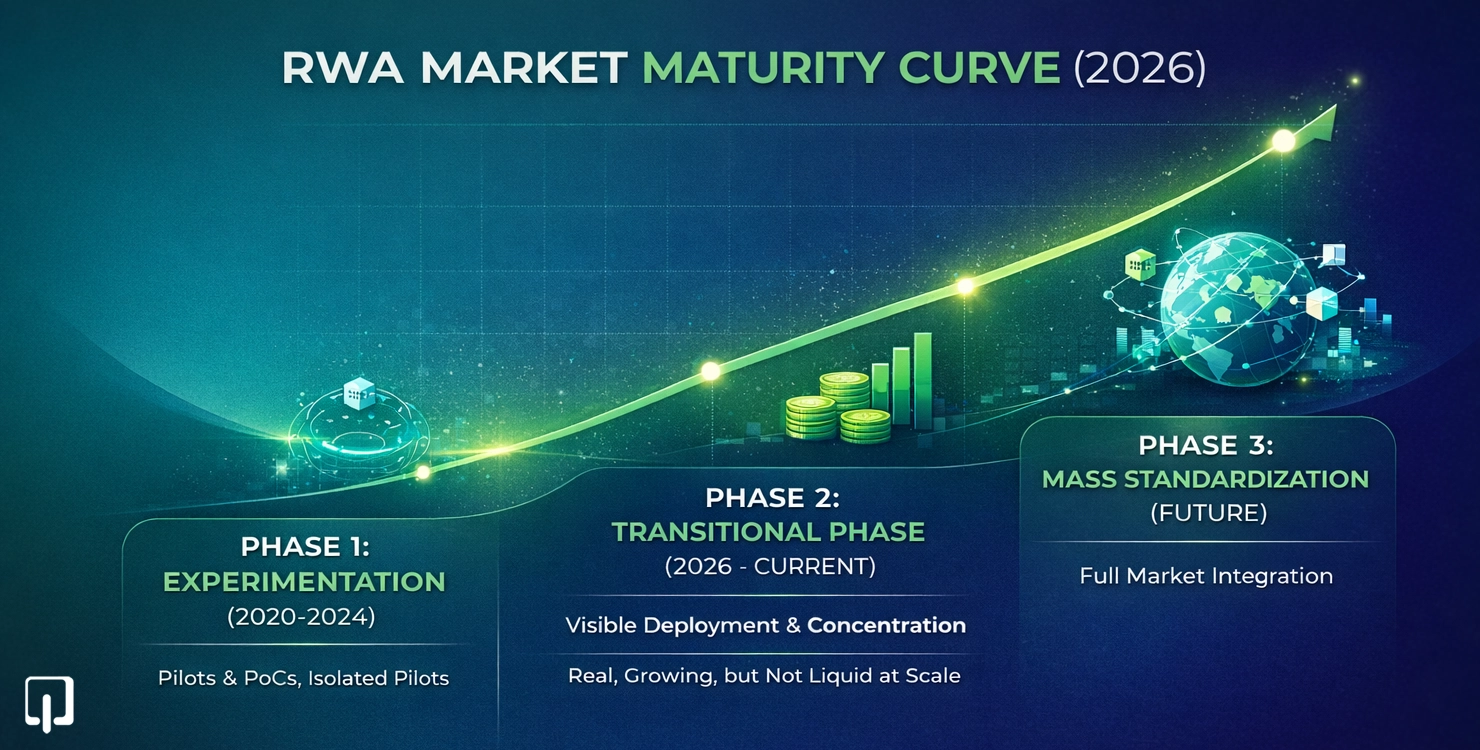
Publicly observable data across multiple trackers and research reports shows that:
In practical terms, the current market can be described as:
Most on-chain value today sits in cash-equivalent or yield-bearing instruments, structured credit exposures, and early-stage tokenized real estate investment models.
This places the RWA market in a transitional phase:
That context is essential for understanding RWA tokenization trends 2026, because most trends today are about where capital is concentrating, what is proving operationally viable, and what is still structurally hard to tokenize.
The real-world asset tokenization market is rapidly growing and becoming more quantifiable. What once seemed like a theoretical concept is now a substantial segment of the digital finance ecosystem.
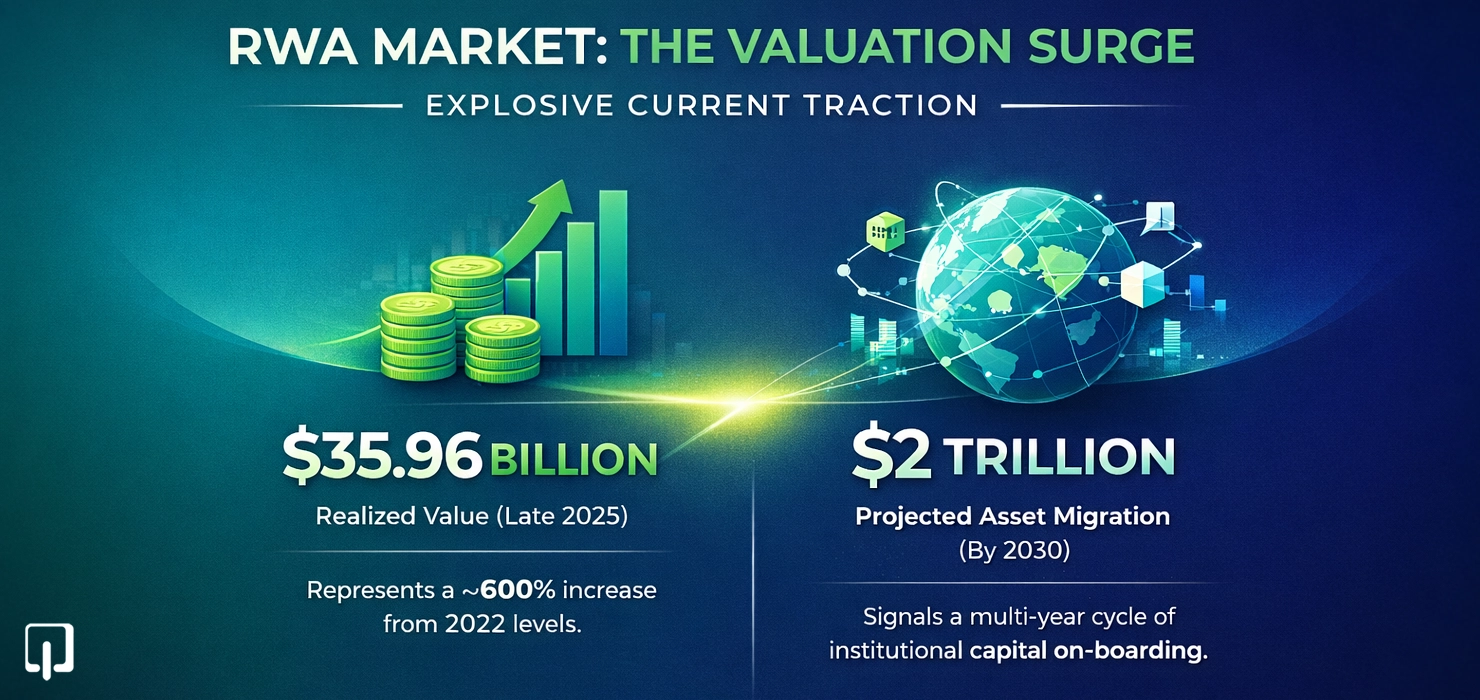
According to multiple market compilers and data aggregators:
These figures indicate that real world asset tokenization is no longer a fringe concept. It is an observable, quantifiable segment of the digital finance ecosystem.
.webp)
Among all RWA tokenization trends 2026, institutional participation stands out as one of the most consequential.
This trend is visible in several ways:
This level of institutional engagement marks a clear departure from earlier crypto cycles, where asset tokenization was largely driven by startups and experimental DeFi protocols. In 2026, real world asset tokenization is increasingly positioned as a component of broader capital-market modernization rather than a standalone crypto narrative.
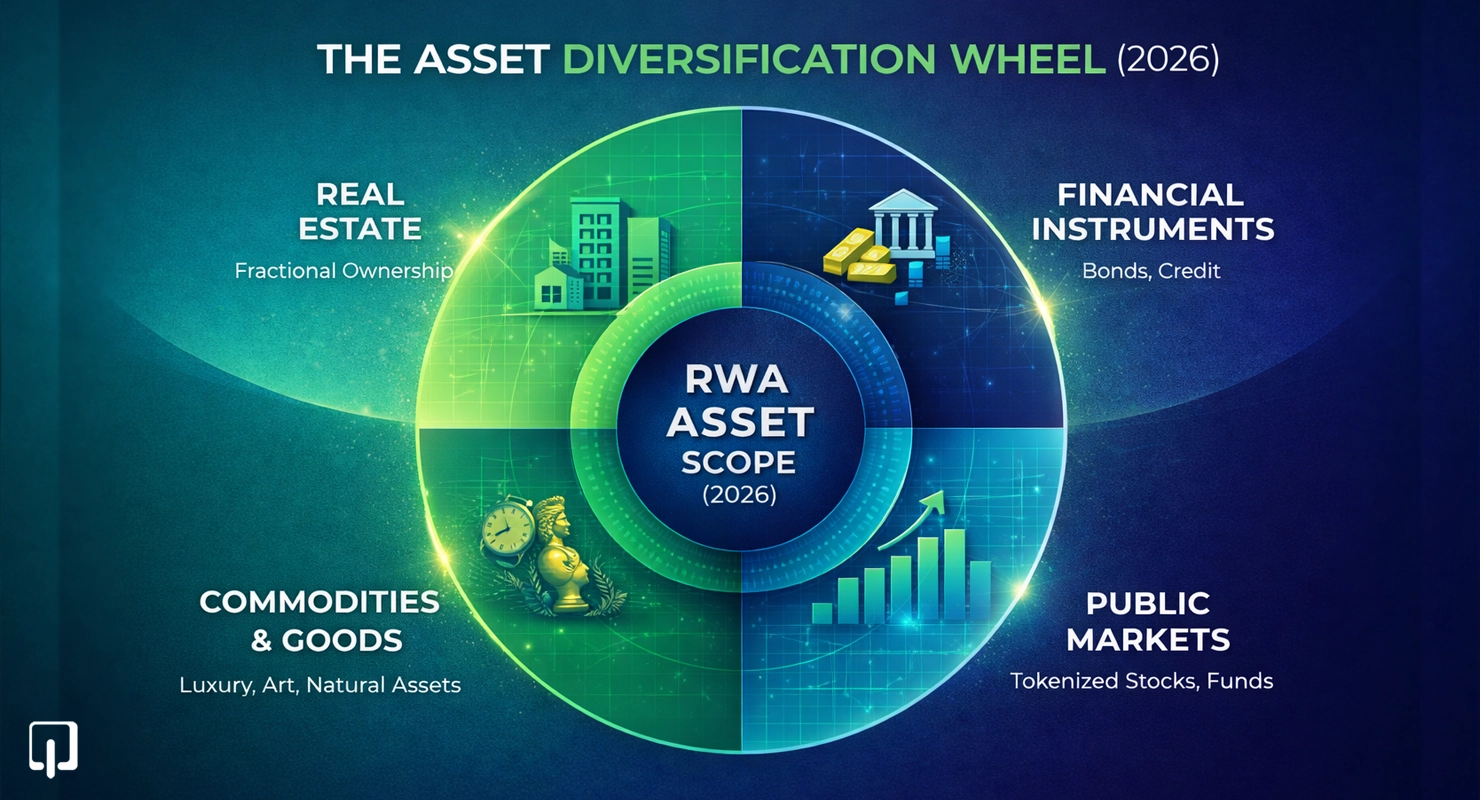
While early tokenization efforts often focused on private credit or short-duration financial instruments, 2026’s landscape is showing diversification across asset classes:
Property is being tokenized for fractional ownership and global investor access.
Tokenization is expanding into luxury goods, art, collectibles, and even natural assets like forestry products in China.
Tokenized stocks and traded funds are being trialled by major exchanges and brokers.
As a result, real world asset tokenization is not confined to a single niche. It is becoming relevant to multiple sectors of global finance and commerce.
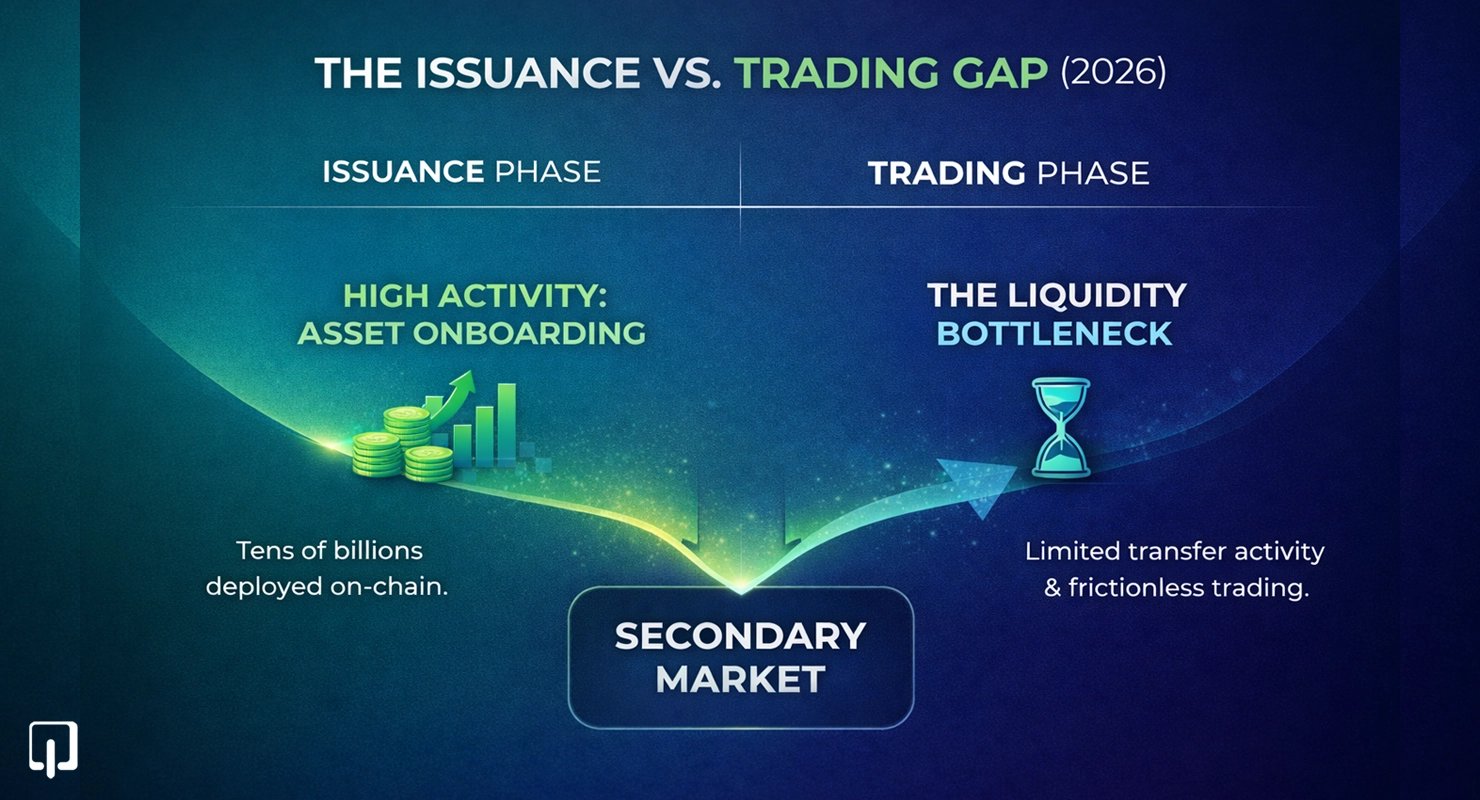
Liquidity, the ability to buy and sell assets with minimal friction, remains one of the most practical challenges in RWA tokenization.
Academic research and market observations highlight that many tokenized assets show limited transfer activity and modest liquidity despite significant on-chain totals.
This pattern reflects both structural issues (e.g., whitelisting, compliance constraints) and nascent secondary market infrastructure.
Instead of being a hurdle, this trend shows where real market development needs to occur, particularly for institutional portfolios and tradable liquidity pools.
Modern asset tokenization platforms rely on more than basic blockchain functionality. Several technical trends are shaping how tokenization of assets is implemented in practice:
These advances indicate steady technical maturation, but interoperability and data integrity remain active focus areas for teams working on RWA tokenization platform development.
A dominant theme across credible reportage is the regulatory reality of RWA tokenization.
The International Organization of Securities Commissions (IOSCO), a major global regulatory body, has publicly highlighted that while tokenization can improve efficiency, it introduces new investor protection risks tied to representation vs ownership and third-party intermediaries.
Some traditional regulators have taken precautionary stances, such as advising brokerages in Hong Kong to pause real-world asset businesses to strengthen risk management practices.
Regulation is not slowing the entire market, but it is shaping how and where tokenization projects can be launched, traded, and adopted for institutional participants.
As a result, regulatory clarity is shaping where and how tokenization initiatives are launched. This environment favours structured approaches, clear disclosures, and robust governance models, particularly for institutional grade RWA tokenization solutions.
As RWA total values rise, so does focus on secondary markets and how investors trade tokenized assets:
This trend marks the transition from issuance phase to trading readiness phase, which historically influences institutional capital allocation decisions.
While true decentralization has long been a crypto ideal, one of the stronger observable trends is the embrace of tokenization by traditional financial institutions and enterprise market players.
Examples include:
This trend shows that real world asset tokenization is being considered not just by builders in DeFi development, but by legacy financial ecosystems looking to modernize settlement, transparency, and ownership record flows.
Multiple industry projections, even conservative research, suggest continued exponential growth of tokenized assets:
These projections reflect both current adoption and future possibility tied to infrastructure, legal frameworks, and market participation.
Across industry commentary and signals, the following use cases are repeatedly listed as part of the 2026 trend set:
These use cases reflect the breadth of real-world asset tokenization adoption, from tangible property to financial instruments.
Across market size, asset diversity, institutional participation, liquidity, technology, and regulation, RWA tokenization trends 2026 point to a market that is steadily maturing.
The ecosystem is no longer defined by hype. It is shaped by measurable growth, real operational deployments, and the increasing role of governance and infrastructure.
Whether approached through custom builds, white label RWA tokenization platform development, or modular RWA tokenization platform development, the direction is clear: tokenization is becoming part of the financial system’s long-term evolution.
As experimentation gives grounding to execution, real world asset tokenization is positioning itself as a structural layer at the intersection of blockchain development and traditional asset finance, with implications that will continue to unfold over the coming decade.

Let’s discuss and plan how we can accelerate your growth. Fill out this form and take the first step towards constant advancement.

We will respond to you within 24 hours.
Access to dedicated product specialists.