


Conversational AI has transitioned from experimental chatbot implementations into fundamental enterprise infrastructure. The global market, valued at $17.97 billion in 2026, projects growth to $82.46 billion by 2034 with a compound annual growth rate of 31.11%. This expansion reflects a critical shift where adoption has moved from innovation pilots to operational baseline expectations across industries.
Seventy-eight percent of companies have integrated conversational AI into at least one operational area, while 64% of customer experience leaders plan to increase investment in conversational AI chatbots in 2026. The technology is increasingly viewed as table stakes for maintaining customer satisfaction and operational efficiency rather than a competitive advantage.
The defining characteristic of 2026 involves convergence between conversational AI, which specializes in natural language understanding and user engagement, and agentic AI, which emphasizes autonomous execution and decision-making. This synthesis enables organizations to move beyond reactive customer service toward proactive, autonomous systems that anticipate needs, initiate actions, and drive measurable business outcomes.
The conversational AI market exhibits divergent growth forecasts from authoritative sources. Fortune Business Insights projects the market will reach $82.46 billion by 2034, with intermediate growth from $17.97 billion in 2026 to $57.4 billion in 2032. Research and Markets forecasts more aggressive expansion, with the market reaching $221.51 billion by 2032, valued at $23.22 billion in 2026, representing a 44.5% CAGR.
Capital allocation from technology leaders underscores market confidence. The six largest U.S. technology companies collectively invested $212 billion in 2025, representing a 63% year-over-year increase, with significant portions directed toward AI infrastructure supporting conversational systems.
Regional dynamics show divergent maturity profiles. North America leads in innovation output, accounting for over 60% of all conversational AI patents filed globally. Asia-Pacific emerges as the fastest-growing regional market, driven by digital transformation, mobile-first consumer bases, and government support for AI initiatives across China, India, Japan, and Australia.
Conversational AI in 2026 is repositioning from reactive, query-response models toward proactive, anticipatory systems that initiate interactions based on behavioral signals and contextual inference. Approximately 65% of consumers prefer receiving offers and recommendations tailored to their specific needs rather than generic communications. More significantly, 71% of customers demonstrate preference for brands that deliver proactive support, with 72% of those experiencing proactive interactions reporting substantially higher satisfaction levels.
Proactive conversational AI operates by analyzing customer behavior patterns, sentiment signals, and contextual data such as purchase history, browsing activity, and service interactions to anticipate needs before customers explicitly request assistance. A telecommunications provider might detect from consumption patterns that a customer is approaching data limits, proactively offering a plan upgrade before service degradation occurs. A financial institution might identify unusual account activity and initiate a security check conversation.
This trend represents a fundamental shift in customer engagement economics. Rather than customers initiating conversations and bearing the friction cost of articulating needs, systems now bear that cost by monitoring behavioral signals and surfacing relevant assistance.
The evolution from text-only chatbots to multimodal conversational systems capable of processing and generating responses across text, voice, images, and visual cues constitutes a major trend reshaping user engagement. Approximately 50% of consumers express preference for multimodal interactions as their default communication mode. IDC forecasts that by 2026, 40% of AI models will blend different data modalities, moving beyond single-modality constraints toward integrated reasoning across text, voice, visual, and contextual signals.
Multimodal integration operates across three dimensions. First, input modality diversity allows users to communicate through voice commands, text queries, image uploads for visual problem-solving, product identification, or receipt processing, and gestures. Second, output modality richness enables systems to respond with combinations that include visual elements, spatial representations, and structured data visualizations. Third, modality context fusion integrates different input types to inform a single continuous interaction.
The infrastructure enabling this shift consists of Large Multimodal Models that process multiple input types natively, improved NLP/NLU capabilities that extract intent from diverse signals, and orchestration frameworks that maintain contextual coherence across modality transitions. This technical stack is mature enough that 82% of companies have integrated voice technology into operations.
Conversational systems have begun developing capability to recognize, interpret, and respond appropriately to human emotional states. Seventy percent of consumers now expect conversational AI to understand and react to their emotions. The technical foundation for emotional intelligence rests on three complementary mechanisms: sentiment analysis algorithms that extract emotional tone from text, voice patterns, speech rate, and acoustic features; behavioral cue interpretation that identifies frustration signals, confusion markers, and satisfaction indicators; and response calibration that adjusts system tone, vocabulary, and escalation behavior based on inferred emotional state.
Seventy-two percent of users report noticing improved AI comprehension of human language and communication styles, while 64% specifically recognize AI's improved response to emotional cues. For customer service operations, emotional intelligence creates efficiency gains. Rather than escalating all frustrated customers to human agents, systems can recognize frustration, modify interaction style toward empathetic tone, and frequently resolve issues at the automated level without human involvement.
Hyper-personalization, the delivery of individually customized interactions, recommendations, and content based on comprehensive user behavioral modeling, has evolved from a retail marketing tactic into a foundational conversational AI capability. Seventy percent of consumers expect companies to use AI for customized interactions and personalized offers, while 66% specifically expect businesses to recognize their unique needs and preferences.
Modern LLM-based systems, combined with advanced customer data platforms and real-time analytics infrastructure, can deliver genuinely personalized responses to millions of simultaneous conversations without exponential cost scaling. User profiles synthesize behavioral history, explicit preferences, and inferred preferences. Conversational context dynamically retrieves relevant profile elements and past interaction history to inform each system response. Companies excelling at personalization report up to 40% revenue lift.
Two-thirds of consumers are willing to exchange additional personal data in exchange for deeper individualization, provided the system demonstrates clear value for that information sharing. This creates a virtuous cycle where more data enables better personalization, which increases engagement, which generates more data.
Voice interaction with conversational AI systems has evolved from a niche accessibility feature into a primary user interface paradigm. Eighty-two percent of companies have integrated voice technology into operations, while 85% of decision-makers forecast widespread adoption across their industries within five years. The technical enabling factor is the maturation of Automatic Speech Recognition technology, which has reached a critical capability threshold with an estimated CAGR of 34.3%.
Seventy-four percent of organizations report improved speech-to-text accuracy, while 68% acknowledge enhanced conversation intelligence capabilities enabled by voice interaction. Most significantly, 64% report cost-saving advantages from voice-based systems, suggesting that voice adoption is driven not just by user preference but by genuine economic efficiency.
Voice-first interfaces deliver particular value in use cases where typing is friction-intensive or unsafe. Automotive contexts represent the clearest example where drivers cannot safely type queries or review onscreen information while operating vehicles. Smart home environments similarly benefit from voice interaction. Healthcare settings benefit from voice-first documentation, where clinicians can naturally narrate observations while maintaining focus on patient care.
The most significant structural shift in conversational AI involves the emergence of autonomous agents, systems that not only understand intent and generate responses but also independently execute complex, multi-step tasks with minimal human intervention. This represents repositioning from conversational interfaces for human decision-making toward autonomous systems that act on behalf of users while maintaining oversight and accountability.
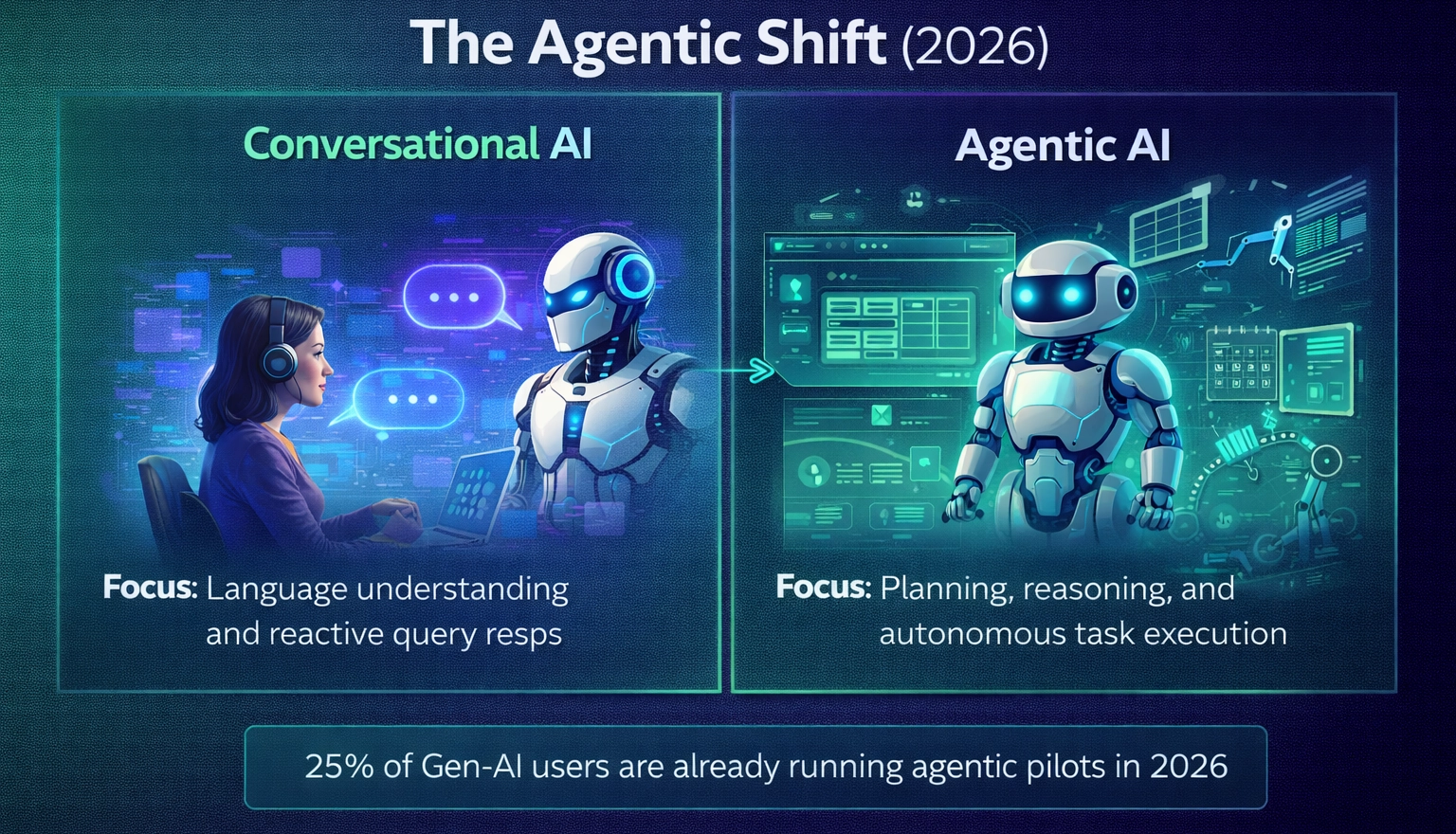
The distinction between conversational AI and agentic AI is architecturally profound. Conversational AI specializes in dialog understanding, intent recognition, and generating contextually appropriate responses. Agentic AI combines conversational understanding with planning, reasoning, execution, and feedback mechanisms. Twenty-five percent of companies using generative AI are running agentic pilots in 2026, with this figure projected to reach 50% by 2027. McKinsey reports that 62% of businesses are currently testing agentic AI, with 23% starting implementation in at least one operational area.
Functionally, autonomous agents set goals independently based on user intent rather than following predefined scripts. They reason about multiple action pathways to achieve goals and select approaches based on likelihood of success and resource efficiency. They coordinate across multiple tools, APIs, and systems without requiring humans to manually sequence these interactions.
Rather than deploying generic conversational platforms across organizations, enterprises are increasingly adopting industry-specialized solutions trained on domain-specific terminology, regulatory requirements, and business processes. Organizations deploying conversational AI systems trained on their specific industry terminology and processes experience 30% reductions in support costs compared to generic chatbot implementations.
Healthcare represents the most advanced vertical implementation. Seventy-eight percent of consumers have used conversational AI or voice agents for health support, with 37% specifically using these systems for symptom checking. Healthcare-specific systems integrate Electronic Health Record data, medical terminology databases, HIPAA compliance controls, and clinical decision support algorithms.
Finance and banking represent the second-most mature vertical, with 48% of U.S. banks planning generative AI integration into customer-facing systems and projected 110 million U.S. banking customers using chatbots by 2026. Financial-specific systems integrate account data, transaction history, regulatory compliance requirements, fraud detection algorithms, and financial product information.
Retail and e-commerce show rapid vertical specialization. Retailers deploying conversational AI-driven product discovery achieve 47% faster purchase completion rates and up to 10x increases in conversion rates in some use cases. Retail and e-commerce account for 21% of the global conversational AI market, with anticipated chatbot spending reaching $72 billion by 2028.
Large Language Models have evolved to achieve near-human-level language understanding and generation, with training data growing at an average rate of 260% annually and computational training capacity increasing at 360% annually over the past fifteen years. This exponential scaling has driven down inference costs while enabling more sophisticated reasoning and contextual understanding.
Natural Language Processing has achieved sufficient maturity that 69% of service agents actively use NLP tools to automatically convert conversational requests into structured actions. This automation reduces the need for manual request parsing and classification, accelerating request handling and reducing error rates.
Emotional intelligence capabilities have advanced sufficiently that conversational systems can now recognize and respond appropriately to emotional tone, sentiment, and behavioral cues. Sixty-four percent of users recognize AI's improved response to their emotions, demonstrating meaningful progress.
Organizations should begin by identifying specific business outcomes conversational AI will support. Rather than pursuing broad implementation mandates, high-performing organizations define specific use cases with measurable success metrics. For example, reducing average customer service handle time from 8 minutes to 4 minutes while maintaining or improving CSAT scores, or enabling 80% of FAQ inquiries to be resolved without escalating to human agents.
Early-stage implementations should focus on high-volume, lower-complexity inquiries before advancing to complex, context-dependent interactions. As organizational capability matures, scope can expand to include emotional intelligence, autonomous agents, and proactive engagement.
Vendor selection should extend beyond pricing and feature evaluations to assess deep capabilities in target vertical, regulatory compliance expertise, deployment flexibility, and support for iterative improvement. Organizations should prioritize vendors with industry-specific implementation experience, regulatory compliance expertise, integrated tooling for bias detection and conversation analytics, support for multimodal interfaces and voice integration, and pricing models aligned with enterprise scale.
Successful conversational AI implementations require well-structured, representative training data. Organizations should conduct early data audits to assess whether customer service transcripts are available for training, whether customer data is accessible in normalized databases, and whether data governance processes exist to manage sensitive information. Data preparation typically accounts for 40-60% of implementation timeline.
Rather than optimizing for technical metrics, align measurement to business outcomes. Relevant metrics include containment rate, first-contact resolution rate, customer satisfaction, average handle time reduction, cost-per-interaction savings, and customer lifetime value impact.
Conversational AI performance improves substantially through continuous tuning and feedback incorporation. Organizations should establish processes for identifying conversational failure cases, analyzing root causes, and refining models based on learnings. Every user conversation generates data that identifies opportunities for model refinement.
Despite rapid adoption, conversational AI deployment faces substantial obstacles around data privacy and security. Forty percent of organizations have experienced AI-related privacy breaches, while over 50% of consumers view conversational AI's use of personal data as a significant privacy threat. The EU AI Act, which entered binding force in 2025, establishes transparency and oversight requirements for conversational AI deployments.
Conversational AI systems trained on large language models inherit biases present in training data and can perpetuate discriminatory outcomes. Sixty-three percent of consumers worry about bias and discrimination in algorithm decision-making. Addressing bias requires systematic approaches including diverse and representative training data, regular bias audits using standardized measurement frameworks, and monitoring of real-world system outputs for discriminatory patterns.
Many enterprises struggle to integrate conversational AI with existing legacy systems. Twenty-two percent of IT decision-makers report having data trapped in systems that cannot be migrated, while 79% struggle with undocumented data pipelines. Addressing legacy integration challenges typically requires substantial middleware investments or phased system modernization.
User trust remains a significant adoption obstacle. Fifty-seven percent of global consumers view AI as a privacy threat, while 61% remain distrustful of conversational AI systems. Building trust requires transparency, reliability, accountability, and demonstrated respect for user autonomy.
Conversational AI has evolved from experimental technology to foundational enterprise infrastructure in 2026. The seven key trends collectively represent a fundamental repositioning of how organizations interact with customers and employees. Organizations that implement conversational AI effectively will deliver measurably superior customer experiences, realize substantial cost savings, and improve employee productivity.
The competitive imperative is clear: conversational AI is not a differentiating feature but table stakes. Organizations that fail to implement conversational AI capabilities competently will find themselves increasingly unable to compete for customers and talent who expect frictionless, intelligent, personalized interactions as default. The market opportunity is substantial, with projections reaching $82-221 billion by 2032 depending on adoption velocity.
Looking beyond 2026, conversational interfaces will evolve toward autonomous agency, emotional and ethical intelligence will mature, multimodal ubiquity will become the default, sovereign and localized AI systems will emerge, and human-AI collaboration will become the standard operating model. Organizations investing in conversational AI development services, NLP development services, and machine learning development services today position themselves for sustained competitive advantage in an AI-driven future.
Conversational AI uses natural language processing, machine learning, and large language models to understand context, intent, and sentiment in human communication. Unlike traditional chatbots that follow predefined scripts and rules, conversational AI systems learn from interactions, handle complex queries, maintain context across conversations, and provide personalized responses. Traditional chatbots typically offer menu-driven interactions, while conversational AI enables natural, human-like dialogue.
Organizations implementing conversational AI in customer service experience 30% reductions in support costs, 47% faster resolution times, and substantial improvements in customer satisfaction scores. Systems handle high-volume, routine inquiries autonomously, reducing the need for human agent intervention. Conversational AI operates 24/7 without fatigue, maintains consistent service quality, and scales efficiently during peak demand periods. This allows human agents to focus on complex, high-value interactions requiring emotional intelligence and judgment.
Conversational AI in healthcare manages appointment scheduling, conducts symptom pre-screening, provides medication reminders, and enables patient education. Seventy-eight percent of consumers have used conversational AI for health support. Healthcare-specific systems must integrate Electronic Health Record data while maintaining HIPAA compliance controls, implement audit trails for regulatory oversight, and provide human escalation pathways for clinical decisions. Ambient AI scribes automatically transcribe clinical encounters, eliminating documentation burden for physicians.
Voice-first interfaces have become a primary user interaction paradigm, with 82% of companies integrating voice technology into operations. Automatic Speech Recognition technology is growing at 34.3% CAGR, driven by improved accuracy, reduced latency, and enhanced noise robustness. Voice interfaces deliver particular value in hands-free contexts like automotive, smart home, and healthcare documentation. Seventy-four percent of organizations report improved speech-to-text accuracy, while 64% cite cost-saving advantages from voice-based systems.
Conversational AI specializes in dialog understanding, intent recognition, and generating contextually appropriate responses. It answers questions and provides guidance but typically requires human action to execute decisions. Agentic AI combines conversational understanding with planning, reasoning, and autonomous execution. Agentic systems independently determine steps required to achieve goals, sequence actions across multiple tools and systems, monitor outcomes, and adapt based on results. Twenty-five percent of companies using generative AI are running agentic pilots in 2026.
Hyper-personalization delivers individually customized interactions based on comprehensive user behavioral modeling. Systems synthesize behavioral history, explicit preferences, and inferred preferences into user profiles. Conversational context dynamically retrieves relevant profile elements and past interaction history to inform each response. Recommendation engines integrated within conversational flows surface products, services, or information aligned with individual user models. Companies excelling at personalization report up to 40% revenue lift.
Key challenges include data privacy and security concerns, with 40% of organizations experiencing AI-related privacy breaches. Bias and fairness issues affect 63% of consumers who worry about discriminatory algorithm decision-making. Legacy system integration obstacles impact 79% of organizations struggling with undocumented data pipelines. User trust remains problematic, with 61% of consumers remaining distrustful of conversational AI systems. Organizations must address these challenges through systematic governance, bias audits, middleware investments, and transparency measures.
Healthcare leads with 78% consumer adoption for health support and 33.7% CAGR through 2028. Finance and banking show 48% of U.S. banks planning generative AI integration, with 110 million projected users by 2026. Retail and e-commerce demonstrate 47% faster purchase completion rates and account for 21% of the global market, with $72 billion in anticipated chatbot spending by 2028. Each vertical deploys industry-specialized solutions trained on domain-specific terminology, regulatory requirements, and business processes.
Organizations should measure business outcomes rather than technical metrics. Key performance indicators include containment rate, measuring the percentage of interactions resolved without human escalation; first-contact resolution rate; customer satisfaction scores; average handle time reduction; cost-per-interaction savings; and customer lifetime value impact. Organizations implementing conversational AI report 30% support cost reductions and 47% faster resolution times when optimizing for these business-aligned metrics.
Future trajectories include convergence between conversational interfaces and autonomous agency, with most enterprise systems incorporating agentic capabilities by 2030. Emotional and ethical intelligence will mature beyond basic sentiment detection toward deeper emotional understanding. Multimodal ubiquity will become the default, with text-only interfaces viewed as legacy technology. Sovereign and localized AI systems optimized for specific languages, dialects, and regulatory regimes will emerge. Human-AI collaboration will become the standard operating model, with AI handling routine interactions and humans focusing on complex problem-solving.

Let’s discuss and plan how we can accelerate your growth. Fill out this form and take the first step towards constant advancement.

We will respond to you within 24 hours.
Access to dedicated product specialists.



.png)

.png)

