


The conversation around artificial intelligence has shifted from “should we adopt AI?” to “which type of AI fits our business goals best?” Two terms dominate enterprise boardrooms in 2026: agentic AI and conversational AI. While both fall under the broader AI umbrella, they serve fundamentally different purposes, and understanding the distinction is critical for any business leader, product manager, or developer planning their AI strategy.
Conversational AI powers the chatbots and voice assistants you interact with daily. Agentic AI, on the other hand, operates behind the scenes, autonomously executing complex workflows without waiting for a human to press “next.” Together, they form the backbone of modern AI for business automation, but confusing one for the other can lead to misallocated budgets, underwhelming results, and missed opportunities.
This article breaks down the core differences between agentic AI vs. conversational AI, explains where each delivers the most value, and shows how forward-thinking enterprises are combining both for maximum impact.
Conversational AI refers to AI systems, including chatbots, voice bots, and virtual assistants, that understand, process, and respond to human language across channels like web chat, mobile, SMS, and voice. These systems rely on:
· Natural Language Processing (NLP): To interpret user intent from unstructured text or speech
· Machine Learning Models: To improve response accuracy over time through training data
· Dialogue Management: To maintain context across multi-turn conversations
· Back-end Integrations: To fetch information or trigger simple actions (like checking an order status)
The key characteristic of conversational AI is that it is interaction-centric and reactive. It responds when a user or support agent initiates a query and operates within tightly scoped flows defined by conversational designers and business rules. Think of AI chatbots answering FAQs, customer support chatbots routing tickets, or banking chatbots helping with password resets.
By 2025-26, conversational AI adoption has become mainstream. According to Gartner, estimates suggest around two-thirds of large enterprises use AI chatbots, with cost savings of 30-40% in customer service and average annual savings per company of approximately $2.5 million. Chatbots can cut first-response times by up to 90% and reduce ticket volume by roughly 35%.
Agentic AI (or AI agents) describes autonomous systems that can perceive context, reason about goals, plan multi-step workflows, and take actions across software systems with minimal human supervision. Unlike conversational AI, agentic artificial intelligence operates in a perceive-reason-act-learn loop, choosing which actions to take and when.
The core components that separate AI agents from conversational systems include:
· Planning Engines: Decompose high-level objectives into executable subtasks
· Tool Orchestration: Call APIs, read and write to databases, and interact with enterprise systems
· Persistent Memory: Retain context across sessions and workflows
· Policy Enforcement: Operate within compliance guardrails and approval hierarchies
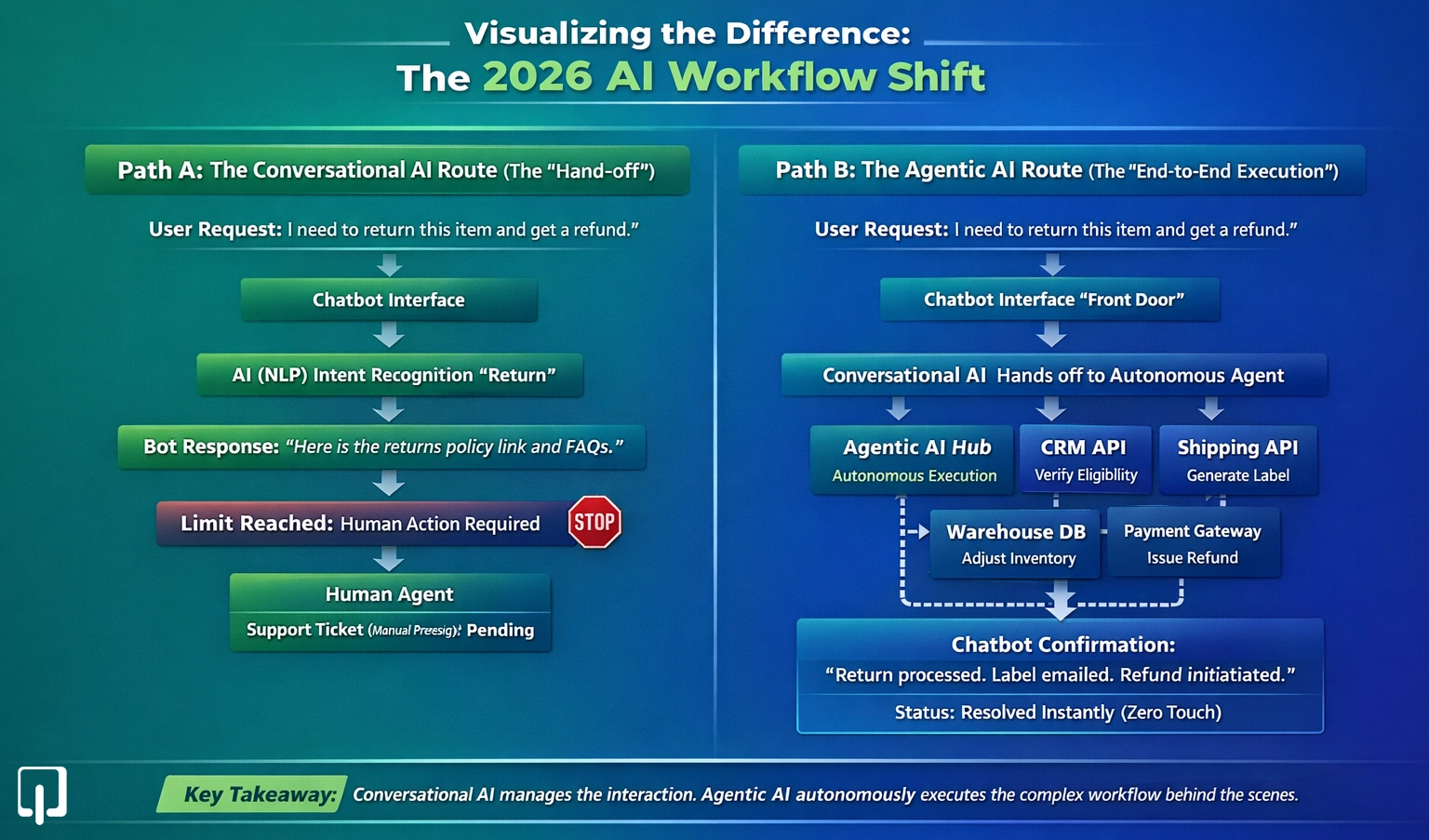
Here is the critical distinction: conversational AI generates responses. Agentic AI generates responses and executes tasks end-to-end. For example, when a customer requests a refund through a chatbot (conversational AI), an agentic AI system behind it can verify eligibility, generate shipping labels, trigger warehouse updates, adjust inventory, and issue the refund, all without a single human touch.
Early production deployments of autonomous AI in banking and financial services, as noted by McKinsey, show reductions of 30-50% in manual workloads, 20-40% in operational costs, and revenue uplifts of 10-30% through better cross-sell, retention, and pricing decisions.
Understanding the difference between AI agents vs conversational AI is easier when you compare them across key business dimensions. The table below highlights the practical distinctions enterprises care about most.
The most advanced 2026 architectures pair both: conversational AI captures intent and provides a human-friendly front door, while agentic AI translates that intent into a series of governed actions across systems.
AI in customer support has matured significantly. Conversational AI now forms the core layer of enterprise support, with many organizations reporting that chatbots handle 30-80% of routine tasks and can automate roughly 30% of contact-center staff activities.
The numbers tell a compelling story:
· Cost Reduction: Customer support chatbots reduce support costs by 20-40%
· Response Speed: First-response times drop by up to 90%
· Customer Sentiment: 88-92% of users report acceptable to good experiences with chatbots when they provide fast, accurate answers
· Consumer Preference: Over 60% of consumers prefer a good bot over waiting for a human
Agentic AI takes this further by converting conversations into fully automated resolutions. For example, an agentic support flow can accept a returns request from a chatbot, verify eligibility, generate labels, trigger warehouse and inventory updates, and issue AI-driven refunds without human intervention. Analyst and vendor case studies for 2025-26 describe 60-80% reductions in return-processing time when autonomous AI agents are deployed behind conversational interfaces.
AI in banking presents one of the clearest contrasts between conversational and agentic approaches.
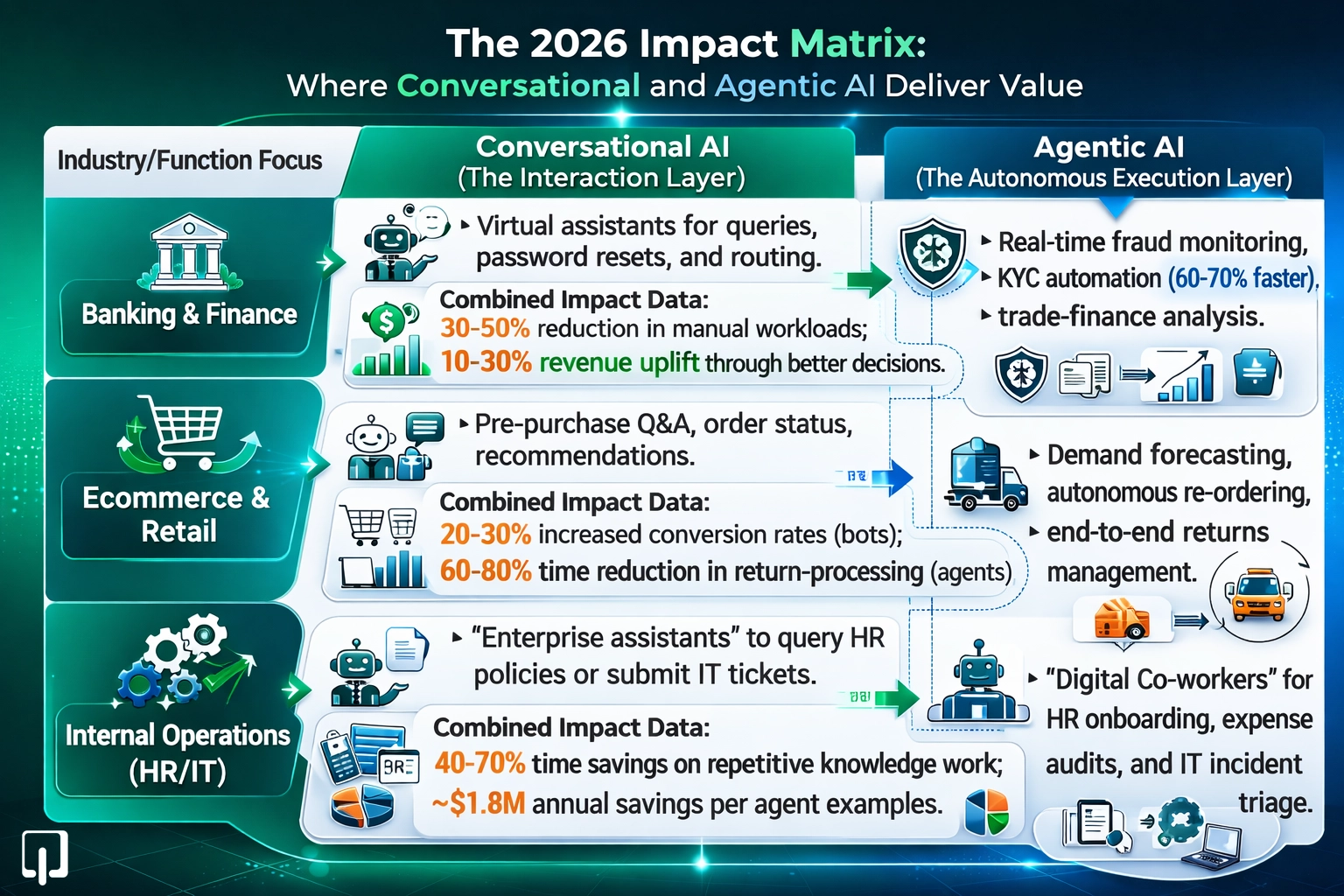
Conversational AI in banking powers virtual assistants that answer account queries, assist with password resets, explain products, and route customers to the right teams. Banks combining conversational AI with analytics report higher digital engagement and cross-sell rates, with one example showing a 25% increase in cross-sell and 35% uplift in digital engagement after rolling out AI-powered advisory agents.
Agentic AI in banking is where the deepest 2026 impact is emerging. Banks are using autonomous agents for:
· Real-time fraud monitoring and lower false positives
· Continuous credit-risk reassessment
· KYC automation with 60-70% faster processing
· Trade-finance document analysis
· SLA monitoring and continuous auditing
· AI-driven treasury optimization and dynamic pricing
Case studies report 30-50% reductions in manual workloads and earlier intervention on deteriorating loans, which together reduce operational cost and non-performing asset risk. Research highlighted by Harvard Business Review that in 2025, about 50 of the world’s largest banks disclosed more than 160 early agentic AI use cases, many targeting “zero-touch” operations by connecting risk, compliance, and core banking systems.
Conversational AI is widely adopted in AI in ecommerce for pre-purchase Q&A, order status updates, product recommendations, and basic returns support via chatbots. Statistics across 2024-26 show ecommerce bots increasing conversion rates by 20-30% and driving roughly 14-15% additional revenue lift through conversational upsell and cross-sell.
Agentic AI extends this by managing operational workflows behind the scenes:
· Demand Forecasting: Agents forecast demand and automate re-ordering
· Returns Management: AI-powered returns processing with 60-80% time reduction through end-to-end logistics coordination
· Dynamic Merchandising: Adjusting product placement based on real-time shopper behavior
· Supply Chain Optimization: Monitoring stock levels, supplier lead times, and promotion calendars to automatically generate purchase orders or rebalance inventory
One reported result showed a 23% conversion uplift from AI agents that proactively guide shoppers and personalize flows. This goes beyond what a conversational bot can achieve, which typically only surfaces limited order or stock information without re-planning the underlying operations.
Within enterprises, conversational AI serves as an interface to internal systems. Employees use chat-like experiences to query HR policies, submit IT tickets, pull reports, or trigger standard AI-enabled workflows. These “enterprise assistants” reduce friction in accessing information, but most actual execution still happens in traditional workflow engines or by humans.
Agentic AI is being deployed as digital co-workers that own and execute entire processes:
· HR Onboarding: Cutting administrative work by 50-60%
· Expense Management: Automated receipt capture and policy checks
· Financial Close: Autonomous reconciliation and exception handling
· IT Incident Triage: Automated classification, routing, and resolution
Vendors and practitioners report time savings of 40-70% on repetitive knowledge-work tasks when AI agents handle document collection, validation, data entry, and follow-ups. Some manufacturing companies cite around $1.8 million in annual savings per deployed agent through error reduction and improved utilization.
As these agents gain persistent memory and policy awareness, they can continuously monitor processes for exceptions and self-correct, moving enterprises closer to “self-healing” operations.
Conversational AI already supports AI for research by letting users ask natural-language questions over documents, dashboards, and knowledge bases. This improves accessibility of analytics but typically stops at insight generation. The human still decides what actions to take and executes them in downstream tools.
Agentic AI shifts the paradigm from “insight” to “insight-to-action.” Multi-agent systems can continuously ingest market data, internal performance metrics, and unstructured content, then synthesize executive-ready views and kick off follow-up tasks. For AI for market research and AI-driven data analysis, this includes:
· Updating forecasts automatically based on real-time signals
· Recommending price changes triggered by competitive analysis
· Scheduling stakeholder reviews when KPIs breach defined thresholds
· Running scenario analysis and implementing the most promising adjustments within guardrails
Reports from 2025-26 describe leaders building “decision intelligence” layers where agents watch KPIs in real time, compressing data-to-decision cycles. According to MIT Technology Review, this is particularly visible in pricing, treasury, and portfolio optimization use cases.
Conversational AI in enterprises typically requires integration with CRM, ticketing, and knowledge systems, along with guardrails for privacy, PII masking, and secure escalation to human agents.
Agentic AI raises the stakes because agents are allowed to act, not just talk. Banks and other regulated firms address this by:
· Encoding policies as executable logic
· Enforcing approvals for high-risk actions
· Maintaining full audit trails for every decision and API call
· Operating within transaction caps, whitelisted systems, and human checkpoints
Across both paradigms, 2026 best practice is to start in lower-risk domains, calibrate metrics like error rates and override frequency, and only then expand to higher-value workflows as confidence and controls mature. The NIST AI Risk Management Framework provides essential guidance here. Strong monitoring, red-teaming, and continuous retraining remain essential to keep both conversational and agentic systems reliable.
The choice between these two approaches depends on what problem you are solving.
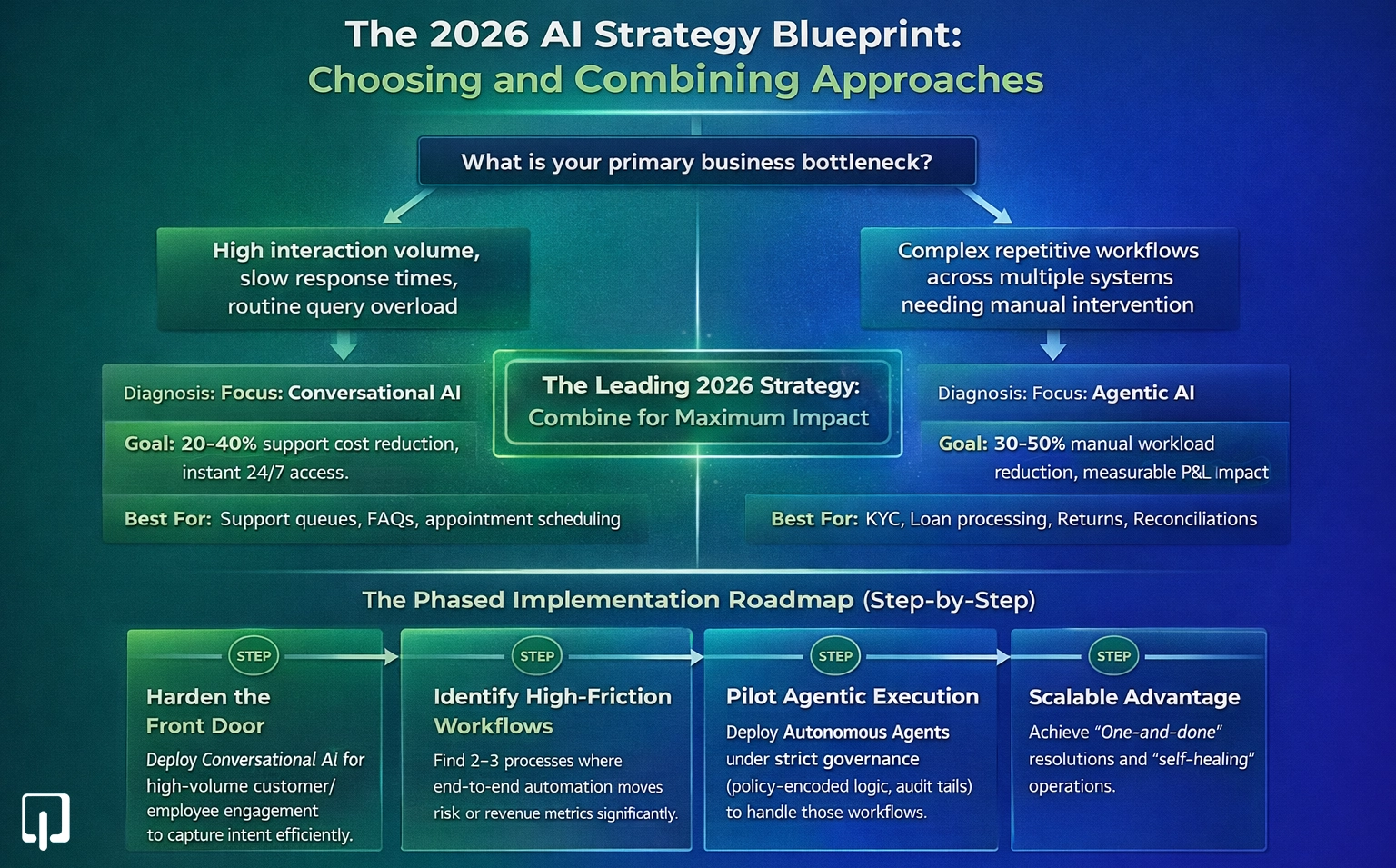
· The primary pain is high interaction volume (support queues, FAQs, lead generation AI, appointment scheduling)
· The goal is reducing response times and deflecting routine work
· You want 20-40% support cost reduction without changing back-office processes
· The bottleneck is executing complex, repetitive workflows across multiple systems
· Processes like KYC, loan processing, returns, inventory adjustments, and reconciliations need end-to-end automation
· You need 30-50% manual-workload reduction and measurable impact on revenue and risk
· Harden conversational AI for high-volume AI for customer experience and employee use cases
· Identify 2-3 high-friction workflows where end-to-end AI for business automation would significantly move P&L or risk metrics
· Pilot agentic AI under strict governance to convert those workflows into scalable advantages
At Webmob, we help enterprises design and build both conversational and agentic AI solutions, from intelligent chatbot development to autonomous workflow agents, ensuring every implementation aligns with your business objectives, compliance requirements, and growth targets.
The distinction between agentic AI vs. conversational AI is not about which technology is better. It is about matching the right tool to the right problem. Conversational AI excels at scaling human interactions, reducing service costs by 30-40%, and delivering instant 24/7 support. Agentic AI goes further by autonomously executing multi-step workflows, cutting manual work by 30-50%, and driving measurable revenue gains. The most effective enterprises in 2026 are not choosing one over the other. They are combining conversational AI as the front door for customer engagement with agentic AI as the execution engine behind it. For businesses ready to move beyond simple chatbots and into intelligent, end-to-end AI for business automation, the path forward lies in understanding where each technology delivers its greatest value and building a strategy that leverages both.
Conversational AI focuses on understanding and responding to human language through chatbots and voice assistants. Agentic AI goes beyond conversation by autonomously planning and executing multi-step workflows across systems with minimal human supervision.
Agentic AI refers to autonomous AI systems that operate in a perceive-reason-act-learn loop. They decompose goals into subtasks, call APIs, interact with enterprise tools, and adapt their plans when conditions change, all without needing continuous human input.
Enterprises use conversational AI primarily for AI in customer support, FAQ handling, lead generation AI, appointment scheduling, and assisting human agents in real time by surfacing knowledge and recommending next best actions.
Yes. Leading enterprises in 2026 pair conversational AI to capture intent and engage users with agentic AI to translate those conversations into automated actions, creating “one-and-done” customer resolutions.
Banks use autonomous agents for real-time fraud monitoring, KYC automation (60-70% faster processing), continuous credit-risk reassessment, trade-finance document analysis, and AI-driven treasury optimization.
Conversational AI reduces support costs by 20-40%, while agentic AI cuts manual workloads by 30-50%. Combined deployments achieve operational cost reductions of 20-40% with additional revenue uplifts of 10-30%.
AI agents in ecommerce manage demand forecasting, automate re-ordering, orchestrate full returns and refunds, and adjust merchandising in real time, delivering up to 23% conversion uplift and 60-80% reductions in return-processing time.
Yes, when deployed with proper governance. Regulated firms implement policy-encoded logic, approval hierarchies for high-risk actions, full audit trails, transaction caps, and human checkpoints to ensure compliance.
Studies and vendor benchmarks report that conversational AI delivers an average ROI of around 340% in the first year when deployed at scale, with first-response time reductions of up to 90%.
Webmob specializes in building both conversational AI and agentic AI solutions as a full-stack software development company, helping enterprises design intelligent chatbots, autonomous workflow agents, and integrated AI architectures that align with specific business goals and compliance requirements.

Let’s discuss and plan how we can accelerate your growth. Fill out this form and take the first step towards constant advancement.

We will respond to you within 24 hours.
Access to dedicated product specialists.




.png)

