What happens when the physical world's most valuable assets meet the intelligence of autonomous AI on the blockchain?
Real-World Asset (RWA) tokenization is already unlocking fractional ownership, enhanced liquidity, and decentralized trading of physical assets like real estate, securities, and commodities. Yet challenges in compliance, valuation, and market efficiency persist. AI agents are changing that by streamlining the entire lifecycle of tokenized assets to make them more secure, efficient, and adaptive to real-world conditions.
In this blog, we explore how AI agents support digital ownership by automating tokenization, improving smart contracts, and enabling real-time compliance.
Tokenization traditionally relies on “static” smart contracts that automate predefined tasks, such as ownership transfer and transaction execution. While effective in many cases, these smart contracts often require manual updates or human oversight for changes in asset values, compliance requirements, or regulatory rules. This lack of adaptability can slow down transactions, reduce market efficiency, and limit the scope of what’s possible within the tokenization ecosystem.
In contrast, AI agents in asset tokenization introduce a level of autonomy and adaptivity that transforms the field. By leveraging these agents, platforms can move from rigid, rule-based systems to more adaptive digital ownership models. This shift allows for a more flexible and efficient tokenization process, paving the way for autonomous AI agents to govern and manage assets without human intervention.
By integrating AI-powered systems into the tokenization stack, these models can automate platform workflows in real time. They also support governance and operational monitoring across the platform.
To understand how AI agents integrate into asset tokenization, it's important to break down the tokenization stack into its key components. Here's an overview of how AI agents in asset tokenization enhance each layer:

AI agents rely on real-time data provided by oracles to feed relevant information, such as market data, asset prices, and external events, into the system. These agents process this data to make intelligent, data-driven decisions that inform asset pricing, market conditions, and token issuance.
At the core of any tokenized asset platform is the blockchain-based tokenization layer, where digital tokens representing real-world assets are created. Here, smart contracts automate the rules governing token ownership, transfers, and rights.
This layer consists of the AI agents responsible for automating key processes like asset valuation, compliance, risk management, and market liquidity. These agents coordinate core workflows such as valuation, compliance, risk management, and liquidity.
On the front end, AI agents personalize the investor experience. They provide tailored insights, real-time pricing updates, and notifications, helping investors make more informed decisions. Web3 and AI integration supports investor communications and platform experience.
One of the most critical steps in the tokenization of assets is verifying the value and authenticity of the asset being tokenized. Traditional methods of asset verification often involve manual processes and slow data reconciliation, which can delay the tokenization process and introduce risks. This is where AI agents in asset tokenization make a significant difference.
One of the key barriers to widespread adoption of asset tokenization is ensuring compliance with regulatory requirements, especially KYC (Know Your Customer) and AML (Anti-Money Laundering) rules. These regulations vary significantly by jurisdiction, and ensuring compliance across borders can be a complex and time-consuming process.
Smart contracts have been a cornerstone of blockchain and AI integration in tokenized assets. These self-executing contracts automate transactions and enforce predefined rules without needing intermediaries. However, as tokenization systems become more complex, the limitations of static smart contracts become apparent.
The integration of multi-agent systems is the next step in the evolution of AI agents in asset tokenization. Different agents within the system specialize in specific tasks, working collaboratively to ensure smooth operations throughout the asset lifecycle.
This agent is responsible for the creation and issuance of new tokens, ensuring that the asset is tokenized correctly and in compliance with rules.
Continuously monitors and manages compliance with regulatory requirements, as well as analyzing risk factors for each tokenized asset.
Ensures that liquidity is maintained across tokenized markets, adjusting token prices and managing supply/demand dynamics.
Enhances investor experience through chatbots, personalized insights, and real-time updates on token performance.
Together, these agents enable straight-through processing, handle exceptions, and coordinate tasks across different layers of the platform, ensuring that tokenized assets are managed efficiently from issuance to transfer.
As AI agents in asset tokenization become more mainstream, we’re seeing significant applications in various sectors:
For people exploring AI agents in asset tokenization, the benefits are clear:
Despite the numerous benefits, there are challenges to consider:
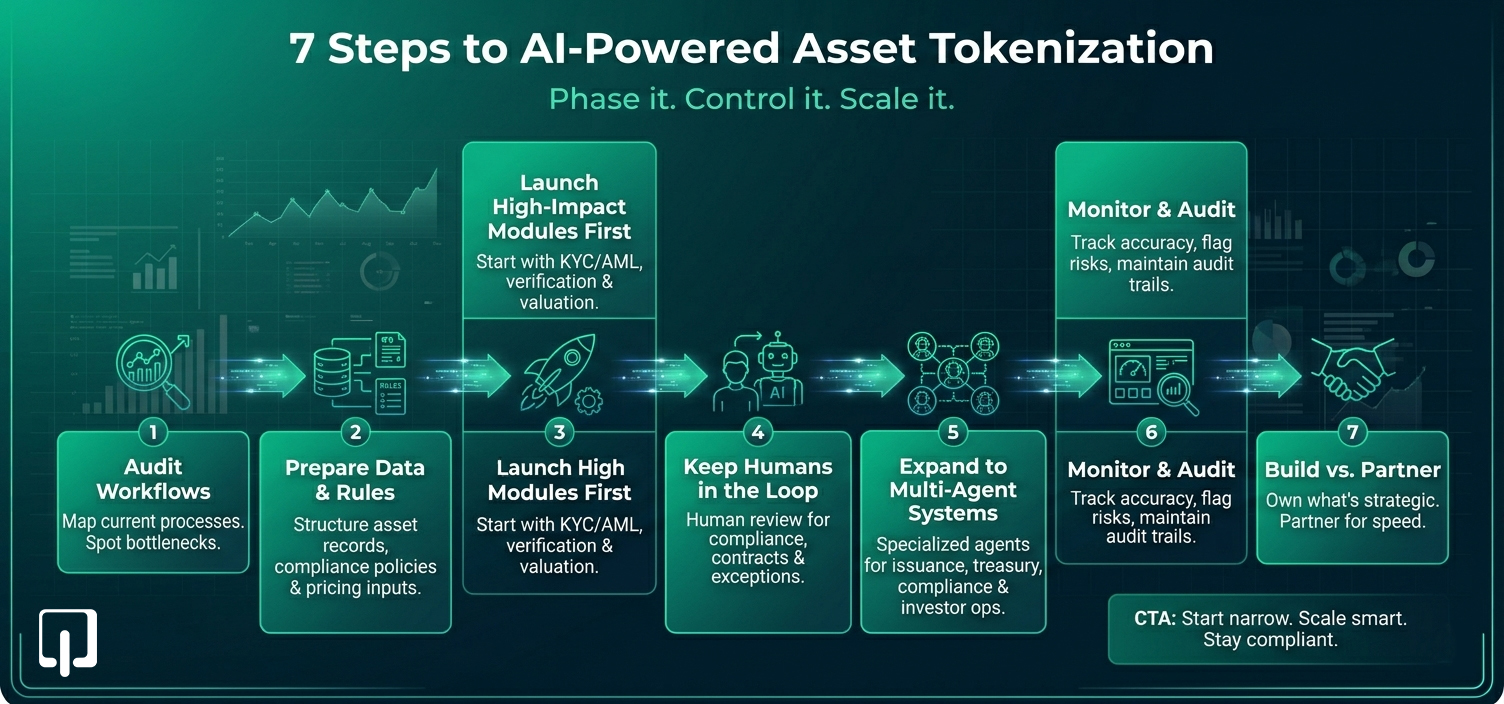
For businesses moving toward AI-powered asset tokenization, adoption works best when it is phased, controlled, and aligned with compliance requirements. A practical roadmap should focus on operational readiness first, then expand into automation and multi-agent coordination over time.
Start by mapping how asset onboarding, valuation, compliance checks, issuance, reporting, and investor communications work today. This helps teams identify manual bottlenecks, fragmented data flows, and areas where automation can reduce risk or delay.
AI agents are only as effective as the data and rule frameworks behind them. Before deployment, teams should organize asset records, pricing inputs, compliance policies, investor eligibility rules, and reporting requirements into structured systems that AI models can use reliably.
Begin with narrowly scoped functions such as KYC/AML automation, sanctions screening, asset verification, or valuation support. These use cases are easier to measure, create faster operational gains, and allow teams to introduce AI without disrupting the full platform experience. For broader context on building these systems, see our guide on how to build AI agents.
For areas like compliance escalation, contract updates, investor restrictions, or exception handling, human review should remain part of the workflow. This improves trust, supports explainability, and reduces operational risk during early adoption.
Once core modules are stable, teams can introduce specialized agents for issuance, compliance, treasury, liquidity, and investor operations. At this stage, the focus shifts from isolated automation to coordinated lifecycle management across the tokenization platform.
After rollout, teams should continuously track model performance, false positives, pricing accuracy, operational efficiency, and regulatory alignment. Audit trails, logging, and governance controls are essential for proving that the system remains reliable in production.
Teams should evaluate where internal development creates strategic value and where external partners can accelerate delivery, especially for compliance tooling, valuation engines, and AI orchestration layers. For guidance on selecting the right development partner, see our overview of top asset tokenization platform development companies.
The future of AI agents in asset tokenization is bright, with AI evolving into the backbone of autonomous digital ownership. As decentralized AI agents take over governance, it’s likely we will see AI-powered DAOs (Decentralized Autonomous Organizations) managing entire tokenized asset ecosystems. This tokenization of AI agents could become a new frontier, where AI models themselves are treated as assets and traded on the blockchain.

Let’s discuss and plan how we can accelerate your growth. Fill out this form and take the first step towards constant advancement.

We will respond to you within 24 hours.
Access to dedicated product specialists.



.png)
.png)